Malaysia’s Crown Prince has formally stepped into the digital-asset sector with a new state-backed stablecoin initiative and a large crypto-treasury planMalaysia’s Crown Prince has formally stepped into the digital-asset sector with a new state-backed stablecoin initiative and a large crypto-treasury plan

Malaysia’s Crown Prince Launches $121M Crypto Treasury – Despite Bubble Fears

2025/12/10 02:13

Malaysia’s Crown Prince has formally stepped into the digital-asset sector with a new state-backed stablecoin initiative and a large crypto-treasury plan, even as concerns grow over whether the global digital-asset treasury boom has already entered a fragile phase.

Bullish Aim Sdn. Bhd., chaired and owned by His Royal Highness Tunku Ismail Ibni Sultan Ibrahim, the Regent of Johor, announced the launch of RMJDT, a ringgit-backed stablecoin issued on Zetrix, the Layer-1 blockchain that powers Malaysia’s national Malaysia Blockchain Infrastructure.

The rollout took place under the supervision of the country’s regulated sandbox, which is overseen by both the Securities Commission and Bank Negara Malaysia, to test financial innovations ranging from stablecoins to programmable payment systems.

Crown Prince Drives RMJDT Rollout With $121M Digital Asset Reserve

RMJDT is intended to strengthen the ringgit’s profile in cross-border settlements and attract foreign direct investment, echoing Malaysia’s broader push into tokenization and digital-asset modernization.

The Crown Prince said the initiative is part of Johor’s effort to align with the country’s Digital Asset National Policy, which encourages real-world asset tokenization and experiments in supply-chain finance.

Alongside the stablecoin launch, Bullish Aim confirmed plans to establish a Digital Asset Treasury Company with an initial allocation of 500 million ringgit, roughly $121 million, in Zetrix tokens.

The firm intends to expand the treasury to one billion ringgit over time. The treasury will be used to stabilize gas fees for RMJDT transactions and to support up to 10% of validator nodes within the national blockchain infrastructure.

The move draws inspiration from high-profile corporate treasury strategies such as those employed by Strategy, which has accumulated more than 660,000 Bitcoin since 2020.

Additionally, Ismail’s reported $2.7 billion bid for a land deal in Singapore back in August shows how some well-capitalized players are still willing to take major swings, even as worries grow about others mimicking the same strategies.

The Regent of Johor said the Zetrix reserve was necessary to ensure predictable operations and tighter alignment with the national blockchain.
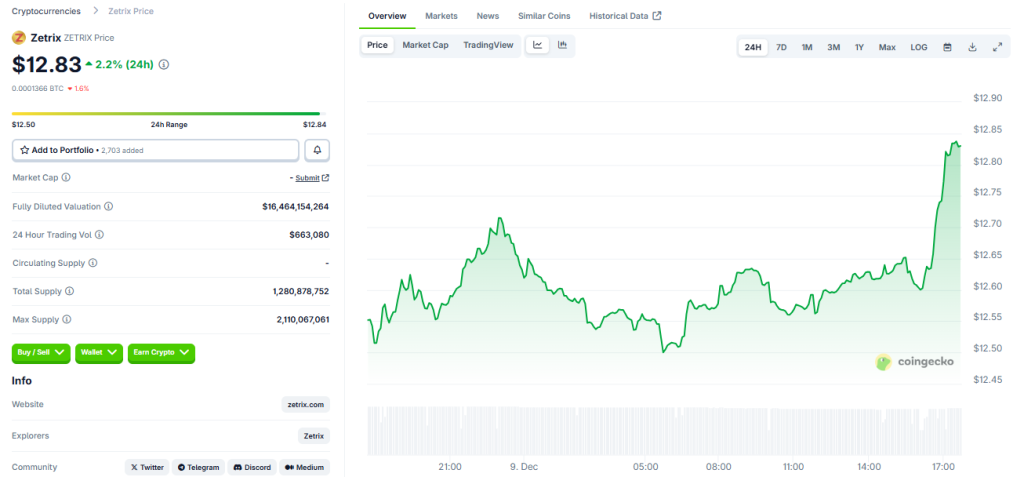
Source: CoinGecko

The launch comes at a time when Zetrix trades around $12.60, well below its peak above $20 recorded roughly a year earlier, according to CoinGecko data.

Malaysia Ramps Up Crypto Treasuries Even as Global Inflows Slow

The timing also places Johor’s initiative inside a broader regional shift. In recent months, Malaysia has seen a series of digital-asset treasury announcements.

On November 12, VCI Global said it would acquire $100 million worth of OOB tokens in a deal that will make Tether the company’s largest shareholder.

VCI Global plans to fold the token into its AI and fintech platforms and establish its own digital treasury division.

The firm had already purchased $50 million worth of tokens through a restricted share issuance and intends to buy another $50 million on the secondary market after Oobit completes its migration from Ethereum to Solana.

These developments are unfolding as Malaysia’s regulators accelerate reforms to support a more active digital-asset ecosystem.

The Securities Commission has proposed an overhaul of exchange rules after trading volumes more than doubled in 2024 to nearly 14 billion ringgit.

The new framework would allow certain tokens to be listed without prior approval, provided they meet strict criteria, while requiring operators to adopt tighter governance and risk controls.

Source: DefiLlama

But the broader digital-asset treasury sector is showing signs of fatigue. Data from DefiLlama shows corporate crypto treasuries recorded their slowest month of the year in November, with inflows dropping to $1.32 billion, down sharply from September’s peak.

Galaxy Research described the market as entering a “Darwinian phase,” with leverage unraveling and several treasury-backed stocks trading at deep discounts.

Even major players like Strategy, despite adding nearly $1 billion in Bitcoin last week, have seen their equity fall more than 35% over the past month.


Disclaimer: The articles reposted on this site are sourced from public platforms and are provided for informational purposes only. They do not necessarily reflect the views of MEXC. All rights remain with the original authors. If you believe any content infringes on third-party rights, please contact service@support.mexc.com for removal. MEXC makes no guarantees regarding the accuracy, completeness, or timeliness of the content and is not responsible for any actions taken based on the information provided. The content does not constitute financial, legal, or other professional advice, nor should it be considered a recommendation or endorsement by MEXC.

You May Also Like

Pepeto vs Blockdag Vs Layer Brett Vs Remittix and Little Pepe

Pepeto vs Blockdag Vs Layer Brett Vs Remittix and Little Pepe

The post Pepeto vs Blockdag Vs Layer Brett Vs Remittix and Little Pepe appeared on BitcoinEthereumNews.com. Crypto News 18 September 2025 | 05:39 Hunting the best crypto investment in 2025? Presales can flip a portfolio fast and sometimes change a life overnight when you choose well, which is why we start with receipts instead of slogans and cut straight to what’s live, audited, and usable today, not vague aspirations likely to drift as cycles turn and narratives fade for months. In this head-to-head we put Pepeto (PEPETO) up against Blockdag, Layer Brett, Remittix, and Little Pepe using simple yardsticks, team intent and delivery, on-chain proofs, tokenomics clarity, DEX and bridge readiness, PayFi rails, staking, and listing prep, so you can act on facts, not hype, and decide confidently before the next leg higher catches you watching from the sidelines. Pepeto’s Utility Play: Zero-Fee DEX, Bridge, And StrongPotential Pepeto treats the meme coin playbook like a platform brief, not a joke. The team ships fast, polishes details, and shows up weekly, aiming for staying power rather than a momentary pop. A hard-capped design anchors PepetoSwap, a zero-fee exchange where every trade routes through PEPETO for built-in usage instead of buzz. Already 850+ projects have applied to list, fertile ground for volume if listings follow. A built-in cross-chain bridge adds smart routing to unify liquidity, cut extra hops, and reduce slippage, turning activity into steady token demand because every swap touches PEPETO. Pepeto is audited by independent experts Solidproof and Coinsult, a trust marker reflected in more than $6,7 Million already raised in presale. Early momentum is visible. The presale puts early buyers at the front of the line with staking and stage-based price increases, and that line is getting long. Utility plus purpose, culture plus tools, the combo that tends to run farther than hype alone. Translation for you: Pepeto is graduating from noise to usage. If…
Share
BitcoinEthereumNews2025/09/18 10:41
OCC Confirms Banks Can Facilitate No-Risk Crypto Transactions

OCC Confirms Banks Can Facilitate No-Risk Crypto Transactions

The post OCC Confirms Banks Can Facilitate No-Risk Crypto Transactions appeared on BitcoinEthereumNews.com. U.S. national banks have been passed by the Office of the Comptroller of the Currency (OCC) to enable their customers perform instant crypto trades with no risk. This decision has cleared a significant obstacle in the way of banks that desire to be part of the expanding digital assets market. Banks Receive Clarity on Crypto Trading Authority  Interpretive Letter 1188 states that a bank can be an intermediary in crypto transactions without having digital assets in its possession. The OCC clarified that one client may sell a crypto asset to one bank and that bank will sell the asset to the other client at the same time. Since the two trades take place virtually at the same time the bank does not have an exposure to the market. The license provides banks with a regulated structure to provide crypto trading services. This is in line with preceding actions like enabling banks to hold major crypto assets. Another explanation that OCC provides is that the role of the bank is not to trade digital assets. Instead, the only responsibility of the bank is linking the sellers and the buyers. OCC Reinforces Bank’s Crypto Oversight The regulator mentioned that such transactions carry a limited amount of settlement risk. The decision is an update of a previous guidance that permitted crypto custody and some stablecoin transactions. The latest clarification strengthens the same allowances but indicates continued regulation of responsible crypto services in the banking space. With this, the banks are now enabled to provide customers with a secure means of accessing digital assets in compliance with federal regulations. The OCC stressed that institutions need to continue having robust risk controls, such as cybersecurity controls and compliance programs. Hence, all their operations can be safe and in line with current rules. How Institutions Might…
Share
BitcoinEthereumNews2025/12/10 07:46



