The Office of the Comptroller of the Currency confirmed that national banks may engage in riskless principal crypto-asset transactions, eliminating a The Office of the Comptroller of the Currency confirmed that national banks may engage in riskless principal crypto-asset transactions, eliminating a

Federal Regulator Approves Riskless Crypto Trading for US Banks

2025/12/10 16:54

The Office of the Comptroller of the Currency confirmed that national banks may engage in riskless principal crypto-asset transactions, eliminating a key barrier between traditional banking and digital assets.

The decision allows banks to act as intermediaries in crypto trades by simultaneously buying from one customer and selling to another without holding inventory.

The policy shift marks the OCC’s most aggressive step yet toward integrating crypto into mainstream banking, building on earlier approvals for custody services and balance sheet holdings.

Banks can now facilitate client crypto trades while assuming only minimal settlement and credit risk.

Banking’s Crypto Gateway Opens Under New Framework

In Interpretive Letter 1188, senior deputy comptroller Adam Cohen said the activity falls squarely within the business of banking because it mirrors existing brokerage functions.

National banks have long acted as financial intermediaries in securities, derivatives, and other asset classes through riskless principal transactions, taking momentary ownership to bridge buyer and seller.

The OCC applied the same logic to crypto-assets, noting that banks eliminate market risk through offsetting trades while retaining limited exposure to counterparty defaults.

Cohen emphasized that the authority extends beyond securities to any crypto-asset, including those not classified under federal securities law, because the transactions align with banks’ traditional intermediary role.

Meanwhile, the regulator dismissed concerns about operational complexity, arguing that banks already manage similar risks when settling securities via electronic ledgers.

Cohen said distributed ledger technology simply represents a modern method of recording transactions, no different in principle from book-entry settlement systems that banks have used for decades.
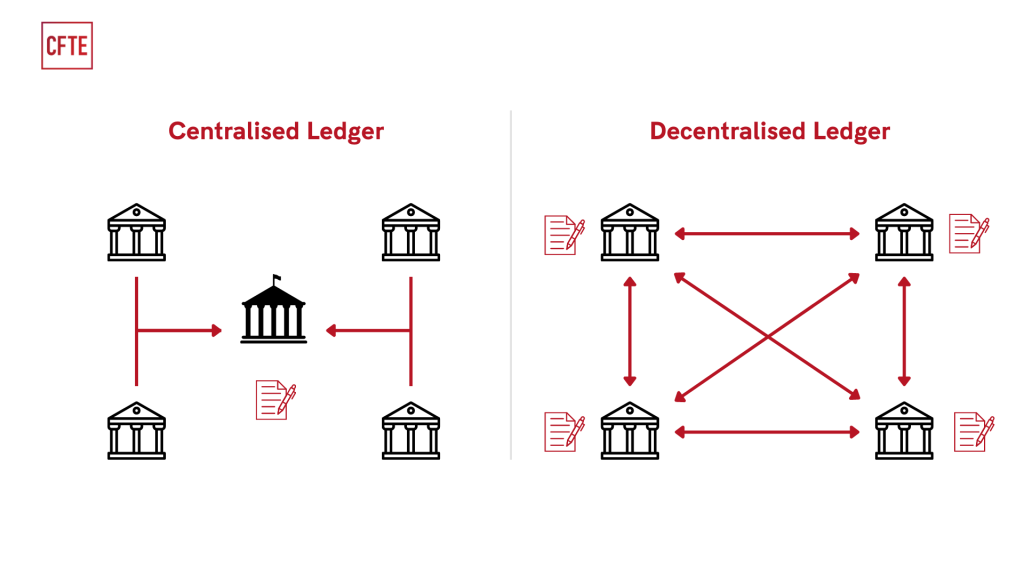
Crypto Trading for US Banks - Centralized vs Decentralized LedgerSource: CFTE

Why This Changes Bank Crypto Operations

The decision removes a structural obstacle that forced banks to either avoid crypto trading entirely or rely on third-party intermediaries for client transactions.

By allowing direct riskless principal activity, the OCC enables banks to offer seamless crypto services while maintaining regulatory compliance and customer protections.

Banks can now serve clients who want crypto exposure without partnering with unregulated exchanges or pseudonymous counterparties.

The framework requires banks to implement know-your-customer protocols, transaction monitoring, and the ability to freeze or reverse transfers when necessary, features built into certain blockchain platforms, such as Stellar.

The policy also strengthens banks’ competitive position against fintech rivals and crypto-native firms seeking federal bank charters.

Several major institutions have already moved toward crypto integration, with Bank of America authorizing advisers to recommend Bitcoin ETFs and JPMorgan allowing customers to fund Coinbase accounts via Chase cards.

Regulatory Momentum Builds Across Digital Assets

The OCC’s move comes as federal agencies accelerate the development of stablecoin and tokenized deposit frameworks under the GENIUS Act.

The FDIC will publish its first stablecoin rule proposal later this month, establishing capital, liquidity, and reserve requirements for bank-issued dollar-backed tokens.

Federal Reserve Vice Chair Michelle Bowman said the central bank is coordinating with peer agencies on standards to anchor digital assets to traditional finance.

The Treasury Department closed its second public consultation on non-bank stablecoin issuers in recent weeks, creating parallel oversight tracks that will govern the entire US stablecoin market.

Acting FDIC chair Travis Hill revealed that guidance on tokenized deposits is also underway, clarifying how blockchain-based representations of bank deposits will be treated under existing regulations.

The effort responds to growing industry interest in using distributed ledgers for payments and settlement.

Jonathan Gould, who became the OCC’s first permanent comptroller since 2020 after confirmation in July, has pushed back against banking industry complaints about approving crypto firm charters.

Speaking at the Blockchain Association Policy Summit last week, he said digital asset custody and safekeeping have operated electronically for decades, adding there is no justification for treating crypto differently.

The OCC received roughly 14 bank charter applications this year, including from Coinbase, Circle, and Ripple, all seeking federal oversight for stablecoin and custody operations.

Gould dismissed concerns about supervisory capacity, noting the agency already supervises a crypto-native national trust bank and fields daily inquiries from traditional banks launching innovative products.


Disclaimer: The articles reposted on this site are sourced from public platforms and are provided for informational purposes only. They do not necessarily reflect the views of MEXC. All rights remain with the original authors. If you believe any content infringes on third-party rights, please contact service@support.mexc.com for removal. MEXC makes no guarantees regarding the accuracy, completeness, or timeliness of the content and is not responsible for any actions taken based on the information provided. The content does not constitute financial, legal, or other professional advice, nor should it be considered a recommendation or endorsement by MEXC.

You May Also Like

Putin deems AI double-edged sword as Russia drafts plan for wide adoption

Putin deems AI double-edged sword as Russia drafts plan for wide adoption

The post Putin deems AI double-edged sword as Russia drafts plan for wide adoption appeared on BitcoinEthereumNews.com. Russian President Vladimir Putin has recognized the potential of artificial intelligence (AI), while warning about the risks that it carries as well. No one knows what to do with it, the master of the Kremlin said in comments coming after his government indicated Russia will be introducing AI everywhere. Putin worried about ‘losing everything’ due to AI President Putin has spoken about the potential benefits, but also the perils of artificial intelligence as a modern invention his country is willing to take advantage of. “This is an important and very difficult issue,” the head of state noted during a meeting of Russia’s human rights council. The Russian leader was commenting on a remark by the chief executive of the tech and research company Kribrum, Igor Ashmanov, who highlighted the lack of AI regulation. “It is becoming evident even for those who are far from these problems that something should be done, but no one knows exactly what to do,” he elaborated, while also referring to the use of big data in general and other related topics. Quoted by the TASS news agency on Tuesday, Putin put his figure on the center issue: “Because not using these instruments would mean losing everything we care about. But at the same time, if we use it thoughtlessly, it will also end up in the loss of everything we value.” Russia prepares to introduce AI across sectors Putin’s input on the matter comes as the Russian government is drafting a plan for the deployment of artificial intelligence tools across the country. The executive power in Moscow now wants to see AI applications widely implemented, from the public administration to different sectors of the economy as well as in all regions of the vast nation. Announcing the initiative, Russian Prime Minister Mikhail Mishustin recalled an…
Share
BitcoinEthereumNews2025/12/10 17:56
VeChain (VET) Welcomes Draper Dragon and Fenbushi Capital as Validators

VeChain (VET) Welcomes Draper Dragon and Fenbushi Capital as Validators

The post VeChain (VET) Welcomes Draper Dragon and Fenbushi Capital as Validators appeared on BitcoinEthereumNews.com. Luisa Crawford Dec 09, 2025 17:43 VeChain strengthens its network with Draper Dragon and Fenbushi Capital joining as validators, enhancing the blockchain’s credibility and enterprise readiness. VeChain, a prominent player in the blockchain space, has announced the inclusion of Draper Dragon and Fenbushi Capital as new strategic validators on the VeChainThor blockchain. This significant development coincides with the full launch of the Hayabusa upgrade and the Delegated Proof of Stake (DPoS) consensus mechanism, according to VeChain Official. Institutional Validators Signal Maturity and Trust The addition of these prestigious venture leaders signals a robust endorsement of VeChain’s standing as a secure and enterprise-ready Layer 1 blockchain platform. Draper Dragon and Fenbushi Capital’s participation underscores the network’s credibility and aligns with its focus on delivering blockchain infrastructure that addresses real economic challenges. Andy Tang, founding partner at Draper Dragon, expressed confidence in VeChain’s scalable, enterprise-grade adoption, aligning with their long-term investment philosophy. Similarly, Bo Shen, founding partner at Fenbushi Capital, emphasized VeChain’s ability to deliver practical value on a global scale, reinforcing their belief in the network’s technology and vision. Strengthened Governance to Meet Professional Needs VeChain’s governance model, which emphasizes reputable organizations as validators, sets it apart from other blockchains. The inclusion of Draper Dragon and Fenbushi Capital enhances this model, providing operational rigor and strategic insight that align with enterprise expectations. The validator set now includes around 19 participants, contributing to the network’s resilience and credibility. Hayabusa: A Technical Leap The timing of these institutional additions coincides with the launch of the Hayabusa upgrade, which enhances consensus efficiency and positions VeChainThor for global-scale utility. This upgrade improves performance, economic sustainability, and scalability, essential for sectors like sustainability, digital product passports, and asset tokenization. Sunny Lu, CEO of VeChain, highlighted that the Hayabusa…
Share
BitcoinEthereumNews2025/12/10 18:42