Bitcoin Short-Term Holders Maintain Profits Despite Negative Year-to-Date Performance Despite Bitcoin’s significant decline this year, with prices struggling toBitcoin Short-Term Holders Maintain Profits Despite Negative Year-to-Date Performance Despite Bitcoin’s significant decline this year, with prices struggling to

66% of 2025 BTC Short-Term Holders in Profit – Surprising Market Insight
For feedback or concerns regarding this content, please contact us at crypto.news@mexc.com
66% Of 2025 Btc Short-Term Holders In Profit – Surprising Market Insight

Bitcoin Short-Term Holders Maintain Profits Despite Negative Year-to-Date Performance

Despite Bitcoin’s significant decline this year, with prices struggling to sustain above $100,000 and registering negative returns, short-term holders have demonstrated resilience by remaining profitable for the majority of 2025. An analysis of on-chain data reveals a nuanced market structure that counters the apparent weak performance, shedding light on investor behavior and potential market stability.

Key Takeaways

  • Bitcoin short-term holders experienced profit in 66% of the days in 2025, even amid declining prices.
  • The realized price of around $81,000 served as a critical sentiment pivot, separating phases of panic from recovery.
  • Unrealized losses narrowed from -28% to -12%, indicating diminishing capitulation and market exhaustion.
  • The market’s recent rebound above the realized price suggests potential stabilization and future growth.

Market Dynamics and On-Chain Insights

The volatility observed throughout 2025 can largely be attributed to the behavior of Bitcoin’s one-to-three-month short-term holder cohort. As illustrated in recent analyses, Bitcoin’s price repeatedly oscillated around its realized price, creating alternating waves of profitability and losses as reflected in the Net Unrealized Profit/Loss (NUPL) metric. Early in the year, Bitcoin remained above this cost basis for nearly two months, providing short-term holders with their initial sustained profits.

However, during the February and March decline, prices dipped below the realized price, dragging short-term holder NUPL into deep red territory and marking one of the year’s longest periods of losses. Momentum shifted again from late April through mid-October, when Bitcoin’s recovery caused broad green zones in the data, reflecting over 172 days of predominantly profitable activity among short-term investors. Despite broader bearish sentiments, these recoveries kept short-term profitability higher than market narratives suggested. Recently, in late October, the price slipped back below the realized price, initiating a 45-day period of losses coinciding with increasing red NUPL regions.

Bitcoin short-term realized price and NUPL ranges. Source: CryptoQuant

This pattern indicates that short-term holder profitability in 2025 was driven more by the frequency of Bitcoin reclaiming its realized price than by its overall directional trend. Frequent rebounds above this level allowed many traders to exit with profits, even within a negative YTD environment. Currently, the rebound towards approximately $92,500 has reduced unrealized losses from -28% to -12%, signaling easing selling pressure and decreasing emotional exhaustion among holders.
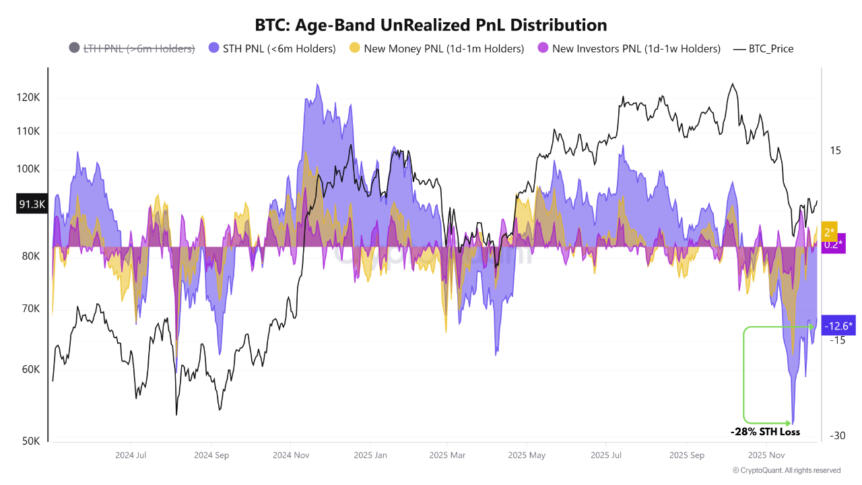
BTC age-band unrealized P&L distributionBitcoin age-band unrealized profit and loss distribution. Source: CryptoQuant

Interacting near the $81,000 realized price remains a critical psychological support, with new investors entering close to breakeven. Should Bitcoin sustain these levels and improve short-term profitability, the current correction phase could be nearing its end, paving the way for a new expansion cycle.

This article was originally published as 66% of 2025 BTC Short-Term Holders in Profit – Surprising Market Insight on Crypto Breaking News – your trusted source for crypto news, Bitcoin news, and blockchain updates.

Market Opportunity
Bitcoin Logo
Bitcoin Price(BTC)
$67,858.06
$67,858.06$67,858.06
+2.00%
USD
Bitcoin (BTC) Live Price Chart
Disclaimer: The articles reposted on this site are sourced from public platforms and are provided for informational purposes only. They do not necessarily reflect the views of MEXC. All rights remain with the original authors. If you believe any content infringes on third-party rights, please contact crypto.news@mexc.com for removal. MEXC makes no guarantees regarding the accuracy, completeness, or timeliness of the content and is not responsible for any actions taken based on the information provided. The content does not constitute financial, legal, or other professional advice, nor should it be considered a recommendation or endorsement by MEXC.

You May Also Like

Chorus One and MEV Zone Team Up to Boost Avalanche Staking Rewards

Chorus One and MEV Zone Team Up to Boost Avalanche Staking Rewards

The post Chorus One and MEV Zone Team Up to Boost Avalanche Staking Rewards appeared on BitcoinEthereumNews.com. Through the partnership with MEV Zone, Chorus One users will earn extra yield automatically. The Chorus One Avalanche node has a total stake of over 1.7 million, valued at around $55 million. This collaboration will introduce MEV Zone to both public nodes and Validator-as-a-Service. The Avalanche network stands to benefit from fairer and more efficient markets due to enhanced transparency. Chorus One, a highly decorated institutional-grade staking provider, has inked a strategic partnership with MEV Zone to enhance yield generation on the Avalanche (AVAX) network. The Chorus One partnered with MEV Zone to increase the AVAX staking yields, while simultaneously contributing to the general growth of the Avalanche network. “At Chorus One, we see this as an important step in our ongoing journey to provide robust infrastructure and innovative yield strategies for our partners and clients,” the announcement noted.  Why Did Chorus One Partner With MEV Zone? The Chorus One platform has grown to a top-tier institutional-grade staking ecosystem, with more than 40 blockchains, since 2018. In a bid to evolve with the needs of crypto investors and the supported blockchains, Chorus One has inked several strategic partnerships in the recent past, including MEV Zone. In the recent past, MEV Zone has specialized in addressing the Maximal Extractable Value (MEV) challenges on the Avalanche network. The MEV Zone will help Chorus One’s AVAX node validator to use Proposer-Builder Separation (PBS). As such, Chorus One’s AVAX node will seamlessly select certain transactions that are more profitable when making blocks. For instance, MEV Zone will help Chorus One’s AVAX node validator to capture arbitrage and liquidation transactions more often since they are more profitable.  How will Chorus One’s AVAX Stakers Benefit Via This Partnership? The Chorus One AVAX node has grown over the years to more than 1.77 million coins staked, valued…
Share
BitcoinEthereumNews2025/09/18 03:19
NYDFS Mandates Blockchain Analysis for Banks’ Digital Asset Offerings

NYDFS Mandates Blockchain Analysis for Banks’ Digital Asset Offerings

Detail: https://coincu.com/news/nydfs-blockchain-guidance-digital-assets/
Share
Coinstats2025/09/17 23:40
Arbitrageurs profited over $40 million from pricing mismatches on Polymarket in a single year.

Arbitrageurs profited over $40 million from pricing mismatches on Polymarket in a single year.

PANews reported on September 18th that, according to Decrypt, a new academic paper revealed systematic pricing biases on the prediction market platform Polymarket, allowing arbitrageurs to profit from it by over $40 million in a single year. The paper, titled "Unraveling the Probability Forest: Arbitrage Opportunities in Prediction Markets," analyzed data from April 2024 to April 2025 and found pricing errors in over 7,000 markets. The research identified two primary arbitrage patterns: one where the sum of "yes/no" share prices in the same market deviates from the theoretical value of $1; and the other where probability divergences occur in logically related markets (such as "Trump wins" and "Republicans win"). By simultaneously buying and selling related contracts, traders can achieve risk-free returns. While arbitrage activity ultimately leads to market price inequality, research indicates that pricing misalignments can persist for hours. This phenomenon is not limited to Polymarket but also occurs on regulated platforms such as Kalshi.
Share
PANews2025/09/18 11:46
