Solana has been battling what some ecosystem builders are calling an internet-scale DDoS campaign — and, despite the usual “Solana is fragile” jokes, the networkSolana has been battling what some ecosystem builders are calling an internet-scale DDoS campaign — and, despite the usual “Solana is fragile” jokes, the network

Solana Hit By One Of The Largest DDoS Attacks In Internet History

2025/12/16 23:00
4 min read
For feedback or concerns regarding this content, please contact us at crypto.news@mexc.com

Solana has been battling what some ecosystem builders are calling an internet-scale DDoS campaign — and, despite the usual “Solana is fragile” jokes, the network seems to be shrugging it off.

Pipe Network said of the ongoing attack via X today: “The ongoing DDoS attack on Solana is one of the largest in internet history. 6 Tbps volumetric attack translates to billions of packets per second. Under that kind of load, you’d normally expect rising latency, missed slots, or confirmation delays.”

Pipe further says that’s not what the data is showing. “Median tx confirmation ~450ms,” the team wrote, adding that p90 remains under 700ms and slot latency is holding at 0–1 slots. In other words, if you’re a regular user or trader, you might not even know anything’s happening. Which is kind of the point.
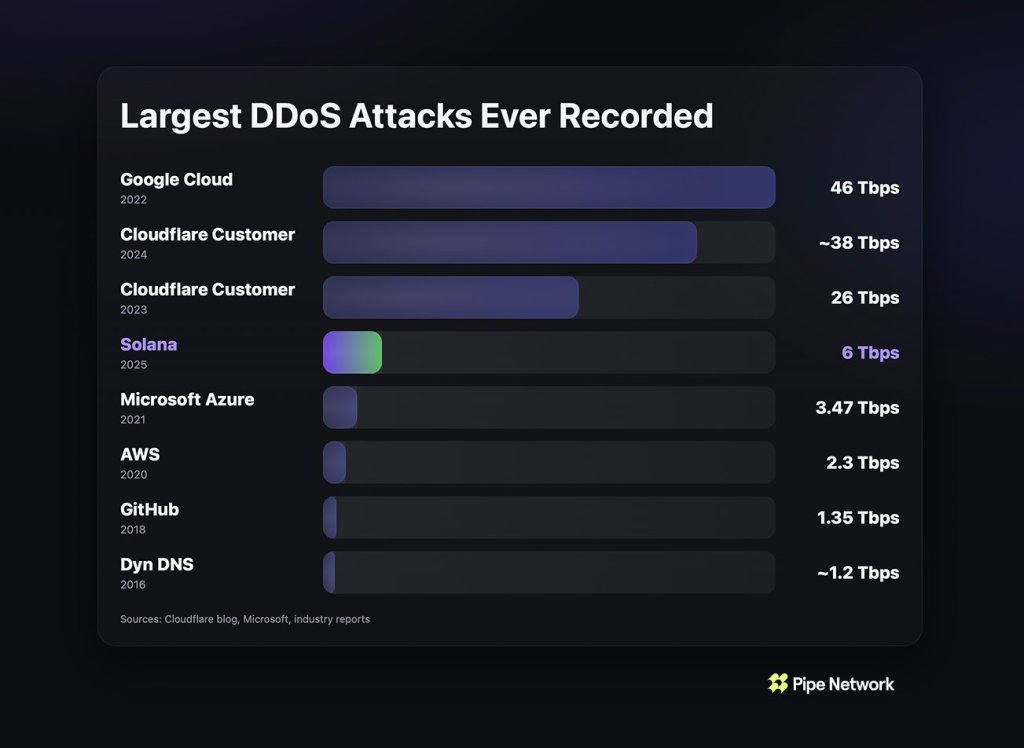
Largest DDos attacks in internet history

Reactions From The Solana Community

Raj Gokal, Solana Labs’ co-founder and COO, put it more bluntly in a reply to a broader DDoS debate: “have you heard about the ongoing DDOS against Solana that has had zero effect on performance?”

The backdrop here matters. Justin Bons had posted about Sui being DDoS’d yesterday, claiming it triggered “mass delays” and arguing that “127 validators is not enough,” with the broader warning: don’t let validator counts drift too low if you want a chain to be resilient.

Mert Mumtaz, CEO of Helius, largely agreed with the premise — but pushed back on the simplistic “more validators = solved” framing.

“I understand your point & mostly agree with you,” Mert wrote, before adding that “a chain is more resistant to DDoS with 100 professional high powered validators compared to 10k validators run by amateurs.” He also said there are scenarios where higher validator count can help, but emphasized it isn’t the core defense by itself. Then he dropped the key detail: Solana’s attack hasn’t been a one-day headline, it’s been going on for a while.

“And fyi there has been a colossal ddos attack on Solana for weeks now,” Mert wrote, later adding that Solana “has been under a colossal DDoS attack for at least over a week now btw” — and that the fact most users haven’t felt it is “a big testament to the level of engineering present here.”

Solana co-founder Anatoly Yakovenko chimed in with a more technical angle on why validator count can matter in specific leader-hand-off dynamics: “Validators count helps if the previous leader can finish their block while the current one is being hit. Then the cost of ddos approaches the cost of ddos the whole network.”

Translation: if an attacker wants to reliably disrupt block production, they may have to sustain pressure across more of the network, not just pick off a single leader at the wrong moment. That gets expensive fast.

SolanaFloor summed it up via X: “Solana has been under a sustained DDoS attack for the past week, peaking near 6 Tbps, the 4th largest attack ever recorded for any distributed system. Network data shows no impact, with sub second confirmations and stable slot latency. The Sui network was also targeted by a DDoS attack yesterday, resulting in delays in block production and periods of degraded network performance.”

And there’s a more strategic takeaway that’s starting to sound less theoretical each month: blockchains are now juicy targets. David Rhodus, founder of Permissionless Labs (and a contributor to Pipe Network), said: “This puts Solana among the most heavily DDoSed targets in internet history. It reinforces that blockchains are now Tier-1 DDoS targets. This is not “script kiddie” activity — 6 Tbps is industrial-scale.”

If you’re a validator, Mumtaz offered the practical advice you’d expect in a week like this: have backups across multiple hosting providers and regions. Because even if the chain holds, your own infrastructure might not.

The broader point, though, is the new baseline: these networks are getting stress-tested like mainstream internet services now. Solana’s claim today is that it passed — quietly, under load, and without users noticing. That’s the kind of victory that doesn’t look dramatic on a chart. It just […] works.

At press time, Solana traded at $126.
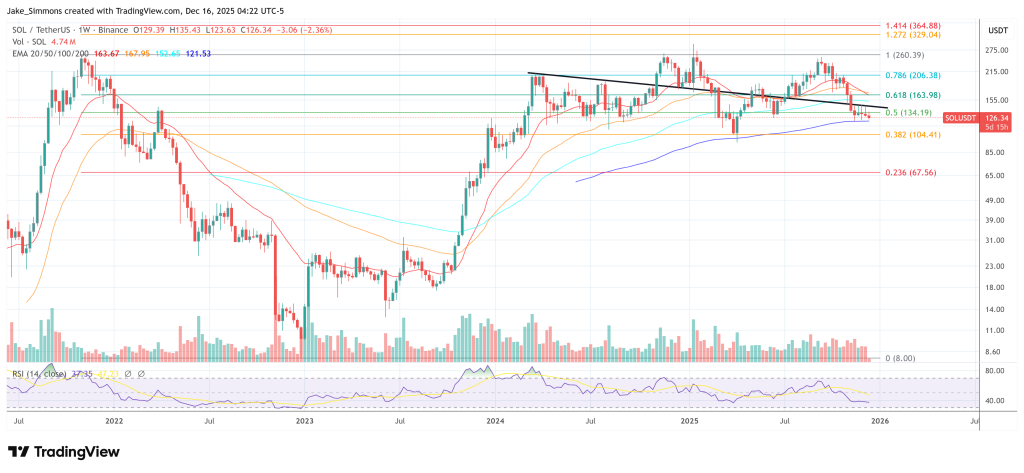
Solana price chart
Market Opportunity
USUAL Logo
USUAL Price(USUAL)
$0.01273
$0.01273$0.01273
-3.70%
USD
USUAL (USUAL) Live Price Chart
Disclaimer: The articles reposted on this site are sourced from public platforms and are provided for informational purposes only. They do not necessarily reflect the views of MEXC. All rights remain with the original authors. If you believe any content infringes on third-party rights, please contact crypto.news@mexc.com for removal. MEXC makes no guarantees regarding the accuracy, completeness, or timeliness of the content and is not responsible for any actions taken based on the information provided. The content does not constitute financial, legal, or other professional advice, nor should it be considered a recommendation or endorsement by MEXC.

You May Also Like

[Vantage Point] How Corporate Philippines is quietly war-gaming a supply shock

[Vantage Point] How Corporate Philippines is quietly war-gaming a supply shock

An empty gas station along Kalayaan Avenue in Quezon City is seen without customers because its fuel supply ran out on March 9, 2026, ahead of a new round of oil
Share
Rappler2026/03/31 12:00
Ondo Finance Launches USDY Yieldcoin on Stellar, Bringing Tokenized U.S. Treasuries to Users

Ondo Finance Launches USDY Yieldcoin on Stellar, Bringing Tokenized U.S. Treasuries to Users

Ondo Finance, a U.S.-based digital asset firm specializing in bringing traditional financial products on-chain through tokenization, is expanding its yieldcoin USDY to the Stellar network. This lates update marks a step forward in merging tokenized real-world assets with a global payments infrastructure, unlocking new opportunities for users worldwide. The announcement was made at the Stellar Meridian event in Copacabana, Rio de Janeiro, on September 17. USDY Joins the Stellar Ecosystem Ondo Finance, a recognized leader in tokenized real-world assets, announced the deployment of United States Dollar Yield (USDY) on Stellar, the payments-focused blockchain known for speed and low transaction costs. USDY is the most widely available “yieldcoin,” offering investors access to onchain assets backed by U.S. Treasuries. This launch allows Stellar’s global user base to tap into permissionless, yield-bearing assets tied to one of the safest financial instruments in the world. It also aligns with Stellar’s mission of driving fast, affordable cross-border payments. Combining Yield with Payments Infrastructure “Stablecoins unlocked global access to the U.S. dollar. With USDY, we’re taking the next step by bringing U.S. Treasuries onchain in a form that combines stability, liquidity, and yield,” said Ian De Bode, Chief Strategy Officer at Ondo Finance. “Fast, affordable cross-border payments are at the center of what Stellar was designed to do. The global reach of the Stellar ecosystem combined with a yield-bearing asset like USDY levels up what is possible onchain, allowing wallets and businesses to offer yield opportunities to their users,” said Denelle Dixon, CEO of the Stellar Development Foundation. Ondo claims by pairing USDY with Stellar’s infrastructure, new possibilities open up in treasury management, collateralization, and everyday financial applications. Unlocking Institutional and Retail Use Cases USDY currently manages over $650 million in total value locked (TVL) across nine blockchains and offers a 5.3% APY. By launching on Stellar, Ondo Finance extends these benefits to global retail and institutional users. The firm explains balances on Stellar can now become productive, supporting use cases such as onchain savings, institutional treasury strategies, cost-efficient collateral for DeFi protocols, and remittance flows that carry yield rather than remaining static. A Milestone for Tokenized Treasuries With the integration of USDY, Stellar users gain more than just access to stable-value assets—they gain access to institutional-grade yield. For investors outside the U.S., the launch represents a new way to combine the safety of Treasuries with the accessibility of blockchain technology. As tokenization accelerates globally, Ondo Finance’s decision to deploy USDY on Stellar reinforces the narrative that blockchain is not just about speculation, but about reimagining the global financial system through secure, yield-bearing digital assets
Share
CryptoNews2025/09/18 00:46
Midas Raises $50M for Instant Liquidity Layer in Tokenized RWAs

Midas Raises $50M for Instant Liquidity Layer in Tokenized RWAs

The post Midas Raises $50M for Instant Liquidity Layer in Tokenized RWAs appeared on BitcoinEthereumNews.com. Tokenization startup Midas’s Series A round was led
Share
BitcoinEthereumNews2026/03/31 12:06
