XRP has slipped below the $2 level, a psychologically important threshold, as broader market conditions continue to deteriorate and selling pressure weighs on riskXRP has slipped below the $2 level, a psychologically important threshold, as broader market conditions continue to deteriorate and selling pressure weighs on risk

XRP Liquidity Dries Up: Futures Buy Volume On Binance Falls from $5.8B to $250M

2025/12/17 07:00
4 min read
For feedback or concerns regarding this content, please contact us at crypto.news@mexc.com

XRP has slipped below the $2 level, a psychologically important threshold, as broader market conditions continue to deteriorate and selling pressure weighs on risk assets. While Bitcoin dominates liquidity and investor attention, altcoins are struggling to attract sustained demand, and XRP is increasingly reflecting this imbalance.

According to a CryptoQuant report by Darkfost, the weakness in XRP is not an isolated event but part of a broader contraction across the altcoin market. Whether on spot markets or in derivatives, trading activity has been shrinking significantly over recent months. Liquidity is gradually drying up, signaling a clear retreat from speculative positioning as investors reduce exposure to higher-risk assets.

This trend is especially visible in XRP’s derivatives data. The Taker Buy Volume on Binance, which tracks aggressive buy orders in futures markets, has collapsed to its lowest levels of the year. After peaking above $5.8 billion in July, this metric has fallen to roughly $250 million, representing a sharp 95.7% decline.

XRP Ledger Taker Buy Volume on Binance | Source: CryptoQuant

Such a dramatic contraction highlights the near-total evaporation of buying pressure and underscores the lack of conviction among traders.

XRP Liquidity Compression Signals Downside Risk

According to Darkfost, the broader market context is a major factor amplifying XRP’s current weakness. Liquidations have been accumulating across crypto markets, confidence remains fragile, and many participants are still psychologically impacted by the October 10 event. This lingering stress has reduced risk tolerance, particularly among short-term traders who typically provide liquidity during corrective phases.

Beyond sentiment, altcoins are facing a clear structural headwind. Bitcoin continues to absorb the majority of available capital, both in spot and derivatives markets. As BTC dominance remains elevated, liquidity that would normally rotate into altcoins during recoveries is instead staying concentrated in Bitcoin. This leaves very limited room for a sustained rebound across the broader altcoin market, including XRP.

Within this environment, the sharp collapse in XRP’s Taker Buy Volume is not surprising. The signal becomes even more relevant given that it is unfolding on Binance, which still accounts for the largest share of global XRP trading activity. A sustained drop in aggressive buying on the dominant exchange highlights the depth of demand erosion.

At the same time, the Taker Buy Sell Ratio has remained negative for most of the period, confirming that sellers continue to dominate XRP’s derivatives market. Historically, such severe volume compression can precede volatility expansions.

XRP Ledger Taker Buy Sell Ratio on Binance | Source: CryptoQuant

However, in the current setup, the lack of meaningful buying pressure and persistent bearish positioning suggests downside risks remain elevated. Even ETF-related optimism has failed to offset these structural weaknesses.

XRP Price Struggles Below Key Moving Averages

XRP price action on the 3-day chart reflects a clear loss of bullish structure and growing downside pressure. After peaking above the $3.40–$3.60 zone earlier in the year, XRP has formed a sequence of lower highs and lower lows, confirming a medium-term downtrend. The recent breakdown below the psychological $2.00 level is particularly significant, as this zone previously acted as both support and consolidation.
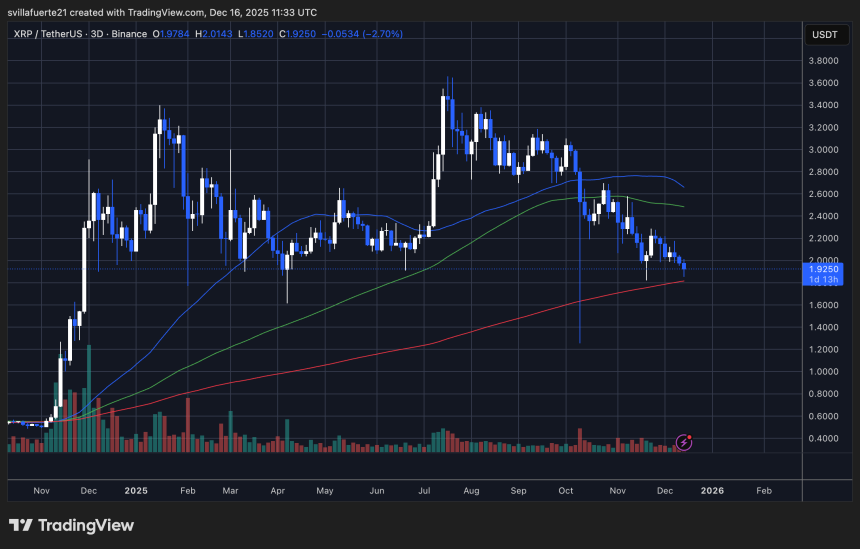
XRP testing key demand level | Source: XRPUSDT chart on TradingView

From a technical perspective, XRP is now trading below its 50-day and 100-day moving averages, both of which have started to slope downward. This alignment reinforces bearish momentum and suggests that rallies are being sold rather than accumulated. The 200-day moving average, currently near the $1.70–$1.80 area, represents the next major structural support. A sustained move toward this level would not be surprising if selling pressure persists.

Volume dynamics further confirm weakness. Since the August high, volume has steadily declined, indicating fading participation and weak dip-buying interest. The sharp volatility spike in October was followed by distribution rather than continuation, often a sign of a local market top.

As long as XRP remains below $2.00 and fails to reclaim the declining moving averages, the path of least resistance remains to the downside. For any meaningful trend reversal, XRP would need to regain $2.30–$2.50 with expanding volume, signaling renewed demand rather than short-term relief rallies.

Featured image from ChatGPT, chart from TradingView.com

Market Opportunity
XRP Logo
XRP Price(XRP)
$1.3107
$1.3107$1.3107
-2.57%
USD
XRP (XRP) Live Price Chart
Disclaimer: The articles reposted on this site are sourced from public platforms and are provided for informational purposes only. They do not necessarily reflect the views of MEXC. All rights remain with the original authors. If you believe any content infringes on third-party rights, please contact crypto.news@mexc.com for removal. MEXC makes no guarantees regarding the accuracy, completeness, or timeliness of the content and is not responsible for any actions taken based on the information provided. The content does not constitute financial, legal, or other professional advice, nor should it be considered a recommendation or endorsement by MEXC.

You May Also Like

The Role of Reference Points in Achieving Equilibrium Efficiency in Fair and Socially Just Economies

The Role of Reference Points in Achieving Equilibrium Efficiency in Fair and Socially Just Economies

This article explores how a simple change in the reference point can achieve a Pareto-efficient equilibrium in both free and fair economies and those with social justice.
Share
Hackernoon2025/09/17 22:30
Cryptos Signal Divergence Ahead of Fed Rate Decision

Cryptos Signal Divergence Ahead of Fed Rate Decision

The post Cryptos Signal Divergence Ahead of Fed Rate Decision appeared on BitcoinEthereumNews.com. Crypto assets send conflicting signals ahead of the Federal Reserve’s September rate decision. On-chain data reveals a clear decrease in Bitcoin and Ethereum flowing into centralized exchanges, but a sharp increase in altcoin inflows. The findings come from a Tuesday report by CryptoQuant, an on-chain data platform. The firm’s data shows a stark divergence in coin volume, which has been observed in movements onto centralized exchanges over the past few weeks. Bitcoin and Ethereum Inflows Drop to Multi-Month Lows Sponsored Sponsored Bitcoin has seen a dramatic drop in exchange inflows, with the 7-day moving average plummeting to 25,000 BTC, its lowest level in over a year. The average deposit per transaction has fallen to 0.57 BTC as of September. This suggests that smaller retail investors, rather than large-scale whales, are responsible for the recent cash-outs. Ethereum is showing a similar trend, with its daily exchange inflows decreasing to a two-month low. CryptoQuant reported that the 7-day moving average for ETH deposits on exchanges is around 783,000 ETH, the lowest in two months. Other Altcoins See Renewed Selling Pressure In contrast, other altcoin deposit activity on exchanges has surged. The number of altcoin deposit transactions on centralized exchanges was quite steady in May and June of this year, maintaining a 7-day moving average of about 20,000 to 30,000. Recently, however, that figure has jumped to 55,000 transactions. Altcoins: Exchange Inflow Transaction Count. Source: CryptoQuant CryptoQuant projects that altcoins, given their increased inflow activity, could face relatively higher selling pressure compared to BTC and ETH. Meanwhile, the balance of stablecoins on exchanges—a key indicator of potential buying pressure—has increased significantly. The report notes that the exchange USDT balance, around $273 million in April, grew to $379 million by August 31, marking a new yearly high. CryptoQuant interprets this surge as a reflection of…

Share
BitcoinEthereumNews2025/09/18 01:01
A7 leaks reveal Russia’s influence over Eastern European elections with crypto

A7 leaks reveal Russia’s influence over Eastern European elections with crypto

The post A7 leaks reveal Russia’s influence over Eastern European elections with crypto appeared on BitcoinEthereumNews.com. Blockchain analytics firm Elliptic has flagged a cache of leaked data from businesses controlled by sanctioned Moldovan oligarch and Kremlin ally Ilan Shor. The files, leaked earlier this month, provide a detailed look inside the A7 group, an operation based in Russia, operating a specialized “sanctions evasion-as-a-service.” Elliptic’s analysis of the data shows that several crypto wallets have processed stablecoin transactions worth $8 billion over the past 18 months, tracing the digital money flow from Russian-affiliated entities to political operations in Moldova as the country prepares to hold its parliamentary elections. Reports mentioned that Shor’s switch to digital assets was necessary because of his controversial past. A7 document leaks show Russia’s influence using crypto According to several reports, Shor fled Israel after he was convicted in 2017 for his role in the theft of $1 billion from Moldovan banks. Shor ended up in Russia, with the country granting him citizenship. The United States later sanctioned him in 2022, accusing him of making efforts to undermine democracy in Moldova. From his position as a fugitive, Shor started the A7 group in 2024, creating a structured connection for the expertise he had cultivated. In the report released by Elliptic, it claimed that A7 group is partly owned by Russia’s state-owned Promsvyazbank (PSB), a bank that has been sanctioned for financing Russia’s defense industry, tying A7 as a de facto arm of the country’s financial warfare apparatus. The scale of the operation is quite big, with Shor reportedly boasting to Vladimir Putin in a statement earlier this month that A7 had carried out transactions worth 7.5 trillion rubles, which is approximately $89 billion, for Russian businesses in ten months. While the mechanisms of operations were not clear to people at the time, the A7 leaks now provide a detailed look into the blueprint…
Share
BitcoinEthereumNews2025/09/27 18:58