Africa’s tech ecosystem is building cars without brakes. Toyin Akinniyi, Luminate Group's Regional Portfolio Director, Africa explains why builders, policymakersAfrica’s tech ecosystem is building cars without brakes. Toyin Akinniyi, Luminate Group's Regional Portfolio Director, Africa explains why builders, policymakers
Why Toyin Akinniyi believes African tech’s biggest problem is silos
For feedback or concerns regarding this content, please contact us at crypto.news@mexc.com
Toyin Akinniyi has spent her career following problems upstream, from journalism to civic engagement to tech governance. Now, as Regional Portfolio Director, Africa at Luminate Group, she funds organisations that fight to ensure technology serves and not harms people. But she’s convinced the real problem isn’t bad technology or lack of funding. It’s that tech builders, civil society, policymakers, and funders refuse to talk to each other. And time is running out.
Following stories to systems
Akinniyi’s career has been what she calls ‘an exploration of how information and storytelling shape societies.’
She began her civic engagement work in 2005, delivering ICT training to underserved communities. She taught literature at a polytechnic. Then spent nearly seven years in media development, helping shape investigative journalism in Nigeria and strengthening natural resource governance across Nigeria, Ghana, Tanzania, and Uganda.
“I became involved in social justice and accountability work, supporting movements that sought not only to tell stories but to change the systems behind those stories,” she explains. “It didn’t matter what the sector was. It was about changing systems.”
At Luminate, all those threads come together. Luminate Group, established in 2018 by philanthropists Pierre and Pam Omidyar (founder of eBay), work to ensure everyone, especially underrepresented groups, have the information, rights, and power to influence decisions that shape society. The foundation operates across Africa, Asia, and Latin America, funding organisations that enable people to fully participate in civic life, safely challenge power, and access trustworthy information.
In Africa, with priority countries Nigeria and Kenya, Luminate supports a diverse ecosystem: from organisations like SERAP using strategic litigation to hold governments accountable, to BudgIT making budget data accessible, to groups working on digital rights, data protection, and AI governance. Rather than funding individual organisations in isolation, Luminate builds networks, supporting civil society, media, researchers, and advocates who together work to ensure technology serves democracy rather than undermines it.
“I now work at the intersection of technology, governance, social justice, human rights, accountability, all those themes that have characterised my journey so far.”
Get The Best African Tech Newsletters In Your Inbox
Select your country Nigeria Ghana Kenya South Africa Egypt Morocco Tunisia Algeria Libya Sudan Ethiopia Somalia Djibouti Eritrea Uganda Tanzania Rwanda Burundi Democratic Republic of the Congo Republic of the Congo Central African Republic Chad Cameroon Gabon Equatorial Guinea São Tomé and Príncipe Angola Zambia Zimbabwe Botswana Namibia Lesotho Eswatini Mozambique Madagascar Mauritius Seychelles Comoros Cape Verde Guinea-Bissau Senegal The Gambia Guinea Sierra Leone Liberia Côte d'Ivoire Burkina Faso Mali Niger Benin Togo Other
Select your gender Male Female Others
Subscribe
When good intentions meet bad business models
Akinniyi is careful to say she doesn’t think technology was built to harm people. “I do not think at the very beginning when these technologies were developed, the intention was to harm anyone,” she says.
“The biggest factor is the business model that continues to prioritise profit over the integrity of elections, over democracy being strong, over protecting children who access social media platforms.”
The harms are already here. Children dying by suicide. Mental health crises. Elections undermined. Journalists and human rights defenders are surveilled by technologies supposedly built to protect people.
“We’re seeing children die by suicide. We’re seeing spiking mental health issues. There are so many examples,” Akinniyi says. “And this still points to governance. It’s about making sure people do what they should do.”
At Luminate, Akinniyi funds what she calls “ecosystems”, networks of groups approaching tech governance from different angles. “I like to expand the word ecosystem, bring us back to where we first heard it: biology,” she explains. “It’s not just mammals. It’s different types of living things. Different organisations, those coming at this from storytelling, those from advocacy and research, those working on inclusion, those focusing on harms and digital rights, data protection.”
She rattles off examples, using strategic litigation to hold tech companies accountable. Those building narratives to the public. Researchers documenting harms. Advocates pushing for people-centric laws.
The recent example she’s proudest of?
In December 2023, the Federal Competition and Consumer Protection Commission (FCCPC) fined Meta $220 million, requiring the company to comply with Nigeria’s consumer data protection laws, desist from exploiting Nigerian consumers, meet Nigerian standards, and respect consumer rights. The FCCPC filed charges against WhatsApp and Meta regarding WhatsApp’s May 2021 privacy policy, which asked users to consent to having their data shared with third parties.
“That’s the ecosystem working—strategic litigation plus enforcement,” Akinniyi says.
But the ecosystem has a massive gap.
“I would like to see more startups and civil society collaborate,” Akinniyi says. “Right now, it looks like people working in silos. But whatever happens to our legal and regulatory environments will affect everyone basically.”
She’s talking about tech builders, the fintech founders, the climate tech startups, the developers, and the civil society fighting for tech governance. They exist in separate worlds.
“I don’t even think there are two sides of any table,” she continues. “It’s more: From wherever everyone sits, you understand what technology holds, what it’s capable of, why we need to care.”
Good can look like democratised access to payment platforms or innovative tools that enhance lives. But it also looks like “holding power to account, building platforms for people to exercise their voice, supporting those who made this their life mission.”
Get The Best African Tech Newsletters In Your Inbox
Select your country Nigeria Ghana Kenya South Africa Egypt Morocco Tunisia Algeria Libya Sudan Ethiopia Somalia Djibouti Eritrea Uganda Tanzania Rwanda Burundi Democratic Republic of the Congo Republic of the Congo Central African Republic Chad Cameroon Gabon Equatorial Guinea São Tomé and Príncipe Angola Zambia Zimbabwe Botswana Namibia Lesotho Eswatini Mozambique Madagascar Mauritius Seychelles Comoros Cape Verde Guinea-Bissau Senegal The Gambia Guinea Sierra Leone Liberia Côte d'Ivoire Burkina Faso Mali Niger Benin Togo Other
Select your gender Male Female Others
Subscribe
The African accent
There’s another dimension to the problem: Africa largely receives technology rather than creates it.
“There’s a piece I wrote about how we need to make sure that when technology speaks, it has an African accent,” Akinniyi says. “And while that title sounds fancy, it speaks to the amount of work we need to do.”
She doesn’t just mean language. “It has to be technology that’s homegrown, built here by the people here, for the people. Because of that, the contextual realities will be taken care of.”
This is already happening. Across Nigeria, Kenya, Rwanda, and South Africa, builders are creating technology that responds to local realities, not just urban needs. “The AI-inclusive language conversation is emerging and taking root. What does a large language model within the African context look like?”
In 2024, Luminate funded Nigeria’s new AI collective with $1.5 million to bridge the gap between research, innovation, and governance as AI development races into the future. It is evidence of Akinniyi’s and Luminate’s mission to build bridges that connect the many players in the ecosystem.
Recently, she spoke with someone building infrastructure to help young people in communities access information using “very low-intensity technology.”
“More of that is what I would like to see,” she says. “And more policymakers talking across the table. More Nigerians talking to Kenyans, talking to Rwandans. We all want the same thing.”
The urgency is real. Africa will hold 25% of the world’s workforce in just a few years. “We need to be more intentional,” Akinniyi. “An investment today into that future will show right before our eyes and for generations to come.”
Measuring what matters
At Luminate, success doesn’t look like revenue or user growth. “It can look like advocacy for people-centric laws, human rights-respecting laws,” Akinniyi explains. “More access to information. Behaviour change in how people use technology. The government caring more about data protection.”
All of this leads to “better governance, technology working for human flourishing.”
But achieving this requires an enabling environment—policymakers, governments, tech builders, and civil society all understanding what it takes to nurture innovation while protecting rights. “It’s not just about laws. It’s about enforcement,” she says, citing the Meta fine again. “If there’s a regulation requiring tech companies to have certain guardrails, it’s making sure that happens.”
When asked what drives her, Akinniyi’s answer is immediate: “Access is power.”
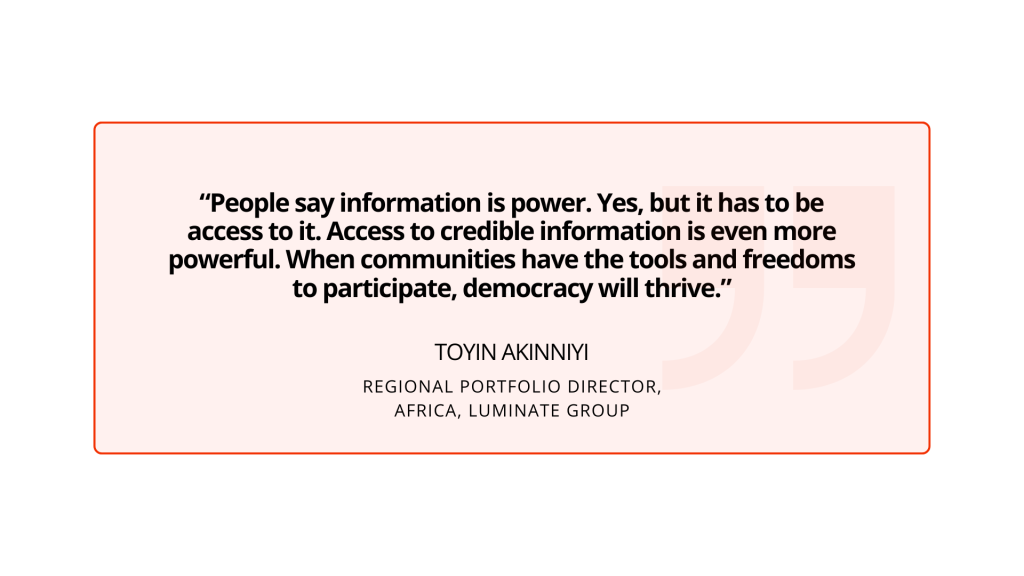
“People say information is power. Yes, but it has to be access to it. Access to credible information is even more powerful,” she says. “When communities have the tools and freedoms to participate, democracy will thrive.”
Her vision for legacy is simple but ambitious, “I would like to see more connection. Less divides, less silos. What we’re building requires collaboration, partnership, a shared understanding of the problem.”
She describes a room, one she might facilitate or simply be part of, where everyone who shapes, builds, and uses technology sits together with equal share of voice.
“Tech builders, civil society, policymakers, users, everyone in the same room. If I can see that, that would be a day well spent.”
Akinniyi is optimistic but clear-eyed about the stakes. The tech governance infrastructure Africa needs doesn’t exist yet. The collaboration between builders and civil society hasn’t happened. The homegrown technology ecosystem is still emerging.
But she’s convinced it’s possible, if people start talking to one another.
“For a continent like ours that’s always playing catch-up with technology, we need everyone,” she says. “The entire ecosystem—governments, funders, tech builders, civil society—banding together to make sure the guardrails are in place.”
“The generation after us needs to know that the tech we’re handing over is healthy, that it’s the one we actually want for the world. Not the one that causes harm.” Like with a car, brakes aren’t optional. They’re not something to add later. They’re a feature that must be in place before you hand the keys to anyone.
And in Africa, where 25% of the world’s future workforce will come from, there’s no time to waste on lonely strolls in separate silos.
The room Akinniyi wants to see, with builders and civil society and policymakers and users all talking to each other, isn’t just aspirational but essential. A car without brakes doesn’t translate to freedom on the road, but an accident waiting to happen.
Disclaimer: The articles reposted on this site are sourced from public platforms and are provided for informational purposes only. They do not necessarily reflect the views of MEXC. All rights remain with the original authors. If you believe any content infringes on third-party rights, please contact crypto.news@mexc.com for removal. MEXC makes no guarantees regarding the accuracy, completeness, or timeliness of the content and is not responsible for any actions taken based on the information provided. The content does not constitute financial, legal, or other professional advice, nor should it be considered a recommendation or endorsement by MEXC.




![[Rappler’s Best] Second quarter storm](https://www.rappler.com/tachyon/2026/04/rapplers-best-second-quarter-storm-April-27-2026.jpg)