Stablecoin supply hits all-time high, which investment strategies will profit from it?
Author: Ignas
Compiled by: Tim, PANews
The total supply of stablecoins has reached an all-time high, increasing 44% over the past two years.
Which investment strategies will profit from the mass adoption of stablecoins?
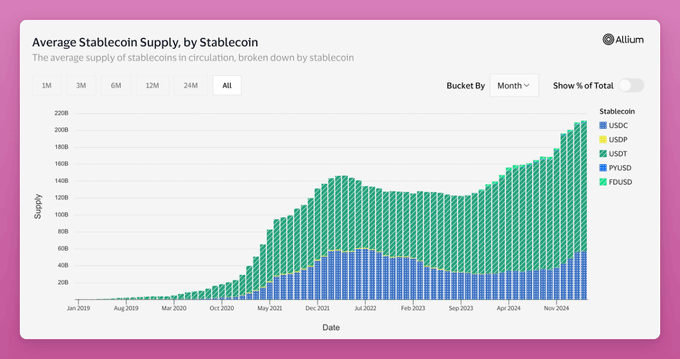
For added context, the Trump administration set August as a deadline for passing a stablecoin bill.
Under this trend, mainstream traditional financial institutions are actively deploying the stablecoin market. To name a few:
- Bank of America : Open to launching its own stablecoin if regulation allows
- Standard Chartered Bank : Plans to launch a stablecoin pegged to the Hong Kong dollar
- PayPal : Market expansion of its stablecoin PYUSD in 2025
- Stripe : Acquires Stablecoin Infrastructure Platform Bridge for $1.1 Billion
- Revolut : Exploring the possibility of issuing stablecoins
- Visa : Integrating stablecoins into payment systems and global business networks
Previously, an increase in the supply of stablecoins tended to push up cryptocurrency prices as people held them for short periods of time, primarily for speculative trading.
Today, the use of stablecoins has gone beyond speculation. For example, SpaceX uses stablecoins to recover funds from its Starlink sales in Argentina and Nigeria, and artificial intelligence company ScaleAI also uses stablecoins to pay overseas contractors.
The simplest investment strategy is to bet on the track where mainstream institutions may issue new stablecoins.
Ethereum, Base, Tron and Solana are the main public chains for the current issuance of stablecoins.
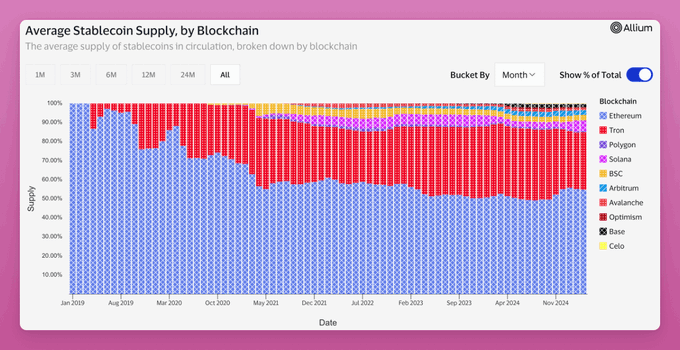
It is worth noting that although SOL has dominated this round of bull market, the growth of stablecoins on the Solana chain is relatively slow. Currently, only the Base chain has successfully sat on the stablecoin competition table with USDC.
Since the Base chain itself does not issue tokens, Coinbase's stock (NASDAQ: COIN) may become a potential target.
Another strategy is to wait for the IPO of Circle, the issuer of USDC, or choose to invest in Visa or PayPal stocks.
In addition to transactions and payments, stablecoins are also used to earn returns in DeFi:
Therefore, if the supply of stablecoins continues to expand, mature DeFi protocols may become the main beneficiaries:
- Aave/Morpho/Euler/Fluid
- Uniswap/Curve
- Maker
-Ethena
Increased stablecoin supply → Pushing up the total locked value (TVL) on the chain → Increased protocol fee income → Increased token valuation (especially tokens with revenue sharing mechanisms)
Yield is a key factor affecting the dynamics of the stablecoin market:
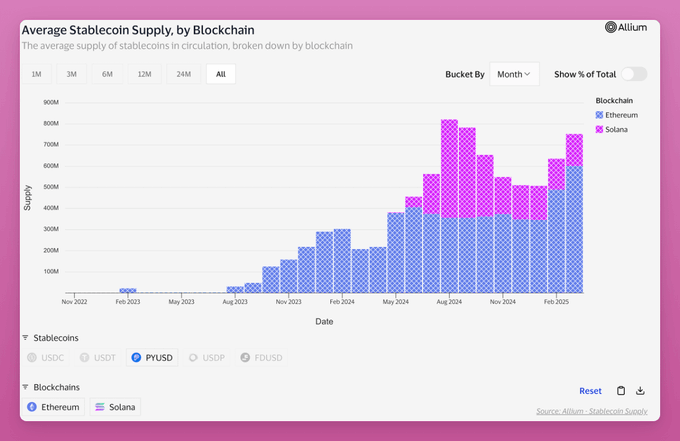
For example: PayPal’s stablecoin PYUSD is now available on Solana and Ethereum, but its growth has been slow.
Solana once used the high annualized returns of the Kamino protocol to incentivize an increase in the supply of stablecoins to challenge Ethereum's position, but its on-chain stablecoin supply subsequently stagnated, while Ethereum's supply continued to grow.
Cross-chain platforms and oracles will benefit from the growth of multi-chain stablecoins, as they will increase transaction volume and fee income:
- Chainlink
- LayerZero/Socket
- Debridge/Across, etc.
However, the most attractive investment opportunities may come from new infrastructure, consumer applications and revenue-generating products that have not yet been launched. New tokens often attract higher market attention.
When cryptocurrency prices pick up, the super narrative of stablecoins will explode, and this will also be an area where I (as an avid researcher) will invest more time and effort.
Regardless, the mass adoption of stablecoins is super bullish for the cryptocurrency market:
The demand for block space on public chains such as Ethereum, Solana, and Base will surge, so betting on smart contract public chains is the most basic investment strategy.
What is your investment strategy?


You May Also Like

LIST: Bayanihan initiatives amid soaring oil prices

Trump 'crashing out' over Orban loss: 'He can't handle the truth'