Connecticut Governor Ned Lamont has officially signed into law a comprehensive “Bitcoin Reserve Ban” that prohibits the state from accepting, holding, or investing in digital asset. The legislation, known as H.B. 7082, passed unanimously through both the state House of Representatives and Senate without a single opposing vote. Source: cga.ct.gov The new law explicitly bars Connecticut and its political subdivisions from accepting virtual currency as payment or establishing any form of digital asset reserve . This positions Connecticut as one of the most restrictive states regarding cryptocurrency adoption, contrasting sharply with the growing trend of Bitcoin reserve legislation across the United States. The timing appears particularly significant, as 26 states have introduced 47 Bitcoin reserve bills, with Texas, New Hampshire, and Arizona already having approved state-level Bitcoin reserve frameworks. Connecticut’s decision effectively removes it from the national conversation around strategic crypto adoption for public treasuries. The legislation extends beyond investment restrictions to comprehensive regulations governing the transmission of money. Crypto businesses must now provide extensive disclosures about material risks, including warnings about fraud potential, market volatility, and the irreversible nature of transactions. Additional protections require parental verification for users under 18 years old. 🚨 NEW: Connecticut Governor Ned Lamont officially signed into law the state's 'Bitcoin Reserve Ban' today. Connecticut is now prohibited from accepting, holding, or investing in digital assets. https://t.co/vIXIkprdHI — Bitcoin Laws (@Bitcoin_Laws) July 1, 2025 States Rally Around Bitcoin Adoption Despite Federal Uncertainty Crypto adoption at the state level is aggressively growing and starkly contrasts with this new Connecticut move. Texas leads the movement with Governor Greg Abbott signing Senate Bill 21 , establishing America’s first state-funded Bitcoin reserve entirely separate from the state treasury. ✅ Texas has officially joined the small but growing list of U.S. states moving toward on-chain finance, passing a bill that protects Bitcoin reserves. #Texas #Bitcoin https://t.co/kBh6nFgROs — Cryptonews.com (@cryptonews) June 22, 2025 Texas Comptroller Glenn Hegar will oversee the fund, with companion legislation HB 4488 protecting reserves from routine fund reallocations. Senator Charles Schwertner led the initiative, arguing, “ the state of Texas should have the option of evaluating the best performing asset over the last 10 years. “ New Hampshire also achieved a historic milestone by becoming the first state to pass laws allowing public funds to be invested in Bitcoin reserves . Governor Kelly Ayotte signed legislation permitting up to a 5% allocation in digital assets with a market capitalization exceeding $500 billion, effectively targeting Bitcoin exclusively. California is also not left out with its progressive adoption through Assembly Bill 1180 , which unanimously passed with 78 Assembly Members supporting pilot programs for digital asset fee payments. The Department of Financial Protection and Innovation will create frameworks for cryptocurrency-based government transactions by 2025. Arizona, however, presents a complex picture, with Governor Katie Hobbs vetoing comprehensive Bitcoin reserve legislation while simultaneously signing HB 2749, which creates frameworks for managing unclaimed digital assets. The state maintains multiple active bills, including revised HB2324, which recently passed Senate reconsideration. Corporate adoption accelerates regardless of state-level policies, with 252 entities now holding Bitcoin, representing approximately 16.57% of the total supply. Source: BitcoinTreasuries Strategy maintains the largest position at 597,325 BTC worth $63.93 billion, with the most recent purchase being 4,980 Bitcoin for $531.1 million, at an average price of approximately $106,801 per bitcoin. Source: SaylorTracker Regulatory Patchwork Creates Compliance Challenges Notably, the new Connecticut law mandates extensive compliance measures, including customer identification protocols, transaction receipt requirements, and robust risk disclosure frameworks that exceed federal minimums. Money transmission licensees must maintain virtual currency holdings equal to customer obligations while prohibiting unauthorized use of controlled assets. The legislation establishes that virtual currency held by licensees becomes property interests of claimants, creating additional legal protections for consumers. Several states have abandoned their efforts to reserve Bitcoin, creating an inconsistent national landscape. Florida withdrew House Bill 487 and Senate Bill 550 during legislative sessions, joining Wyoming , South Dakota, North Dakota , Pennsylvania, Montana, and Oklahoma in failed adoption attempts. Positively, some other states are still in the process. For instance, Michigan introduced House Bill 4087 , which allows for a 10% treasury allocation to cryptocurrencies. 🇺🇸 The Michigan House Bill was introduced by Representatives Bryan Posthumus and Ron Robinson to push for a strategic Bitcoin reserve. #BitcoinReserve #Michigan https://t.co/fXJSPOQ6gs — Cryptonews.com (@cryptonews) February 14, 2025 At the same time, Ohio advanced Senate Bill 57 , which creates exclusive Bitcoin reserve funds with mandatory five-year holding periods. Similarly, North Carolina also passed legislation permitting a 5% investment allocation pending validation by third-party oversight. Additionally, West Virginia’s Inflation Protection Act proposes a 10% treasury allocation to digital assets with a market capitalization exceeding $750 billion, effectively limiting investments to Bitcoin and select stablecoins. The legislation positions precious metals and cryptocurrencies as inflation hedges against government spending deficits. Oklahoma has also approved the Strategic Bitcoin Reserve Act through the House Committee with a 12-2 vote, allowing for a 10% public fund allocation to digital assets that meet market capitalization thresholds. The state previously passed Bitcoin Rights legislation protecting self-custody rights and transaction freedoms.Connecticut Governor Ned Lamont has officially signed into law a comprehensive “Bitcoin Reserve Ban” that prohibits the state from accepting, holding, or investing in digital asset. The legislation, known as H.B. 7082, passed unanimously through both the state House of Representatives and Senate without a single opposing vote. Source: cga.ct.gov The new law explicitly bars Connecticut and its political subdivisions from accepting virtual currency as payment or establishing any form of digital asset reserve . This positions Connecticut as one of the most restrictive states regarding cryptocurrency adoption, contrasting sharply with the growing trend of Bitcoin reserve legislation across the United States. The timing appears particularly significant, as 26 states have introduced 47 Bitcoin reserve bills, with Texas, New Hampshire, and Arizona already having approved state-level Bitcoin reserve frameworks. Connecticut’s decision effectively removes it from the national conversation around strategic crypto adoption for public treasuries. The legislation extends beyond investment restrictions to comprehensive regulations governing the transmission of money. Crypto businesses must now provide extensive disclosures about material risks, including warnings about fraud potential, market volatility, and the irreversible nature of transactions. Additional protections require parental verification for users under 18 years old. 🚨 NEW: Connecticut Governor Ned Lamont officially signed into law the state's 'Bitcoin Reserve Ban' today. Connecticut is now prohibited from accepting, holding, or investing in digital assets. https://t.co/vIXIkprdHI — Bitcoin Laws (@Bitcoin_Laws) July 1, 2025 States Rally Around Bitcoin Adoption Despite Federal Uncertainty Crypto adoption at the state level is aggressively growing and starkly contrasts with this new Connecticut move. Texas leads the movement with Governor Greg Abbott signing Senate Bill 21 , establishing America’s first state-funded Bitcoin reserve entirely separate from the state treasury. ✅ Texas has officially joined the small but growing list of U.S. states moving toward on-chain finance, passing a bill that protects Bitcoin reserves. #Texas #Bitcoin https://t.co/kBh6nFgROs — Cryptonews.com (@cryptonews) June 22, 2025 Texas Comptroller Glenn Hegar will oversee the fund, with companion legislation HB 4488 protecting reserves from routine fund reallocations. Senator Charles Schwertner led the initiative, arguing, “ the state of Texas should have the option of evaluating the best performing asset over the last 10 years. “ New Hampshire also achieved a historic milestone by becoming the first state to pass laws allowing public funds to be invested in Bitcoin reserves . Governor Kelly Ayotte signed legislation permitting up to a 5% allocation in digital assets with a market capitalization exceeding $500 billion, effectively targeting Bitcoin exclusively. California is also not left out with its progressive adoption through Assembly Bill 1180 , which unanimously passed with 78 Assembly Members supporting pilot programs for digital asset fee payments. The Department of Financial Protection and Innovation will create frameworks for cryptocurrency-based government transactions by 2025. Arizona, however, presents a complex picture, with Governor Katie Hobbs vetoing comprehensive Bitcoin reserve legislation while simultaneously signing HB 2749, which creates frameworks for managing unclaimed digital assets. The state maintains multiple active bills, including revised HB2324, which recently passed Senate reconsideration. Corporate adoption accelerates regardless of state-level policies, with 252 entities now holding Bitcoin, representing approximately 16.57% of the total supply. Source: BitcoinTreasuries Strategy maintains the largest position at 597,325 BTC worth $63.93 billion, with the most recent purchase being 4,980 Bitcoin for $531.1 million, at an average price of approximately $106,801 per bitcoin. Source: SaylorTracker Regulatory Patchwork Creates Compliance Challenges Notably, the new Connecticut law mandates extensive compliance measures, including customer identification protocols, transaction receipt requirements, and robust risk disclosure frameworks that exceed federal minimums. Money transmission licensees must maintain virtual currency holdings equal to customer obligations while prohibiting unauthorized use of controlled assets. The legislation establishes that virtual currency held by licensees becomes property interests of claimants, creating additional legal protections for consumers. Several states have abandoned their efforts to reserve Bitcoin, creating an inconsistent national landscape. Florida withdrew House Bill 487 and Senate Bill 550 during legislative sessions, joining Wyoming , South Dakota, North Dakota , Pennsylvania, Montana, and Oklahoma in failed adoption attempts. Positively, some other states are still in the process. For instance, Michigan introduced House Bill 4087 , which allows for a 10% treasury allocation to cryptocurrencies. 🇺🇸 The Michigan House Bill was introduced by Representatives Bryan Posthumus and Ron Robinson to push for a strategic Bitcoin reserve. #BitcoinReserve #Michigan https://t.co/fXJSPOQ6gs — Cryptonews.com (@cryptonews) February 14, 2025 At the same time, Ohio advanced Senate Bill 57 , which creates exclusive Bitcoin reserve funds with mandatory five-year holding periods. Similarly, North Carolina also passed legislation permitting a 5% investment allocation pending validation by third-party oversight. Additionally, West Virginia’s Inflation Protection Act proposes a 10% treasury allocation to digital assets with a market capitalization exceeding $750 billion, effectively limiting investments to Bitcoin and select stablecoins. The legislation positions precious metals and cryptocurrencies as inflation hedges against government spending deficits. Oklahoma has also approved the Strategic Bitcoin Reserve Act through the House Committee with a 12-2 vote, allowing for a 10% public fund allocation to digital assets that meet market capitalization thresholds. The state previously passed Bitcoin Rights legislation protecting self-custody rights and transaction freedoms.

Connecticut Goes Anti-Crypto as Governor Lamont Signs Bill Banning State Digital Asset Investments

2025/07/01 20:11
4 min read

Connecticut Governor Ned Lamont has officially signed into law a comprehensive “Bitcoin Reserve Ban” that prohibits the state from accepting, holding, or investing in digital asset.

The legislation, known as H.B. 7082, passed unanimously through both the state House of Representatives and Senate without a single opposing vote.
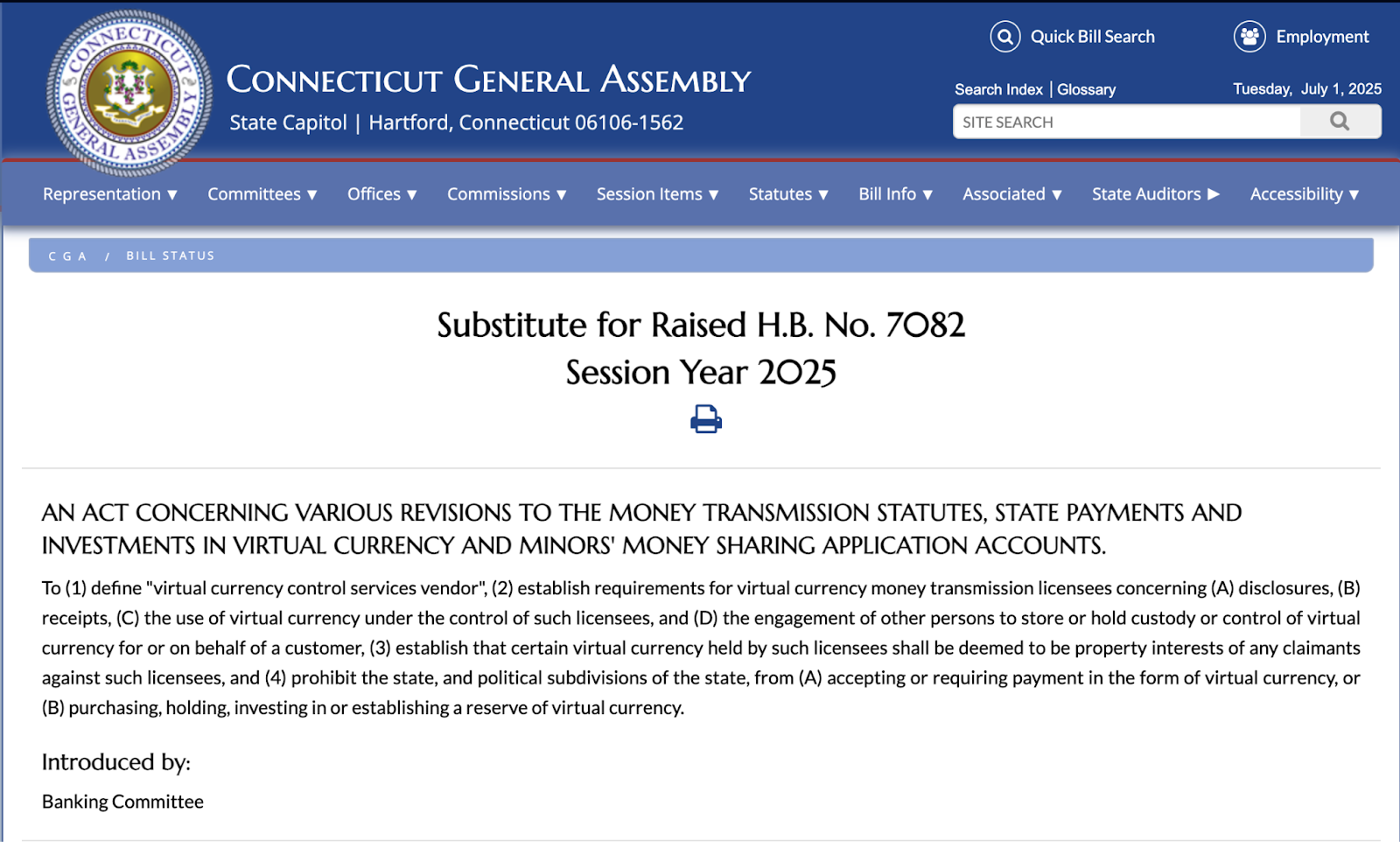
Connecticut Goes Anti-Crypto as Governor Lamont Signs Bill Banning State Digital Asset InvestmentsSource: cga.ct.gov

The new law explicitly bars Connecticut and its political subdivisions from accepting virtual currency as payment or establishing any form of digital asset reserve.

This positions Connecticut as one of the most restrictive states regarding cryptocurrency adoption, contrasting sharply with the growing trend of Bitcoin reserve legislation across the United States.

The timing appears particularly significant, as 26 states have introduced 47 Bitcoin reserve bills, with Texas, New Hampshire, and Arizona already having approved state-level Bitcoin reserve frameworks.

Connecticut’s decision effectively removes it from the national conversation around strategic crypto adoption for public treasuries.

The legislation extends beyond investment restrictions to comprehensive regulations governing the transmission of money.

Crypto businesses must now provide extensive disclosures about material risks, including warnings about fraud potential, market volatility, and the irreversible nature of transactions.

Additional protections require parental verification for users under 18 years old.

States Rally Around Bitcoin Adoption Despite Federal Uncertainty

Crypto adoption at the state level is aggressively growing and starkly contrasts with this new Connecticut move.

Texas leads the movement with Governor Greg Abbott signing Senate Bill 21, establishing America’s first state-funded Bitcoin reserve entirely separate from the state treasury.

Texas Comptroller Glenn Hegar will oversee the fund, with companion legislation HB 4488 protecting reserves from routine fund reallocations.

Senator Charles Schwertner led the initiative, arguing, “the state of Texas should have the option of evaluating the best performing asset over the last 10 years.

New Hampshire also achieved a historic milestone by becoming the first state to pass laws allowing public funds to be invested in Bitcoin reserves.

Governor Kelly Ayotte signed legislation permitting up to a 5% allocation in digital assets with a market capitalization exceeding $500 billion, effectively targeting Bitcoin exclusively.

California is also not left out with its progressive adoption through Assembly Bill 1180, which unanimously passed with 78 Assembly Members supporting pilot programs for digital asset fee payments.

The Department of Financial Protection and Innovation will create frameworks for cryptocurrency-based government transactions by 2025.

Arizona, however, presents a complex picture, with Governor Katie Hobbs vetoing comprehensive Bitcoin reserve legislation while simultaneously signing HB 2749, which creates frameworks for managing unclaimed digital assets.

The state maintains multiple active bills, including revised HB2324, which recently passed Senate reconsideration.

Corporate adoption accelerates regardless of state-level policies, with 252 entities now holding Bitcoin, representing approximately 16.57% of the total supply.

Connecticut Goes Anti-Crypto as Governor Lamont Signs Bill Banning State Digital Asset InvestmentsSource: BitcoinTreasuries

Strategy maintains the largest position at 597,325 BTC worth $63.93 billion, with the most recent purchase being 4,980 Bitcoin for $531.1 million, at an average price of approximately $106,801 per bitcoin.

Connecticut Goes Anti-Crypto as Governor Lamont Signs Bill Banning State Digital Asset InvestmentsSource: SaylorTracker

Regulatory Patchwork Creates Compliance Challenges

Notably, the new Connecticut law mandates extensive compliance measures, including customer identification protocols, transaction receipt requirements, and robust risk disclosure frameworks that exceed federal minimums.

Money transmission licensees must maintain virtual currency holdings equal to customer obligations while prohibiting unauthorized use of controlled assets.

The legislation establishes that virtual currency held by licensees becomes property interests of claimants, creating additional legal protections for consumers.

Several states have abandoned their efforts to reserve Bitcoin, creating an inconsistent national landscape.

Florida withdrew House Bill 487 and Senate Bill 550 during legislative sessions, joining Wyoming, South Dakota, North Dakota, Pennsylvania, Montana, and Oklahoma in failed adoption attempts.

Positively, some other states are still in the process. For instance, Michigan introduced House Bill 4087, which allows for a 10% treasury allocation to cryptocurrencies.

At the same time, Ohio advanced Senate Bill 57, which creates exclusive Bitcoin reserve funds with mandatory five-year holding periods.

Similarly, North Carolina also passed legislation permitting a 5% investment allocation pending validation by third-party oversight.

Additionally, West Virginia’s Inflation Protection Act proposes a 10% treasury allocation to digital assets with a market capitalization exceeding $750 billion, effectively limiting investments to Bitcoin and select stablecoins.

The legislation positions precious metals and cryptocurrencies as inflation hedges against government spending deficits.

Oklahoma has also approved the Strategic Bitcoin Reserve Act through the House Committee with a 12-2 vote, allowing for a 10% public fund allocation to digital assets that meet market capitalization thresholds.

The state previously passed Bitcoin Rights legislation protecting self-custody rights and transaction freedoms.


Market Opportunity
B Logo
B Price(B)
$0.15615
$0.15615$0.15615
-11.80%
USD
B (B) Live Price Chart
Disclaimer: The articles reposted on this site are sourced from public platforms and are provided for informational purposes only. They do not necessarily reflect the views of MEXC. All rights remain with the original authors. If you believe any content infringes on third-party rights, please contact service@support.mexc.com for removal. MEXC makes no guarantees regarding the accuracy, completeness, or timeliness of the content and is not responsible for any actions taken based on the information provided. The content does not constitute financial, legal, or other professional advice, nor should it be considered a recommendation or endorsement by MEXC.

You May Also Like

The UA Sprinkler Fitters Local 669 JATC – Notice of Privacy Incident

The UA Sprinkler Fitters Local 669 JATC – Notice of Privacy Incident

Landover, Maryland, February 6, 2026– The UA Sprinkler Fitters Local 669 Joint Apprenticeship and Training Committee (“JATC”) is providing notice of an event that
Share
AI Journal2026/02/07 07:30
CME pushes Solana, XRP into derivatives spotlight with new options

CME pushes Solana, XRP into derivatives spotlight with new options

CME Group is launching options for Solana and XRP futures this October. The move signals a major shift, acknowledging that institutional liquidity is now firmly expanding beyond the established dominance of Bitcoin and Ether. According to a press release dated…
Share
Crypto.news2025/09/18 01:18
Ethereum koers toont zeldzaam dubbel koopsignaal en richt zich op $4.550

Ethereum koers toont zeldzaam dubbel koopsignaal en richt zich op $4.550

Connect met Like-minded Crypto Enthusiasts! Connect op Discord! Check onze Discord   Ethereum laat op de uurgrafiek twee opeenvolgende TD Sequential koopsignalen zien. Deze indicator meet uitputting in een trend en geeft vaak een signaal dat de verkoopdruk kan afnemen. Dit dubbele signaal verschijnt rond het niveau van $4.516, waar de ETH prijs kortstondig steun vindt. Dit type formatie komt zelden voor en wordt daarom extra nauwlettend gevolgd. Wat gaat de Ethereum koers hiermee doen? Ethereum koers test steun rond $4.516 De scherpe daling van de Ethereum koers vanaf de prijszone rond $4.800 bracht de ETH prijs in korte tijd naar ongeveer $4.516. Op dit niveau trad duidelijke koopactiviteit op, waardoor de neerwaartse beweging tijdelijk werd gestopt. Het dubbele signaal dat door de TD Sequential indicator is gegenereerd, viel precies samen met dit prijspunt. De TD Sequential is opgebouwd uit negen candles die een trend meetellen. Wanneer de negende candle verschijnt, kan dit duiden op een trendomslag. In dit geval verschenen zelfs twee signalen kort na elkaar, wat aangeeft dat de verkoopdruk mogelijk uitgeput is. Het feit dat dit gebeurde in een zone waar ETH kopers actief bleven, maakt het patroon extra opvallend. TD Sequential just flashed two buy signals for Ethereum $ETH! pic.twitter.com/JPO8EhiEPi — Ali (@ali_charts) September 16, 2025 Welke crypto nu kopen?Lees onze uitgebreide gids en leer welke crypto nu kopen verstandig kan zijn! Welke crypto nu kopen? Fed-voorzitter Jerome Powell heeft aangekondigd dat de rentes binnenkort zomaar eens omlaag zouden kunnen gaan, en tegelijkertijd blijft BlackRock volop crypto kopen, en dus lijkt de markt klaar om te gaan stijgen. Eén vraag komt telkens terug: welke crypto moet je nu kopen? In dit artikel bespreken we de munten die… Continue reading Ethereum koers toont zeldzaam dubbel koopsignaal en richt zich op $4.550 document.addEventListener('DOMContentLoaded', function() { var screenWidth = window.innerWidth; var excerpts = document.querySelectorAll('.lees-ook-description'); excerpts.forEach(function(description) { var excerpt = description.getAttribute('data-description'); var wordLimit = screenWidth wordLimit) { var trimmedDescription = excerpt.split(' ').slice(0, wordLimit).join(' ') + '...'; description.textContent = trimmedDescription; } }); }); Technische indicatoren schetsen herstelkans voor ETH Naast de dubbele koopsignalen verstrekken ook andere indicatoren belangrijke aanwijzingen. Tijdens de daling van de ETH koers waren grote rode candles zichtbaar, maar na de test van $4.516 stabiliseerde de Ethereum koers. Dit wijst op een mogelijke verschuiving in het evenwicht tussen de bears en bulls. Als deze opwaartse beweging doorzet, liggen de eerste weerstanden rond $4.550. Daarboven wacht een sterkere zone rond $4.650. Deze niveaus zijn in eerdere Ethereum sessies al meerdere keren getest. Een doorbraak zou ruimte openen richting de all-time high van ETH rond $4.953. Wanneer de prijs toch opnieuw onder $4.516 zakt, liggen er zones rond $4.500 en $4.450 waar grotere kooporders worden verwacht. Deze niveaus kunnen als een vangnet fungeren, mocht de druk opnieuw toenemen. Marktdynamiek bevestigt technische indicatoren De huidige situatie volgt op een bredere correctie in de cryptomarkt. Verschillende vooraanstaande crypto tokens zagen scherpe koersdalingen, waarna traders op zoek gingen naar signalen voor een mogelijke ommekeer. Dat juist Ethereum nu een dubbel TD Sequential signaal toont, versterkt de interesse in dit scenario. Fundamenteel blijft Ethereum sterk. Het aantal ETH tokens dat via staking is vastgezet, blijft groeien. Dat verkleint de vrije circulatie en vermindert verkoopdruk. Tegelijk blijft het netwerk intensief gebruikt voor DeFi, NFT’s en stablecoins. Deze activiteiten zorgen voor een stabiele vraag naar ETH, ook wanneer de prijs tijdelijk onder druk staat. Fundamentele drijfveren achter de Ethereum koers De Ethereum koers wordt echter niet alleen bepaald door candles en patronen, maar ook door bredere factoren. Een stijgend percentage van de totale ETH supply staat vast in staking contracten. Hierdoor neemt de liquiditeit op exchanges af. Dit kan prijsschommelingen versterken wanneer er plotseling meer koopdruk ontstaat. Daarnaast is Ethereum nog steeds het grootste smart contract platform. Nieuwe standaarden zoals ERC-8004 en ontwikkelingen rond layer-2 oplossingen houden de activiteit hoog. Deze technologische vooruitgang kan de waardepropositie ondersteunen en zo indirect bijdragen aan een ETH prijsherstel. Het belang van de korte termijn dynamiek De komende handelsdagen zullen duidelijk maken of de bulls genoeg kracht hebben om door de weerstandszone rond $4.550 te breken. Voor de bears ligt de focus juist op het verdedigen van de prijsregio rond $4.516. De whales, die met grote handelsorders opereren, kunnen hierin een beslissende rol spelen. Het dubbele TD Sequential signaal blijft hoe dan ook een zeldzame gebeurtenis. Voor cryptoanalisten vormt het een objectief aanknopingspunt om de kracht van de huidige Ethereum trend te toetsen. Vooruitblik op de ETH koers Ethereum liet twee opeenvolgende TD Sequential signalen zien op de uurgrafiek, iets wat zelden voorkomt. Deze formatie viel samen met steun rond $4.516, waar de bulls actief werden. Als de Ethereum koers boven dit niveau blijft, kan er ruimte ontstaan richting $4.550 en mogelijk $4.650. Zakt de prijs toch opnieuw onder $4.516, dan komen $4.500 en $4.450 in beeld als nieuwe steunzones. De combinatie van zeldzame indicatoren en een sterke fundamentele basis maakt Ethereum interessant voor zowel technische als fundamentele analyses. Of de bulls het momentum echt kunnen overnemen, zal blijken zodra de Ethereum koers de eerstvolgende weerstanden opnieuw test. Koop je crypto via Best Wallet Best wallet is een topklasse crypto wallet waarmee je anoniem crypto kan kopen. Met meer dan 60 chains gesupport kan je al je main crypto coins aanschaffen via Best Wallet. Best wallet - betrouwbare en anonieme wallet Best wallet - betrouwbare en anonieme wallet Meer dan 60 chains beschikbaar voor alle crypto Vroege toegang tot nieuwe projecten Hoge staking belongingen Lage transactiekosten Best wallet review Koop nu via Best Wallet Let op: cryptocurrency is een zeer volatiele en ongereguleerde investering. Doe je eigen onderzoek. Het bericht Ethereum koers toont zeldzaam dubbel koopsignaal en richt zich op $4.550 is geschreven door Dirk van Haaster en verscheen als eerst op Bitcoinmagazine.nl.
Share
Coinstats2025/09/17 23:31



