The Bybit hack alone drove nearly half of 2025 crypto losses and exposed the growing impact of single catastrophic failures.The Bybit hack alone drove nearly half of 2025 crypto losses and exposed the growing impact of single catastrophic failures.

North Korea Stole Over $2B in Crypto in 2025 Despite Fewer Confirmed Attacks: Chainalysis

Chainalysis has identified a major escalation in global cryptocurrency theft in 2025, with more than $3.4 billion stolen between January and early December.

This represents one of the most severe years on record for crypto-related crime. A single incident, the compromise of Bybit, accounted for approximately $1.5 billion of that total.

Crypto Crime Enters a New Era

The data also points to meaningful structural change in where losses are occurring. Personal wallet compromises have grown significantly over recent years, and rose from just 7.3% of total stolen value in 2022 to 44% in 2024.

In 2025, however, the distribution of stolen funds would have looked substantially different were it not for the outsized impact of the Bybit incident, which heavily skewed losses back toward centralized services. These services continue to face a fundamental challenge around private key security. While large-scale key compromises remain infrequent, their consequences are severe when they do occur. As a result, centralized platforms accounted for 88% of stolen value in the first quarter of 2025, despite the relatively low number of such incidents.
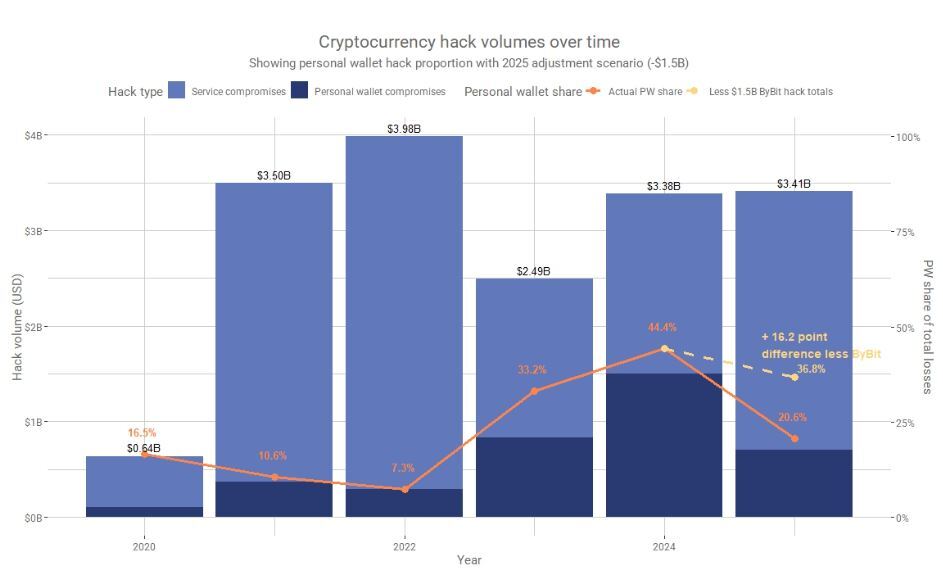
Crypto Hack Volume. Source: ChainalysisCrypto Hack Volume. Source: Chainalysis

The report pointed to a massive widening in the gap between typical crypto thefts and the largest attacks. Historically, stolen fund activity has always been driven by outliers, but in 2025, the ratio between the largest hack and the median incident crossed the 1,000x threshold for the first time, based on the USD value of funds at the time of theft.

This surpasses even the extremes observed during the 2021 bull market and indicates a growing concentration of risk. In practical terms, the top three hacks in 2025 accounted for 69% of all service-related losses, which demonstrated how individual breaches now exert an outsized influence on annual totals even as median incident sizes continue to move more gradually with asset prices.

North Korea remains the dominant nation-state threat actor in this environment. In 2025, DPRK-linked hackers stole at least $2.02 billion in cryptocurrency, $681 million more than in 2024. It represented a 51% year-over-year increase and accounted for a record 76% of all service compromises.

Fewer Hacks, Bigger Hauls

This occurred despite an assessed reduction in the number of confirmed DPRK-attributed incidents, pushing the lower-bound cumulative estimate of cryptocurrency stolen by North Korea to $6.75 billion. Chainalysis attributes the scale of these thefts to North Korea’s growing reliance on embedded IT workers, who infiltrate exchanges, custodians, and Web3 firms to secure privileged internal access ahead of major breaches.

The report also provides rare insight into DPRK laundering behavior. While North Korean hackers consistently steal larger sums, they tend to move funds on-chain in smaller tranches, with over 60% of volume transferred below $500,000.

Their laundering activity shows strong preferences for Chinese-language guarantee and money movement services, cross-chain bridges, mixing services, and specialized platforms. These collectively indicate how crypto theft in 2025 has become more concentrated, more strategic, and increasingly driven by geopolitical actors rather than opportunistic

The post North Korea Stole Over $2B in Crypto in 2025 Despite Fewer Confirmed Attacks: Chainalysis appeared first on CryptoPotato.

Disclaimer: The articles reposted on this site are sourced from public platforms and are provided for informational purposes only. They do not necessarily reflect the views of MEXC. All rights remain with the original authors. If you believe any content infringes on third-party rights, please contact service@support.mexc.com for removal. MEXC makes no guarantees regarding the accuracy, completeness, or timeliness of the content and is not responsible for any actions taken based on the information provided. The content does not constitute financial, legal, or other professional advice, nor should it be considered a recommendation or endorsement by MEXC.

You May Also Like

Shocking OpenVPP Partnership Claim Draws Urgent Scrutiny

Shocking OpenVPP Partnership Claim Draws Urgent Scrutiny

The post Shocking OpenVPP Partnership Claim Draws Urgent Scrutiny appeared on BitcoinEthereumNews.com. The cryptocurrency world is buzzing with a recent controversy surrounding a bold OpenVPP partnership claim. This week, OpenVPP (OVPP) announced what it presented as a significant collaboration with the U.S. government in the innovative field of energy tokenization. However, this claim quickly drew the sharp eye of on-chain analyst ZachXBT, who highlighted a swift and official rebuttal that has sent ripples through the digital asset community. What Sparked the OpenVPP Partnership Claim Controversy? The core of the issue revolves around OpenVPP’s assertion of a U.S. government partnership. This kind of collaboration would typically be a monumental endorsement for any private cryptocurrency project, especially given the current regulatory climate. Such a partnership could signify a new era of mainstream adoption and legitimacy for energy tokenization initiatives. OpenVPP initially claimed cooperation with the U.S. government. This alleged partnership was said to be in the domain of energy tokenization. The announcement generated considerable interest and discussion online. ZachXBT, known for his diligent on-chain investigations, was quick to flag the development. He brought attention to the fact that U.S. Securities and Exchange Commission (SEC) Commissioner Hester Peirce had directly addressed the OpenVPP partnership claim. Her response, delivered within hours, was unequivocal and starkly contradicted OpenVPP’s narrative. How Did Regulatory Authorities Respond to the OpenVPP Partnership Claim? Commissioner Hester Peirce’s statement was a crucial turning point in this unfolding story. She clearly stated that the SEC, as an agency, does not engage in partnerships with private cryptocurrency projects. This response effectively dismantled the credibility of OpenVPP’s initial announcement regarding their supposed government collaboration. Peirce’s swift clarification underscores a fundamental principle of regulatory bodies: maintaining impartiality and avoiding endorsements of private entities. Her statement serves as a vital reminder to the crypto community about the official stance of government agencies concerning private ventures. Moreover, ZachXBT’s analysis…
Share
BitcoinEthereumNews2025/09/18 02:13
Mastercard Partners With Polygon to Enable Crypto Payments for Consumers and Merchants

Mastercard Partners With Polygon to Enable Crypto Payments for Consumers and Merchants

Mastercard is expanding its Crypto Credential system to self-custody wallets through a partnership with Polygon and Mercuyo. The firm has broadened its presence
Share
Crypto News Flash2025/12/19 19:03
USD holds firm despite soft November CPI – ING

USD holds firm despite soft November CPI – ING

The post USD holds firm despite soft November CPI – ING appeared on BitcoinEthereumNews.com. The US Dollar (USD) is proving surprisingly resilient despite the release
Share
BitcoinEthereumNews2025/12/19 19:08

