UNI holders are like "cows" that are about to be squeezed dry, and the value of their tokens has never been captured.UNI holders are like "cows" that are about to be squeezed dry, and the value of their tokens has never been captured.

Analyst: The Uniswap Foundation has passed a huge investment plan of US$165.5 million, but why do I think it is only a temporary solution and not a fundamental solution?

2025/03/06 18:15
3 min read
For feedback or concerns regarding this content, please contact us at crypto.news@mexc.com

Author: Ignas

Compiled by: Tim, PANews

The Uniswap Foundation voted to approve a huge investment plan of US$165.5 million. Why?

Because the performance of Uniswap v4 and Unichain after their release was far from market expectations.

In a little over a month:

  • Uni v4’s total locked value (TVL) is only $85 million
  • Unichain’s TVL is only $8.2 million

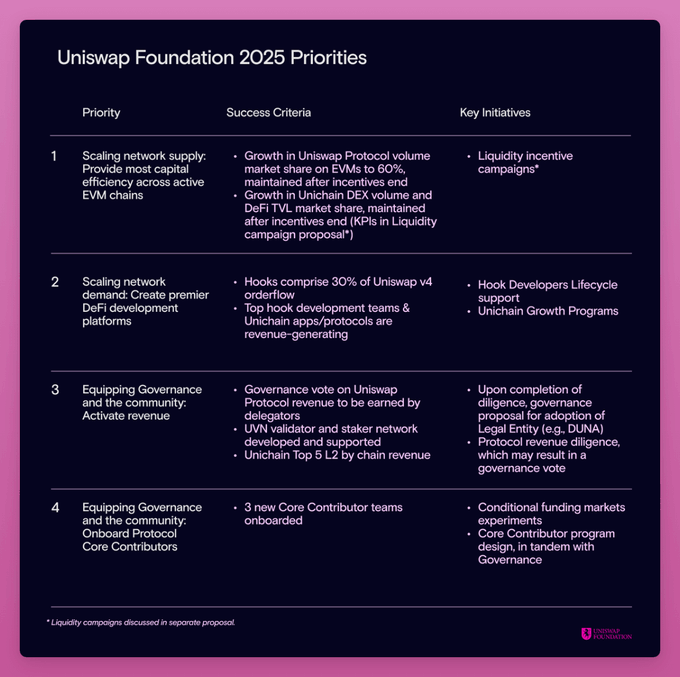
To foster growth, the Uniswap Foundation proposes to allocate $165.5 million to:

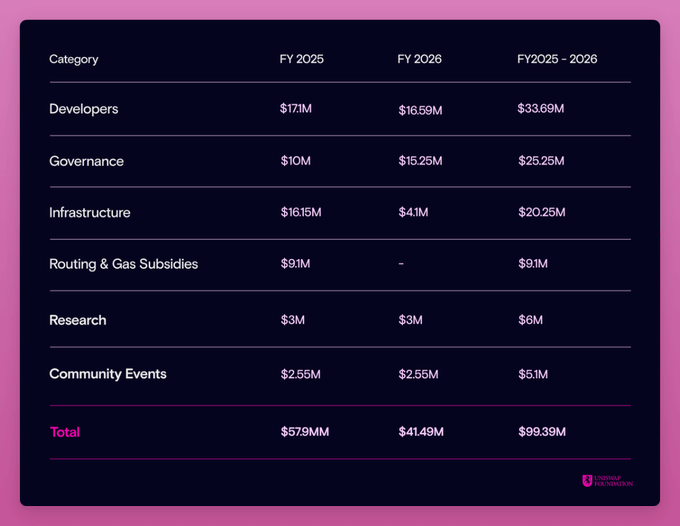
  • $95.4 million for funding (developer programs, core contributors, validators);
  • $25.1 million for operations (team expansion, governance tool development);
  • $45 million for liquidity incentives.

Analyst: The Uniswap Foundation has passed a huge investment plan of US$165.5 million, but why do I think it is only a temporary solution and not a fundamental solution?

As you can see, Uni v4 is not only a DEX, but also a liquidity platform, and Hooks is the application built on it.

Hooks should drive growth in the Uni v4 ecosystem, so this needs to be accelerated through funding programs.

Detailed allocation of funding budget:
Analyst: The Uniswap Foundation has passed a huge investment plan of US$165.5 million, but why do I think it is only a temporary solution and not a fundamental solution?

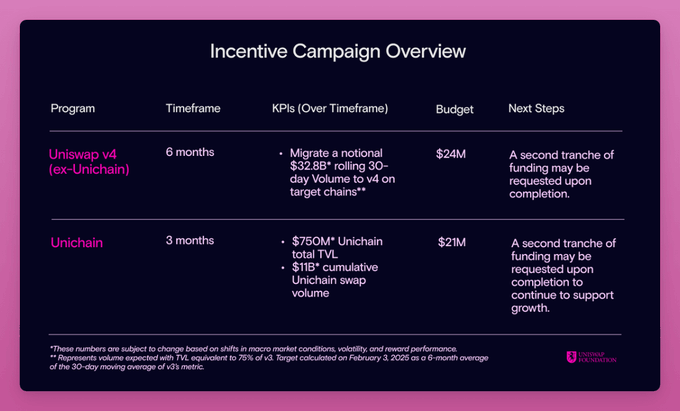
$45 million in liquidity provider (LP) incentives will be used for the following:

  • $24 million (disbursed over 6 months): used to incentivize the migration of liquidity from other platforms to Uni v4;
  • $21 million (disbursed in 3 months): Push Unichain’s total locked value (TVL) from the current $8.2 million to $750 million.
Analyst: The Uniswap Foundation has passed a huge investment plan of US$165.5 million, but why do I think it is only a temporary solution and not a fundamental solution?

In comparison, Aerodrome mints approximately $40-50 million worth of AERO tokens per month for liquidity provider (LP) incentives.

The proposal has passed the temperature check stage, but still faces some criticism:

As the industry landscape changes, Aave proposes to repurchase $1 million of AAVE tokens per week, and Maker plans to repurchase $30 million per month. However, UNI holders are like "cows" that are about to be squeezed dry, and the value of their tokens has never been captured.

The UNI token does not have a fee-sharing mechanism enabled, and Uniswap Labs has earned $171 million through front-end fees in two years.

The key to the entire system lies in Uniswap’s organizational structure design:

  • Uniswap Labs: Focus on protocol technology development;
  • Uniswap Foundation: Promotes ecosystem growth, governance, and funding initiatives (such as grants, liquidity incentives).

What a savvy legal team.

Aave and Maker have established a closer interest binding relationship with token holders, and I don’t understand why Uniswap’s front-end fees cannot be shared with UNI holders.

In summary, other criticisms focus on the high salaries of the core team, Gauntlet’s responsibility for liquidity incentive enforcement, and the establishment of a new centralized DAO legal structure (DUNA).

As a small Uniswap governance representative, I voted in favor of this proposal, but still have significant concerns about the future of UNI holders: the incentive mechanism is not aligned with the interests of holders.

However, I am a big fan of Uniswap and highly recognize its role in promoting the DeFi field. The current growth of Uni v4 and Unichain is very bleak, and they need to introduce incentives to promote development.

The next Uni DAO vote should focus on the value capture mechanism of the UNI token.

Market Opportunity
null Logo
null Price(null)
--
----
USD
null (null) Live Price Chart
Disclaimer: The articles reposted on this site are sourced from public platforms and are provided for informational purposes only. They do not necessarily reflect the views of MEXC. All rights remain with the original authors. If you believe any content infringes on third-party rights, please contact crypto.news@mexc.com for removal. MEXC makes no guarantees regarding the accuracy, completeness, or timeliness of the content and is not responsible for any actions taken based on the information provided. The content does not constitute financial, legal, or other professional advice, nor should it be considered a recommendation or endorsement by MEXC.

You May Also Like

WHY RURAL POWER GRIDS ARE EMERGING AS A CRITICAL FRONT LINE IN CYBERSECURITY

WHY RURAL POWER GRIDS ARE EMERGING AS A CRITICAL FRONT LINE IN CYBERSECURITY

When cybersecurity discussions focus on energy infrastructure, attention typically centers on large metropolitan utilities or high-voltage transmission systems.
Share
Techbullion2026/03/21 02:53
OpenAI Plans to Merge ChatGPT, Codex and Atlas Into One ‘Superapp’: WSJ

OpenAI Plans to Merge ChatGPT, Codex and Atlas Into One ‘Superapp’: WSJ

The post OpenAI Plans to Merge ChatGPT, Codex and Atlas Into One ‘Superapp’: WSJ appeared on BitcoinEthereumNews.com. In brief OpenAI is reportedly consolidating
Share
BitcoinEthereumNews2026/03/21 03:40
CME Group to launch options on XRP and SOL futures

CME Group to launch options on XRP and SOL futures

The post CME Group to launch options on XRP and SOL futures appeared on BitcoinEthereumNews.com. CME Group will offer options based on the derivative markets on Solana (SOL) and XRP. The new markets will open on October 13, after regulatory approval.  CME Group will expand its crypto products with options on the futures markets of Solana (SOL) and XRP. The futures market will start on October 13, after regulatory review and approval.  The options will allow the trading of MicroSol, XRP, and MicroXRP futures, with expiry dates available every business day, monthly, and quarterly. The new products will be added to the existing BTC and ETH options markets. ‘The launch of these options contracts builds on the significant growth and increasing liquidity we have seen across our suite of Solana and XRP futures,’ said Giovanni Vicioso, CME Group Global Head of Cryptocurrency Products. The options contracts will have two main sizes, tracking the futures contracts. The new market will be suitable for sophisticated institutional traders, as well as active individual traders. The addition of options markets singles out XRP and SOL as liquid enough to offer the potential to bet on a market direction.  The options on futures arrive a few months after the launch of SOL futures. Both SOL and XRP had peak volumes in August, though XRP activity has slowed down in September. XRP and SOL options to tap both institutions and active traders Crypto options are one of the indicators of market attitudes, with XRP and SOL receiving a new way to gauge sentiment. The contracts will be supported by the Cumberland team.  ‘As one of the biggest liquidity providers in the ecosystem, the Cumberland team is excited to support CME Group’s continued expansion of crypto offerings,’ said Roman Makarov, Head of Cumberland Options Trading at DRW. ‘The launch of options on Solana and XRP futures is the latest example of the…
Share
BitcoinEthereumNews2025/09/18 00:56