Strategy CEO Phong Le has been on the road with Michael Saylor, and the message from the meetings is less about “orange-pilling” bankers than watching large institutionsStrategy CEO Phong Le has been on the road with Michael Saylor, and the message from the meetings is less about “orange-pilling” bankers than watching large institutions

Strategy CEO Lifts The Curtain On Bitcoin Talks With Largest US Banks

2025/12/24 21:00
4 min read

Strategy CEO Phong Le has been on the road with Michael Saylor, and the message from the meetings is less about “orange-pilling” bankers than watching large institutions sprint to close a Bitcoin product gap they can no longer ignore.

In a Dec. 23 interview with CoinStories host Nathalie Brunell, Le said the conversations start with the most basic building blocks, custody and exchange because banks have already watched meaningful flows move to crypto-native and quasi-crypto incumbents.

“They’re all trying to catch up with just the base of custodying Bitcoin and providing exchange services,” Le said. “They’ve seen, for example, Coinbase or Fidelity, and what they’re doing. And they want to be able to offer their customers native services with BTC so they don’t take the money off the platform out to somewhere else.”

Large US Banks Begin Bitcoin Conversations

Le described this baseline in familiar banking language, positioning BTC as an account-type object inside existing distribution rather than an external asset clients self-custody elsewhere. “So I’ll just start that as a baseline. I call it a checking account and a savings account for Bitcoin, right?” he said. “And then on top of that, what do they want to do?”

His answer was a laddered product roadmap that increasingly resembles the capital-markets “stack” Strategy has spent the last several years industrializing: credit, yield, structured exposure, and eventually something close to money-like instruments backed by BTC collateral.

“Then they want to offer things like the coin lending, which means you get loans against Bitcoin,” Le said. “And we know a lot of folks are doing that on a one-to-one private loan basis, but they should provide it in general. Perhaps offering instruments that give you yield off of Bitcoin. That will be the next sort of step above that.”

From there, Le said, banks start converging on Strategy’s own playbook, not necessarily copying it line-by-line, but arriving at the same conclusion that Bitcoin can be used as balance-sheet collateral to manufacture investable products.

“And then a set of Bitcoin-backed products, not too much different than what we do,” he said. “An investment bank would want to be able to underwrite Bitcoin-backed securities like MSTR or like any of our preferreds. That would be the next step.”

The “underwrite” comment is the tell. This is not merely about giving wealth clients a custody button. It is about turning exposure into fundable, tradable paper that sits comfortably inside existing bank distribution: preferreds, structured notes, and credit instruments that look like what clients already buy, just with BTC as the collateral story.

Le then moved into what he called “digital credit,” explicitly tying it to preferred-style issuance and bank-native variants of the same idea.

“And then you get into offering digital credit, right? Which would be our preferreds or a bank preferred based off of Bitcoin,” he said. “And then the last thing, which is what Mike talked about at Bitcoin in the Middle East, which is digital money, right? How do you give somebody essentially access to something that looks like money backed by Bitcoin that gives them a steady yield that’s better than what they would get otherwise called eight, nine percent?”

That “digital money” framing is aligned with what Saylor has been signaling on stage: BTC as collateral that can support a broader credit superstructure. At Bitcoin MENA 2025 in Abu Dhabi, Saylor argued the shift is already underway and, in his telling, the largest names in US finance are no longer keeping their distance, as Bitcoinist reported.

“In the past six months I have noted and been approached by BNY Mellon, by Wells Fargo, by Bank of America, by Charles Schwab, by JP Morgan, by Citi,” Saylor said. “They are all starting to issue credit against either Bitcoin or against derivatives like IBIT.”

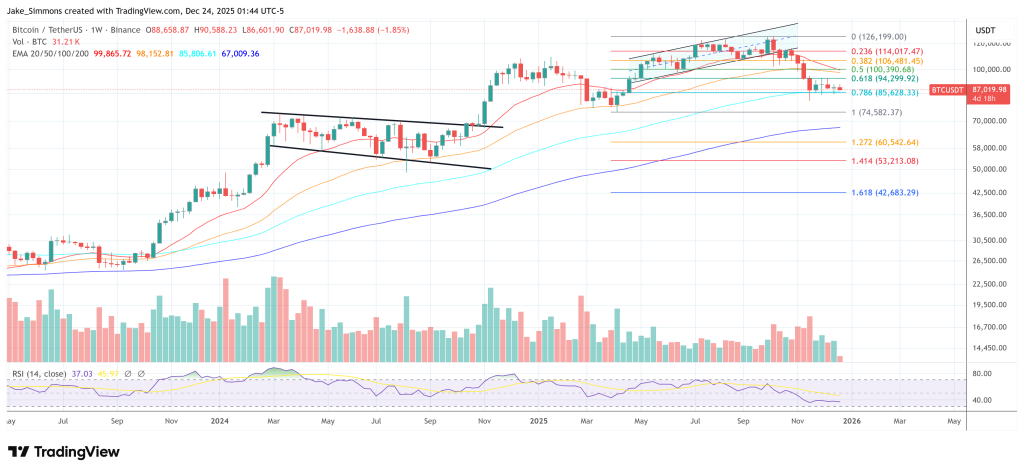
At press time, BTC traded at
Bitcoin price chart
Market Opportunity
Talus Logo
Talus Price(US)
$0.0038
$0.0038$0.0038
+1.87%
USD
Talus (US) Live Price Chart
Disclaimer: The articles reposted on this site are sourced from public platforms and are provided for informational purposes only. They do not necessarily reflect the views of MEXC. All rights remain with the original authors. If you believe any content infringes on third-party rights, please contact service@support.mexc.com for removal. MEXC makes no guarantees regarding the accuracy, completeness, or timeliness of the content and is not responsible for any actions taken based on the information provided. The content does not constitute financial, legal, or other professional advice, nor should it be considered a recommendation or endorsement by MEXC.

You May Also Like

Cashing In On University Patents Means Giving Up On Our Innovation Future

Cashing In On University Patents Means Giving Up On Our Innovation Future

The post Cashing In On University Patents Means Giving Up On Our Innovation Future appeared on BitcoinEthereumNews.com. “It’s a raid on American innovation that would deliver pennies to the Treasury while kneecapping the very engine of our economic and medical progress,” writes Pipes. Getty Images Washington is addicted to taxing success. Now, Commerce Secretary Howard Lutnick is floating a plan to skim half the patent earnings from inventions developed at universities with federal funding. It’s being sold as a way to shore up programs like Social Security. In reality, it’s a raid on American innovation that would deliver pennies to the Treasury while kneecapping the very engine of our economic and medical progress. Yes, taxpayer dollars support early-stage research. But the real payoff comes later—in the jobs created, cures discovered, and industries launched when universities and private industry turn those discoveries into real products. By comparison, the sums at stake in patent licensing are trivial. Universities collectively earn only about $3.6 billion annually in patent income—less than the federal government spends on Social Security in a single day. Even confiscating half would barely register against a $6 trillion federal budget. And yet the damage from such a policy would be anything but trivial. The true return on taxpayer investment isn’t in licensing checks sent to Washington, but in the downstream economic activity that federally supported research unleashes. Thanks to the bipartisan Bayh-Dole Act of 1980, universities and private industry have powerful incentives to translate early-stage discoveries into real-world products. Before Bayh-Dole, the government hoarded patents from federally funded research, and fewer than 5% were ever licensed. Once universities could own and license their own inventions, innovation exploded. The result has been one of the best returns on investment in government history. Since 1996, university research has added nearly $2 trillion to U.S. industrial output, supported 6.5 million jobs, and launched more than 19,000 startups. Those companies pay…
Share
BitcoinEthereumNews2025/09/18 03:26
Spur Protocol Daily Quiz 21 February 2026: Claim Free Tokens and Boost Your Crypto Wallet

Spur Protocol Daily Quiz 21 February 2026: Claim Free Tokens and Boost Your Crypto Wallet

Spur Protocol Daily Quiz February 21 2026: Today’s Correct Answer and How to Earn Free In-App Tokens The Spur Protocol Daily Quiz for February 21, 2026, is
Share
Hokanews2026/02/21 17:10
Alex Acosta Tells Congress He Has No ‘Remorse’ For Jeffrey Epstein ‘Sweetheart Deal,’ Lawmaker Says

Alex Acosta Tells Congress He Has No ‘Remorse’ For Jeffrey Epstein ‘Sweetheart Deal,’ Lawmaker Says

The post Alex Acosta Tells Congress He Has No ‘Remorse’ For Jeffrey Epstein ‘Sweetheart Deal,’ Lawmaker Says appeared on BitcoinEthereumNews.com. Topline A central figure in the Jeffrey Epstein sexual abuse saga—former prosecutor Alex Acosta, who granted in 2007 the former financier what’s been widely blasted as a “sweetheart deal” for his alleged crimes—has no regrets about the agreement, a Democratic lawmaker told CNN on Friday, as the former Trump official faces questioning from the House Oversight Committee. Alex Acosta, center, arrives for a House Oversight Committee deposition about Jeffrey Epstein on September 19 in Washington D.C. CQ-Roll Call, Inc via Getty Images Key Facts This story is breaking and will be updated. Source: https://www.forbes.com/sites/alisondurkee/2025/09/19/prosecutor-acosta-who-gave-epstein-sweetheart-deal-testifies-he-no-remorse-lawmaker-says/
Share
BitcoinEthereumNews2025/09/20 06:37

