Ethereum Set for Major Scaling Advancements in 2026 The upcoming year promises transformative upgrades for Ethereum, targeted at significantly boosting its scalabilityEthereum Set for Major Scaling Advancements in 2026 The upcoming year promises transformative upgrades for Ethereum, targeted at significantly boosting its scalability

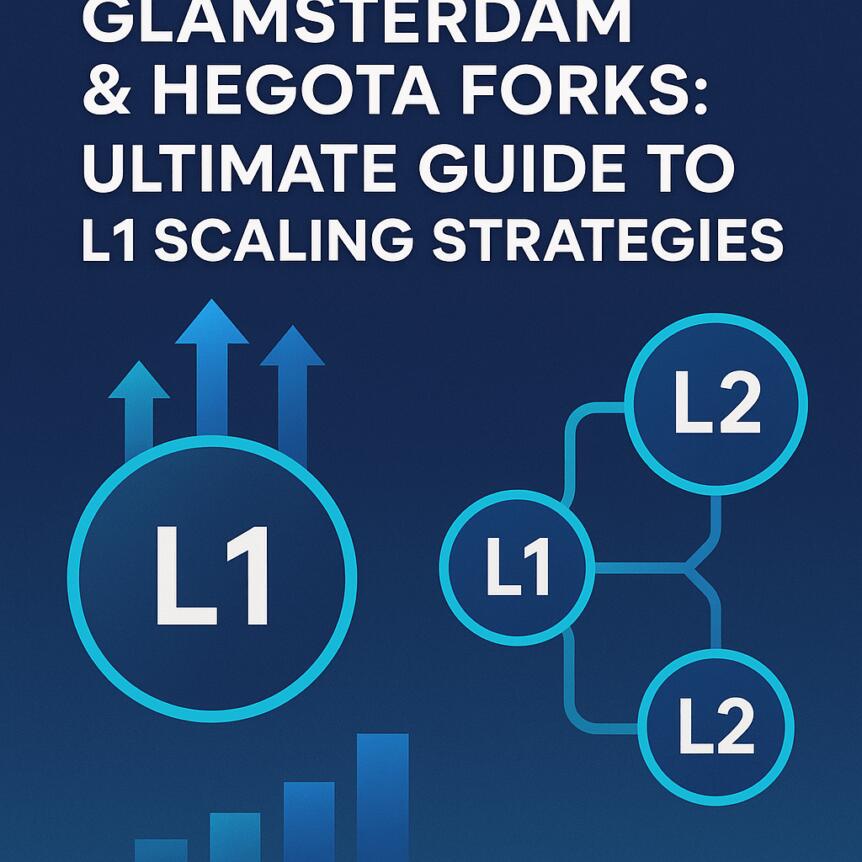
Glamsterdam & Hegota Forks: Ultimate Guide to L1 Scaling Strategies
For feedback or concerns regarding this content, please contact us at crypto.news@mexc.com
Glamsterdam & Hegota Forks: Ultimate Guide To L1 Scaling Strategies

Ethereum Set for Major Scaling Advancements in 2026

The upcoming year promises transformative upgrades for Ethereum, targeted at significantly boosting its scalability and efficiency. Central to these developments is the Glamsterdam fork, scheduled for mid-2026, which aims to introduce perfect parallel processing capabilities and increase the network’s gas limit to 200 million from the current 60 million. Alongside, new consensus protocols and interoperability enhancements are expected to herald a new era of high-speed, low-cost transactions.

Key innovations include a transition of validators from executing transactions to verifying zero-knowledge (ZK) proofs. This shift is anticipated to propel Ethereum’s transaction processing capacity to around 10,000 transactions per second (TPS) and potentially higher, although reaching that milestone immediately remains uncertain. Additionally, data blobs per block could rise to 72 or more, allowing layer 2 solutions to even further scale transactions—potentially to hundreds of thousands per second.

The Glamsterdam Fork: Enhancing Parallel Processing

Developers are finalizing proposals for the Glamsterdam hard fork, expected to activate in 2026, which will incorporate several key Ethereum Improvement Proposals (EIPs). Notable among these are Block Access Lists and Enshrined Proposer Builder Separation. While these technical improvements may sound mundane, their impact could be substantial—enabling “perfect” parallel processing across the network.

Block Access Lists (EIP-7928) will allow transaction processing to occur on multiple CPU cores simultaneously by mapping dependencies within each block. This means transactions affecting different accounts or storage can be executed concurrently, dramatically increasing throughput without raising gas limits. “With Block Access List, we are getting all the state that changes from transaction to transaction, and you are putting that information in the block,” explained Gabriel Trintinalia of Consensys.

Meanwhile, the Enshrined Proposer Builder Separation (ePBS) separates the roles of block proposers and builders, addressing issues related to MEV and centralization. This separation not only improves decentralization but also enhances network security by affording validators more time to validate ZK-proofs, a critical step in scaling Ethereum’s throughput in conjunction with rollups and layer 2 solutions.

Future Gas Limit Increases and Scalability

The current gas limit of 60 million is expected to surge in 2026, with estimates ranging from 100 million to possibly 200 million after implementation of certain upgrades. Ethereum co-creator Vitalik Buterin anticipates targeted, incremental increases rather than uniform jumps, factoring in storage costs and smart contract complexities. Such expansions are key to accommodating increasing transaction demand without sacrificing decentralization or security.

In addition, the Heze-Bogota fork is expected to focus on censorship resistance through mechanisms like Fork-Choice Inclusion Lists, ensuring transaction inclusion even amid contentious scenarios. These innovations collectively highlight Ethereum’s ongoing efforts to enhance scalability, privacy, and resilience as it approaches its network upgrade milestones in 2026.

This article was originally published as Glamsterdam & Hegota Forks: Ultimate Guide to L1 Scaling Strategies on Crypto Breaking News – your trusted source for crypto news, Bitcoin news, and blockchain updates.


Market Opportunity
Major Logo
Major Price(MAJOR)
$0.06112
$0.06112$0.06112
+1.84%
USD
Major (MAJOR) Live Price Chart
Disclaimer: The articles reposted on this site are sourced from public platforms and are provided for informational purposes only. They do not necessarily reflect the views of MEXC. All rights remain with the original authors. If you believe any content infringes on third-party rights, please contact crypto.news@mexc.com for removal. MEXC makes no guarantees regarding the accuracy, completeness, or timeliness of the content and is not responsible for any actions taken based on the information provided. The content does not constitute financial, legal, or other professional advice, nor should it be considered a recommendation or endorsement by MEXC.

You May Also Like

Aave DAO to Shut Down 50% of L2s While Doubling Down on GHO

Aave DAO to Shut Down 50% of L2s While Doubling Down on GHO

The post Aave DAO to Shut Down 50% of L2s While Doubling Down on GHO appeared on BitcoinEthereumNews.com. Aave DAO is gearing up for a significant overhaul by shutting down over 50% of underperforming L2 instances. It is also restructuring its governance framework and deploying over $100 million to boost GHO. This could be a pivotal moment that propels Aave back to the forefront of on-chain lending or sparks unprecedented controversy within the DeFi community. Sponsored Sponsored ACI Proposes Shutting Down 50% of L2s The “State of the Union” report by the Aave Chan Initiative (ACI) paints a candid picture. After a turbulent period in the DeFi market and internal challenges, Aave (AAVE) now leads in key metrics: TVL, revenue, market share, and borrowing volume. Aave’s annual revenue of $130 million surpasses the combined cash reserves of its competitors. Tokenomics improvements and the AAVE token buyback program have also contributed to the ecosystem’s growth. Aave global metrics. Source: Aave However, the ACI’s report also highlights several pain points. First, regarding the Layer-2 (L2) strategy. While Aave’s L2 strategy was once a key driver of success, it is no longer fit for purpose. Over half of Aave’s instances on L2s and alt-L1s are not economically viable. Based on year-to-date data, over 86.6% of Aave’s revenue comes from the mainnet, indicating that everything else is a side quest. On this basis, ACI proposes closing underperforming networks. The DAO should invest in key networks with significant differentiators. Second, ACI is pushing for a complete overhaul of the “friendly fork” framework, as most have been unimpressive regarding TVL and revenue. In some cases, attackers have exploited them to Aave’s detriment, as seen with Spark. Sponsored Sponsored “The friendly fork model had a good intention but bad execution where the DAO was too friendly towards these forks, allowing the DAO only little upside,” the report states. Third, the instance model, once a smart…
Share
BitcoinEthereumNews2025/09/18 02:28
Trump erupts at Fox News reporter during  roundtable: 'What a stupid question'

Trump erupts at Fox News reporter during  roundtable: 'What a stupid question'

An agitated President Donald Trump lashed out at two reporters during his White House “Saving College Sports” roundtable, complaining that the journalists failed
Share
Rawstory2026/03/07 07:19
Lyn Alden Tips Bitcoin Outperforming Gold Through to 2029

Lyn Alden Tips Bitcoin Outperforming Gold Through to 2029

The post Lyn Alden Tips Bitcoin Outperforming Gold Through to 2029 appeared on BitcoinEthereumNews.com. Bitcoin is likely to outperform gold on price performance
Share
BitcoinEthereumNews2026/03/07 07:22