Trust Wallet says a “security incident” hit only one slice of its product stack: the Chrome browser extension on version 2.68. If you are a mobile-only user, theTrust Wallet says a “security incident” hit only one slice of its product stack: the Chrome browser extension on version 2.68. If you are a mobile-only user, the

Trust Wallet Hacked: What Crypto Users Should Do Now

Trust Wallet says a “security incident” hit only one slice of its product stack: the Chrome browser extension on version 2.68. If you are a mobile-only user, the company says you’re not affected. If you are on any other extension version, the company says you’re not affected either. The problem, per Trust Wallet’s own wording, is tightly scoped, even if the fallout doesn’t feel that way when you’re staring at an emptied address.

The first public flare went up on Dec. 25 via on-chain investigator ZachXBT, who posted a Telegram warning that “a number of Trust Wallet users have reported that funds were drained from wallet addresses within the past couple of hours.”

He stressed that “the exact root cause has not been determined,” then pointed out an uncomfortable coincidence: “the Trust Wallet Chrome extension pushed a new update yesterday.” In the same message, he asked victims to DM him on X so he could “update the list of theft addresses below as I verify more,” and he began publishing alleged theft destinations across multiple chains. His list included multiple EVM addresses and a Solana address.

Trust Wallet Confirms The Hack

The wallet firm later confirmed the incident on X. “We’ve identified a security incident affecting Trust Wallet Browser Extension version 2.68 only. Users with Browser Extension 2.68 should disable and upgrade to 2.69,” the company wrote, linking users to the official Chrome Web Store listing.

It added: “Please note: Mobile-only users and all other browser extension versions are not impacted.” The post closed with the kind of line every security team ends up typing sooner or later: “We understand how concerning this is and our team is actively working on the issue. We’ll keep sharing updates as soon as possible.”

Then the guidance got more urgent, and more specific. Trust Wallet warned users who hadn’t updated to 2.69: “please do not open the Browser Extension until you have updated. This may help to ensure the security of your wallet and prevent further issues.”

In a follow-up, it spelled out a step-by-step that boils down to: don’t open the extension, go to Chrome’s extensions page for Trust Wallet, toggle it off if it’s still on, enable Developer mode, hit “Update,” and confirm you’re on version 2.69 before doing anything else. It’s not glamorous, but it’s actionable, which is what matters when you’re in incident mode.

As the claims and counterclaims swirled, cybersecurity firm PeckShield put an early dollar figure on the damage. “The Trust Wallet exploit has drained >$6M worth of cryptos from victims,” PeckShield wrote, adding that while about “~$2.8M of the stolen funds remain in the hacker’s wallets (Bitcoin/EVM/Solana), the bulk – >$4M in cryptos – has been sent to CEXs,” with a breakdown of “~$3.3M to ChangeNOW, ~$340K to Fixed Float, & ~$447K to Kucoin.”

One more pressure point surfaced quickly: compensation. ZachXBT said, “I currently have many concerned victims contacting me via DM so can your team please clarify if you will be offering any compensation for Trust Wallet Browser Extension users.” Trust Wallet did not answer that directly in public. Instead, it replied that its customer support team was already in touch with impacted users regarding next steps and directed people to reach out via its support channel.

So what should users do now, in plain terms? If you are on extension version 2.68, Trust Wallet’s instruction is to stop using it as-is: disable it and upgrade to 2.69 before you open it again. If you think you were affected, the company is routing users to support, while independent investigator ZachXBT is asking for reports to help map theft flows.

UPDATE: Binance founder Changpeng Zhao confirmed via X that user will be compensated for the hack. “So far, $7m affected by this hack. Trust Wallet will cover. User funds are SAFU. Appreciate your understanding for any inconveniences caused. The team is still investigating how hackers were able to submit a new version,” Zhao wrote today.

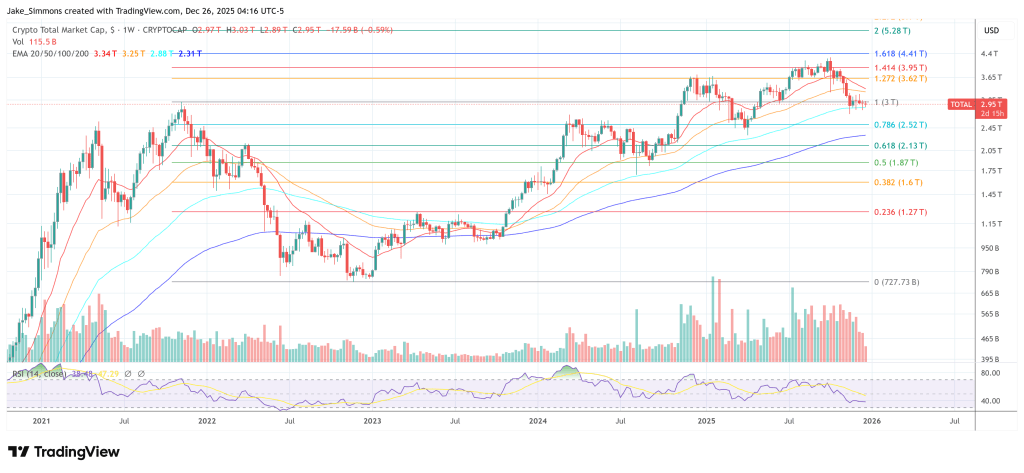
At press time, the total crypto market cap stood at $2.95 trillion.
Total crypto market cap
Market Opportunity
Intuition Logo
Intuition Price(TRUST)
$0.109
$0.109$0.109
+0.09%
USD
Intuition (TRUST) Live Price Chart
Disclaimer: The articles reposted on this site are sourced from public platforms and are provided for informational purposes only. They do not necessarily reflect the views of MEXC. All rights remain with the original authors. If you believe any content infringes on third-party rights, please contact service@support.mexc.com for removal. MEXC makes no guarantees regarding the accuracy, completeness, or timeliness of the content and is not responsible for any actions taken based on the information provided. The content does not constitute financial, legal, or other professional advice, nor should it be considered a recommendation or endorsement by MEXC.

You May Also Like

Satoshi-Era Mt. Gox’s 1,000 Bitcoin Wallet Suddenly Reactivated

Satoshi-Era Mt. Gox’s 1,000 Bitcoin Wallet Suddenly Reactivated

The post Satoshi-Era Mt. Gox’s 1,000 Bitcoin Wallet Suddenly Reactivated appeared on BitcoinEthereumNews.com. X account @SaniExp, which belongs to the founder of the Timechain Index explorer, has published data showing that a dormant BTC wallet was activated after hibernating for six years. However, it was set up 13 years ago, according to the tweet — the time when Satoshi Nakamoto’s shadow was still casting itself around, so to speak. The X post states that the tweet belongs to infamous early Bitcoin exchange Mt. Gox, which suffered from a major hack in the early 2010s, and last year it began paying out compensation to clients who lost their crypto in that hack. The deadline was eventually extended to October 2025. Mt. Gox’s wallet with 1,000 BTC reactivated The above-mentioned data source shared a screenshot from the Timechain Index explorer, showing multiple transactions marked as confirmed and moving a total of 1,000 Bitcoins. This amount of crypto is valued at $116,195,100 at the time of the initiated transaction. Last year, Mt. Gox began to move the remains of its gargantuan funds to pay out compensations to its creditors. Earlier this year, it also made several massive transactions to partner exchanges to distribute funds to Mt. Gox investors. All of the compensations were promised to be paid out by Oct. 31, 2025. The aforementioned transaction is likely preparation for another payout. The exchange was hacked for several years due to multiple unnoticed security breaches, and in 2014, when the site went offline, 744,408 Bitcoins were reported stolen. Source: https://u.today/satoshi-era-mtgoxs-1000-bitcoin-wallet-suddenly-reactivated
Share
BitcoinEthereumNews2025/09/18 10:18
Bitcoin 8% Gains Already Make September 2025 Its Second Best

Bitcoin 8% Gains Already Make September 2025 Its Second Best

The post Bitcoin 8% Gains Already Make September 2025 Its Second Best appeared on BitcoinEthereumNews.com. Key points: Bitcoin is bucking seasonality trends by adding 8%, making this September its best since 2012. September 2025 would need to see 20% upside to become Bitcoin’s strongest ever. BTC price volatility is at levels rarely seen before in an unusual bull cycle. Bitcoin (BTC) has gained more this September than any year since 2012, a new bull market record. Historical price data from CoinGlass and BiTBO confirms that at 8%, Bitcoin’s September 2025 upside is its second-best ever. Bitcoin avoiding “Rektember” with 8% gains September is traditionally Bitcoin’s weakest month, with average losses of around 8%. BTC/USD monthly returns (screenshot). Source: CoinGlass This year, the stakes are high for BTC price seasonality, as historical patterns demand the next bull market peak and other risk assets set repeated new all-time highs. While both gold and the S&P 500 are in price discovery, BTC/USD has coiled throughout September after setting new highs of its own the month prior. Even at “just” 8%, however, this September’s performance is currently enough to make it Bitcoin’s strongest in 13 years. The only time that the ninth month of the year was more profitable for Bitcoin bulls was in 2012, when BTC/USD gained about 19.8%. Last year, upside topped out at 7.3%. BTC/USD monthly returns. Source: BiTBO BTC price volatility vanishes The figures underscore a highly unusual bull market peak year for Bitcoin. Related: BTC ‘pricing in’ what’s coming: 5 things to know in Bitcoin this week Unlike previous bull markets, BTC price volatility has died off in 2025, against the expectations of longtime market participants based on prior performance. CoinGlass data shows volatility dropping to levels not seen in over a decade, with a particularly sharp drop from April onward. Bitcoin historical volatility (screenshot). Source: CoinGlass Onchain analytics firm Glassnode, meanwhile, highlights the…
Share
BitcoinEthereumNews2025/09/18 11:09
Coinbase Joins Ethereum Foundation to Back Open Intents Framework

Coinbase Joins Ethereum Foundation to Back Open Intents Framework

Coinbase Payments has joined the Open Intents Framework as a core contributor, working alongside Ethereum Foundation and other major players. The initiative aims to simplify complex multi-chain interactions through automated solver technology. The post Coinbase Joins Ethereum Foundation to Back Open Intents Framework appeared first on Coinspeaker.
Share
Coinspeaker2025/09/18 02:43