Bitcoin Mining Difficulty Sees Slight Increase as Network Adjusts for 2026 The Bitcoin network’s mining difficulty has edged higher, reaching 148.2 trillion in Bitcoin Mining Difficulty Sees Slight Increase as Network Adjusts for 2026 The Bitcoin network’s mining difficulty has edged higher, reaching 148.2 trillion in

Bitcoin Mining Difficulty Reaches Final 2025 Adjustment Increase
For feedback or concerns regarding this content, please contact us at crypto.news@mexc.com
Bitcoin Mining Difficulty Reaches Final 2025 Adjustment Increase

Bitcoin Mining Difficulty Sees Slight Increase as Network Adjusts for 2026

The Bitcoin network’s mining difficulty has edged higher, reaching 148.2 trillion in the latest adjustment and is expected to rise again in early January 2026. This adjustment reflects the network’s ongoing efforts to maintain stability amidst fluctuating mining activity and market conditions.

The upcoming difficulty recalibration is scheduled for January 8, 2026, at block height 931,392, where estimates project the difficulty to increase to approximately 149 trillion, according to data from CoinWarz. Currently, the average block time stands at around 9.95 minutes, slightly below the 10-minute target, prompting expectations of an upward adjustment to help realign block times with the target interval.

Throughout 2025, Bitcoin mining difficulty has reached historic highs, spiking notably during two sharp rises in September. These surges coincided with a broader uptrend in Bitcoin prices before a significant market decline in October, driven by macroeconomic factors and a historic market crash. The increasing difficulty underscores a dynamic environment where miners face heightened operational costs, as they are compelled to allocate more computational power and energy resources to sustain profitability.

The Bitcoin mining difficulty history from 2014-2025. Source: CoinWarz

The adaptive nature of Bitcoin’s difficulty adjustment protocol plays a crucial role in maintaining the network’s decentralization and security. This adjustment process occurs every 2016 blocks, roughly two weeks, modifying the challenge level based on the time taken to mine previous blocks. When blocks are mined faster than the 10-minute target, difficulty increases; when slower, it decreases, ensuring a balanced addition of new blocks.
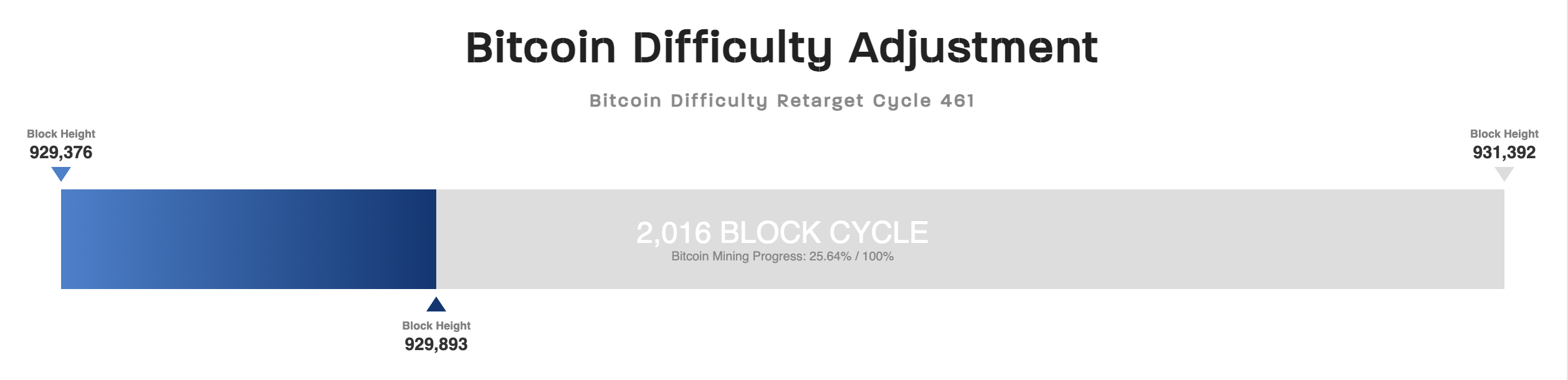
Block progress and adjustmentA gauge showing block progress toward the next adjustment period. Source: CoinWarz

This mechanism exists to prevent any single miner or group from monopolizing the network by rapidly increasing their share of computational power, thereby maintaining Bitcoin’s core principle of decentralization. However, the rise in network hashrate signals a potential for concentrated mining power, which could still threaten network integrity if a dominant miner or consortium attempts a 51% attack—a scenario where they control the majority of computational resources, risking double-spending and undermining trust in the blockchain.

Even absent a 51% attack, the substantial computational resources deployed by miners, combined with rising difficulty, can lead to increased selling pressure, as miners may liquidate their mined Bitcoin to recoup costs, exerting downward pressure on prices. The continual adjustment of mining difficulty, aligned with total network hashing power, aims to preserve decentralization and stability, safeguarding Bitcoin’s price and supply schedule in a volatile environment.

This article was originally published as Bitcoin Mining Difficulty Reaches Final 2025 Adjustment Increase on Crypto Breaking News – your trusted source for crypto news, Bitcoin news, and blockchain updates.


Market Opportunity
RISE Logo
RISE Price(RISE)
$0.003297
$0.003297$0.003297
-0.30%
USD
RISE (RISE) Live Price Chart
Disclaimer: The articles reposted on this site are sourced from public platforms and are provided for informational purposes only. They do not necessarily reflect the views of MEXC. All rights remain with the original authors. If you believe any content infringes on third-party rights, please contact crypto.news@mexc.com for removal. MEXC makes no guarantees regarding the accuracy, completeness, or timeliness of the content and is not responsible for any actions taken based on the information provided. The content does not constitute financial, legal, or other professional advice, nor should it be considered a recommendation or endorsement by MEXC.

You May Also Like

OpenVPP accused of falsely advertising cooperation with the US government; SEC commissioner clarifies no involvement

OpenVPP accused of falsely advertising cooperation with the US government; SEC commissioner clarifies no involvement

PANews reported on September 17th that on-chain sleuth ZachXBT tweeted that OpenVPP ( $OVPP ) announced this week that it was collaborating with the US government to advance energy tokenization. SEC Commissioner Hester Peirce subsequently responded, stating that the company does not collaborate with or endorse any private crypto projects. The OpenVPP team subsequently hid the response. Several crypto influencers have participated in promoting the project, and the accounts involved have been questioned as typical influencer accounts.
Share
PANews2025/09/17 23:58
Trump's allegation against Noem would constitute a federal crime: analyst

Trump's allegation against Noem would constitute a federal crime: analyst

President Donald Trump caught everyone off guard by suddenly firing Homeland Security Secretary Kristi Noem — but being out of a job could just be the start of
Share
Rawstory2026/03/06 04:49
Aave DAO to Shut Down 50% of L2s While Doubling Down on GHO

Aave DAO to Shut Down 50% of L2s While Doubling Down on GHO

The post Aave DAO to Shut Down 50% of L2s While Doubling Down on GHO appeared on BitcoinEthereumNews.com. Aave DAO is gearing up for a significant overhaul by shutting down over 50% of underperforming L2 instances. It is also restructuring its governance framework and deploying over $100 million to boost GHO. This could be a pivotal moment that propels Aave back to the forefront of on-chain lending or sparks unprecedented controversy within the DeFi community. Sponsored Sponsored ACI Proposes Shutting Down 50% of L2s The “State of the Union” report by the Aave Chan Initiative (ACI) paints a candid picture. After a turbulent period in the DeFi market and internal challenges, Aave (AAVE) now leads in key metrics: TVL, revenue, market share, and borrowing volume. Aave’s annual revenue of $130 million surpasses the combined cash reserves of its competitors. Tokenomics improvements and the AAVE token buyback program have also contributed to the ecosystem’s growth. Aave global metrics. Source: Aave However, the ACI’s report also highlights several pain points. First, regarding the Layer-2 (L2) strategy. While Aave’s L2 strategy was once a key driver of success, it is no longer fit for purpose. Over half of Aave’s instances on L2s and alt-L1s are not economically viable. Based on year-to-date data, over 86.6% of Aave’s revenue comes from the mainnet, indicating that everything else is a side quest. On this basis, ACI proposes closing underperforming networks. The DAO should invest in key networks with significant differentiators. Second, ACI is pushing for a complete overhaul of the “friendly fork” framework, as most have been unimpressive regarding TVL and revenue. In some cases, attackers have exploited them to Aave’s detriment, as seen with Spark. Sponsored Sponsored “The friendly fork model had a good intention but bad execution where the DAO was too friendly towards these forks, allowing the DAO only little upside,” the report states. Third, the instance model, once a smart…
Share
BitcoinEthereumNews2025/09/18 02:28