

Ethereum’s Vitalik Buterin Urges Decentralized Models to Avoid Societal Crises

- Ethereum’s Vitalik Buterin has emphasized the importance of projects focusing on decentralization to achieve a balance of power.
- He noted that while people like an independent society, they dislike things like the Taiping Rebellion.
Ethereum (ETH) co-founder Vitalik Buterin has emphasized the need to prevent the excessive concentration of power to avoid societal crises and advance technology, culture, and the economy. This statement was made in his article titled “Balance of Power.” In that article, Vitalik noted that the right balance in society could be attained using technology and decentralization.
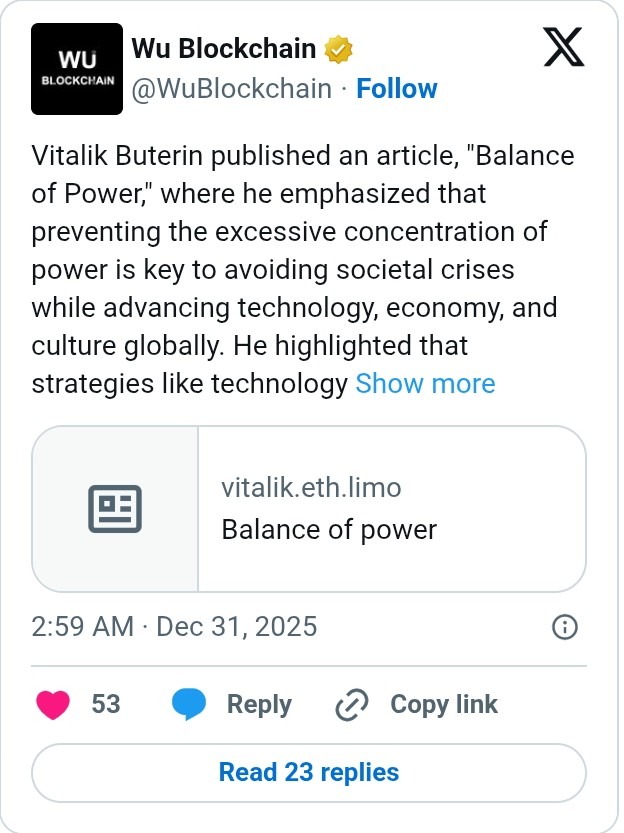 Source: Wu Blockchain on X
Details of the Article
According to Vitalik, there are “three corners of a triangle” that many like and dislike, and the first one is the government. To him, many individuals are interested in the police, court, public order, and many more, but dislike the decisions of governments to arbitrarily restrict what people say, read, or think. Also, he pointed out that governments have the power to ruin society or people far worse than anything crypto sellers could ever do.
The second corner of the triangle is business. According to Vitalik, many people are actually afraid of business, but they like the products and services provided by companies. Delving into this, he disclosed that companies have been accused of being evil and lame. The reason is that they tend to diverge from profit optimization and move away from the goal of their users and society once they get more powerful.
The Final “Corner of the Triangle” and How Ethereum Achieved Balance
Finally, Vitalik spoke about the Big Mob. Under this, he highlighted that while people like the independent civil society, charities, and Wikipedia, they dislike the aspects of mobs lynching people or things like the taiping rebellion. To achieve balance, Vitalik highlighted several solutions, and one of them is pluralist morality.
According to him, it is important to have high diffusion towards the outside world to find balance. In Ethereum, he highlighted the decentralized staking pool, Lido, as an example. Lido has 24% of the total Ethereum staked supply. However, people are less afraid than they would be of anything that has a 24% stake.
Lido does not operate as a single actor. Instead, it operates as an internally decentralized DAO with about a dozen operators. Vitalik suggests that instead of projects operating as just business models, they should have a decentralization model and avoid concentrating power in themselves.
]]>

You May Also Like

Trump biographer predicts next 3 Cabinet members on the chopping block

Kalshi hires ex-Democratic strategist amid legal troubles




