Spain’s second-largest financial institution, BBVA, has introduced Bitcoin and Ethereum trading and custody capabilities for retail customers, marking a significant expansion of regulated digital asset services across Europe . BBVA has fully integrated these cryptocurrency services within its proprietary mobile platform, operating independently without relying on external service providers or third-party custodial solutions. 🚨 Breaking: Spain's major bank BBVA has rolled out trading and custody services for $BTC and $ETH directly in its mobile app for retail customers. Get ready for a surge of capital into the crypto market! pic.twitter.com/ccXoPsWOCf — Crypto Jessica (@CryptoJessXBT) July 7, 2025 The bank’s approach allows customers to execute transactions autonomously while maintaining that it does not offer investment advisory services. BBVA’s 4-Year Crypto Journey Reaches Spain According to an official release dated July 4, the cryptocurrency service launch stems from regulatory approval obtained through Spain’s National Securities Market Commission (CNMV) in March 2025. 🇪🇸 Spanish lending giant BBVA said it won approval to launch Bitcoin and Ether trading, integrating crypto into everyday banking. #BBVA #CryptoTrading https://t.co/ifB7FxuUV8 — Cryptonews.com (@cryptonews) March 10, 2025 This licensing framework authorizes BBVA to provide cryptocurrency services to all customers who meet legal age requirements. “ Our objective is to simplify cryptocurrency investment for retail customers in Spain through an accessible and user-friendly digital platform available on their mobile devices ,” stated Gonzalo Rodríguez, BBVA’s head of retail banking for Spain. The service architecture ensures compliance with the European Union’s Markets in Crypto-Assets (MiCA) regulation, which establishes comprehensive standards for cryptocurrency-related services across EU member states. BBVA’s Spanish cryptocurrency initiative builds upon the success of its Swiss operations. In June 2021, BBVA Switzerland pioneered the bank’s cryptocurrency offerings by introducing Bitcoin custody and trading services for private banking clientele Spain's BBVA, with $782 billion of total assets, is launching a #bitcoin trading service for private clients in Switzerland, due to "significant desire" among investors. — Documenting ₿itcoin 📄 (@DocumentingBTC) June 18, 2021 The Swiss division has since diversified its cryptocurrency portfolio to encompass Ethereum, Solana, XRP, and AVAX, successfully attracting both institutional investors and high-net-worth individuals. Recent reports from June 18 indicate that BBVA has been recommending portfolio allocations of 3% to 7% in cryptocurrencies for its affluent clients. Philippe Meyer, head of digital and blockchain solutions at BBVA Switzerland, indicated that the bank currently advises clients to focus on Bitcoin and Ethereum investments , with plans to introduce additional cryptocurrencies later this year. “ A 3% portfolio allocation to cryptocurrency represents manageable risk exposure ,” Meyer explained. “ In a balanced portfolio structure, introducing 3% cryptocurrency allocation can enhance overall performance. “ Expanding Stablecoin Services See 9% of Spaniards Own Crypto, While 95% of EU Banks Stay Away Beyond Bitcoin and Ethereum, BBVA has incorporated USDC stablecoin services into its offerings. In September 2024, the bank extended its cryptocurrency custody and trading capabilities to include USD Coin for institutional and private banking clients in Switzerland. This expansion enables clients to trade, hold, or convert USDC into euros, dollars, or other currencies with near-instantaneous execution. The bank noted that investment fund managers and large corporations frequently utilize stablecoins like USDC to accelerate transactions across various cryptocurrency exchanges. Additionally, stablecoins serve as a hedge against cryptocurrency volatility by allowing investors to preserve asset value during market fluctuations. Despite approximately 95% of EU banks avoiding cryptocurrency services due to the European Securities and Markets Authority’s (ESMA) cautious regulatory stance, Spain’s cryptocurrency market has demonstrated substantial growth. Europe's crypto regulation will be its biggest mistake since the dotcom era: – EU imposing MiCA – US embracing crypto – Major players leaving EU – $499B+ in crypto flowing through Eastern Europe Is crypto's future in Europe doomed? Here's the full breakdown: pic.twitter.com/mZIi79cru3 — Alessandro Palombo (@thealepalombo) December 16, 2024 A 2024 European Central Bank survey, published in January 2025, revealed that nearly 9% of Spanish citizens now hold digital assets , representing more than double the figure from 2022. Spain’s cryptocurrency adoption rate now equals that of France and Croatia within the Eurozone, though it remains below Slovenia’s 15% adoption rate and Greece’s 14% ownership levels. Between 2023 and 2024 alone, Spain received over $80 billion worth of cryptocurrency, making it the 5th largest European country with the most crypto value received. Source: Chainalysis Spain’s 28% Crypto Tax: The Hidden Cost of Digital Assets Despite growing adoption, Spain has tight tax regulations on crypto. The Spanish cryptocurrency taxation follows specific guidelines established by the Spanish State Agency for Tax Administration (AEAT). Spanish residents are required to declare gains from cryptocurrency transactions and income generated from digital asset holdings or related activities. Source: Blockpit Spanish taxpayers are required to report cryptocurrency gains exceeding €6,000 under the Income Savings Tax (Capital Gains Tax), with rates ranging from 19% to 28% depending on total gains.Spain’s second-largest financial institution, BBVA, has introduced Bitcoin and Ethereum trading and custody capabilities for retail customers, marking a significant expansion of regulated digital asset services across Europe . BBVA has fully integrated these cryptocurrency services within its proprietary mobile platform, operating independently without relying on external service providers or third-party custodial solutions. 🚨 Breaking: Spain's major bank BBVA has rolled out trading and custody services for $BTC and $ETH directly in its mobile app for retail customers. Get ready for a surge of capital into the crypto market! pic.twitter.com/ccXoPsWOCf — Crypto Jessica (@CryptoJessXBT) July 7, 2025 The bank’s approach allows customers to execute transactions autonomously while maintaining that it does not offer investment advisory services. BBVA’s 4-Year Crypto Journey Reaches Spain According to an official release dated July 4, the cryptocurrency service launch stems from regulatory approval obtained through Spain’s National Securities Market Commission (CNMV) in March 2025. 🇪🇸 Spanish lending giant BBVA said it won approval to launch Bitcoin and Ether trading, integrating crypto into everyday banking. #BBVA #CryptoTrading https://t.co/ifB7FxuUV8 — Cryptonews.com (@cryptonews) March 10, 2025 This licensing framework authorizes BBVA to provide cryptocurrency services to all customers who meet legal age requirements. “ Our objective is to simplify cryptocurrency investment for retail customers in Spain through an accessible and user-friendly digital platform available on their mobile devices ,” stated Gonzalo Rodríguez, BBVA’s head of retail banking for Spain. The service architecture ensures compliance with the European Union’s Markets in Crypto-Assets (MiCA) regulation, which establishes comprehensive standards for cryptocurrency-related services across EU member states. BBVA’s Spanish cryptocurrency initiative builds upon the success of its Swiss operations. In June 2021, BBVA Switzerland pioneered the bank’s cryptocurrency offerings by introducing Bitcoin custody and trading services for private banking clientele Spain's BBVA, with $782 billion of total assets, is launching a #bitcoin trading service for private clients in Switzerland, due to "significant desire" among investors. — Documenting ₿itcoin 📄 (@DocumentingBTC) June 18, 2021 The Swiss division has since diversified its cryptocurrency portfolio to encompass Ethereum, Solana, XRP, and AVAX, successfully attracting both institutional investors and high-net-worth individuals. Recent reports from June 18 indicate that BBVA has been recommending portfolio allocations of 3% to 7% in cryptocurrencies for its affluent clients. Philippe Meyer, head of digital and blockchain solutions at BBVA Switzerland, indicated that the bank currently advises clients to focus on Bitcoin and Ethereum investments , with plans to introduce additional cryptocurrencies later this year. “ A 3% portfolio allocation to cryptocurrency represents manageable risk exposure ,” Meyer explained. “ In a balanced portfolio structure, introducing 3% cryptocurrency allocation can enhance overall performance. “ Expanding Stablecoin Services See 9% of Spaniards Own Crypto, While 95% of EU Banks Stay Away Beyond Bitcoin and Ethereum, BBVA has incorporated USDC stablecoin services into its offerings. In September 2024, the bank extended its cryptocurrency custody and trading capabilities to include USD Coin for institutional and private banking clients in Switzerland. This expansion enables clients to trade, hold, or convert USDC into euros, dollars, or other currencies with near-instantaneous execution. The bank noted that investment fund managers and large corporations frequently utilize stablecoins like USDC to accelerate transactions across various cryptocurrency exchanges. Additionally, stablecoins serve as a hedge against cryptocurrency volatility by allowing investors to preserve asset value during market fluctuations. Despite approximately 95% of EU banks avoiding cryptocurrency services due to the European Securities and Markets Authority’s (ESMA) cautious regulatory stance, Spain’s cryptocurrency market has demonstrated substantial growth. Europe's crypto regulation will be its biggest mistake since the dotcom era: – EU imposing MiCA – US embracing crypto – Major players leaving EU – $499B+ in crypto flowing through Eastern Europe Is crypto's future in Europe doomed? Here's the full breakdown: pic.twitter.com/mZIi79cru3 — Alessandro Palombo (@thealepalombo) December 16, 2024 A 2024 European Central Bank survey, published in January 2025, revealed that nearly 9% of Spanish citizens now hold digital assets , representing more than double the figure from 2022. Spain’s cryptocurrency adoption rate now equals that of France and Croatia within the Eurozone, though it remains below Slovenia’s 15% adoption rate and Greece’s 14% ownership levels. Between 2023 and 2024 alone, Spain received over $80 billion worth of cryptocurrency, making it the 5th largest European country with the most crypto value received. Source: Chainalysis Spain’s 28% Crypto Tax: The Hidden Cost of Digital Assets Despite growing adoption, Spain has tight tax regulations on crypto. The Spanish cryptocurrency taxation follows specific guidelines established by the Spanish State Agency for Tax Administration (AEAT). Spanish residents are required to declare gains from cryptocurrency transactions and income generated from digital asset holdings or related activities. Source: Blockpit Spanish taxpayers are required to report cryptocurrency gains exceeding €6,000 under the Income Savings Tax (Capital Gains Tax), with rates ranging from 19% to 28% depending on total gains.

Spanish Banking Giant BBVA Expands Crypto Offerings with Bitcoin and Ethereum Services

4 min read

Spain’s second-largest financial institution, BBVA, has introduced Bitcoin and Ethereum trading and custody capabilities for retail customers, marking a significant expansion of regulated digital asset services across Europe.

BBVA has fully integrated these cryptocurrency services within its proprietary mobile platform, operating independently without relying on external service providers or third-party custodial solutions.

The bank’s approach allows customers to execute transactions autonomously while maintaining that it does not offer investment advisory services.

BBVA’s 4-Year Crypto Journey Reaches Spain

According to an official release dated July 4, the cryptocurrency service launch stems from regulatory approval obtained through Spain’s National Securities Market Commission (CNMV) in March 2025.

This licensing framework authorizes BBVA to provide cryptocurrency services to all customers who meet legal age requirements.

Our objective is to simplify cryptocurrency investment for retail customers in Spain through an accessible and user-friendly digital platform available on their mobile devices,” stated Gonzalo Rodríguez, BBVA’s head of retail banking for Spain.

The service architecture ensures compliance with the European Union’s Markets in Crypto-Assets (MiCA) regulation, which establishes comprehensive standards for cryptocurrency-related services across EU member states.

BBVA’s Spanish cryptocurrency initiative builds upon the success of its Swiss operations. In June 2021, BBVA Switzerland pioneered the bank’s cryptocurrency offerings by introducing Bitcoin custody and trading services for private banking clientele

The Swiss division has since diversified its cryptocurrency portfolio to encompass Ethereum, Solana, XRP, and AVAX, successfully attracting both institutional investors and high-net-worth individuals.

Recent reports from June 18 indicate that BBVA has been recommending portfolio allocations of 3% to 7% in cryptocurrencies for its affluent clients.

Philippe Meyer, head of digital and blockchain solutions at BBVA Switzerland, indicated that the bank currently advises clients to focus on Bitcoin and Ethereum investments, with plans to introduce additional cryptocurrencies later this year.

A 3% portfolio allocation to cryptocurrency represents manageable risk exposure,” Meyer explained. “In a balanced portfolio structure, introducing 3% cryptocurrency allocation can enhance overall performance.

Expanding Stablecoin Services See 9% of Spaniards Own Crypto, While 95% of EU Banks Stay Away

Beyond Bitcoin and Ethereum, BBVA has incorporated USDC stablecoin services into its offerings. In September 2024, the bank extended its cryptocurrency custody and trading capabilities to include USD Coin for institutional and private banking clients in Switzerland.

This expansion enables clients to trade, hold, or convert USDC into euros, dollars, or other currencies with near-instantaneous execution.

The bank noted that investment fund managers and large corporations frequently utilize stablecoins like USDC to accelerate transactions across various cryptocurrency exchanges.

Additionally, stablecoins serve as a hedge against cryptocurrency volatility by allowing investors to preserve asset value during market fluctuations.

Despite approximately 95% of EU banks avoiding cryptocurrency services due to the European Securities and Markets Authority’s (ESMA) cautious regulatory stance, Spain’s cryptocurrency market has demonstrated substantial growth.

A 2024 European Central Bank survey, published in January 2025, revealed that nearly 9% of Spanish citizens now hold digital assets, representing more than double the figure from 2022.

Spain’s cryptocurrency adoption rate now equals that of France and Croatia within the Eurozone, though it remains below Slovenia’s 15% adoption rate and Greece’s 14% ownership levels.

Between 2023 and 2024 alone, Spain received over $80 billion worth of cryptocurrency, making it the 5th largest European country with the most crypto value received.
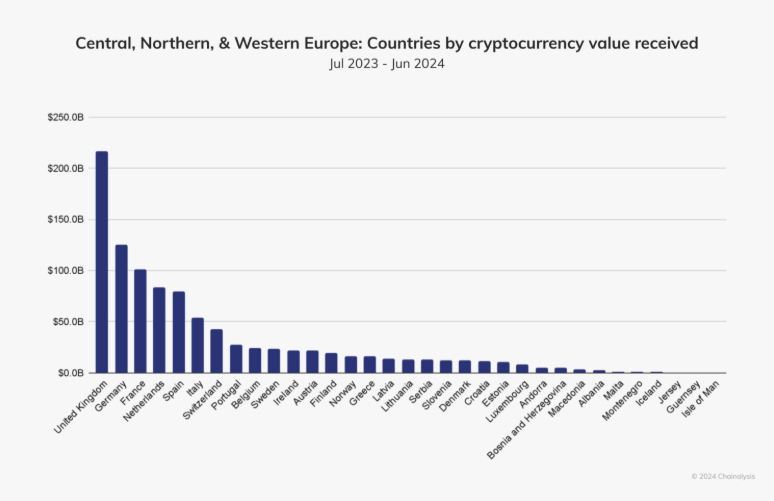
Spanish Banking Giant BBVA Expands Crypto Offerings with Bitcoin and Ethereum ServicesSource: Chainalysis

Spain’s 28% Crypto Tax: The Hidden Cost of Digital Assets

Despite growing adoption, Spain has tight tax regulations on crypto.

The Spanish cryptocurrency taxation follows specific guidelines established by the Spanish State Agency for Tax Administration (AEAT). Spanish residents are required to declare gains from cryptocurrency transactions and income generated from digital asset holdings or related activities.

Spanish Banking Giant BBVA Expands Crypto Offerings with Bitcoin and Ethereum ServicesSource: Blockpit

Spanish taxpayers are required to report cryptocurrency gains exceeding €6,000 under the Income Savings Tax (Capital Gains Tax), with rates ranging from 19% to 28% depending on total gains.


Market Opportunity
NEAR Logo
NEAR Price(NEAR)
$1.194
$1.194$1.194
-0.99%
USD
NEAR (NEAR) Live Price Chart
Disclaimer: The articles reposted on this site are sourced from public platforms and are provided for informational purposes only. They do not necessarily reflect the views of MEXC. All rights remain with the original authors. If you believe any content infringes on third-party rights, please contact service@support.mexc.com for removal. MEXC makes no guarantees regarding the accuracy, completeness, or timeliness of the content and is not responsible for any actions taken based on the information provided. The content does not constitute financial, legal, or other professional advice, nor should it be considered a recommendation or endorsement by MEXC.

You May Also Like

Polygon: Bulls defend $0.10 demand zone – Can POL rally 15%?

Polygon: Bulls defend $0.10 demand zone – Can POL rally 15%?

The $0.13 local supply zone and the short-term Bitcoin bearish momentum threaten POL bulls' potential this week.
Share
Coinstats2026/02/04 09:00
Headwind Helps Best Wallet Token

Headwind Helps Best Wallet Token

The post Headwind Helps Best Wallet Token appeared on BitcoinEthereumNews.com. Google has announced the launch of a new open-source protocol called Agent Payments Protocol (AP2) in partnership with Coinbase, the Ethereum Foundation, and 60 other organizations. This allows AI agents to make payments on behalf of users using various methods such as real-time bank transfers, credit and debit cards, and, most importantly, stablecoins. Let’s explore in detail what this could mean for the broader cryptocurrency markets, and also highlight a presale crypto (Best Wallet Token) that could explode as a result of this development. Google’s Push for Stablecoins Agent Payments Protocol (AP2) uses digital contracts known as ‘Intent Mandates’ and ‘Verifiable Credentials’ to ensure that AI agents undertake only those payments authorized by the user. Mandates, by the way, are cryptographically signed, tamper-proof digital contracts that act as verifiable proof of a user’s instruction. For example, let’s say you instruct an AI agent to never spend more than $200 in a single transaction. This instruction is written into an Intent Mandate, which serves as a digital contract. Now, whenever the AI agent tries to make a payment, it must present this mandate as proof of authorization, which will then be verified via the AP2 protocol. Alongside this, Google has also launched the A2A x402 extension to accelerate support for the Web3 ecosystem. This production-ready solution enables agent-based crypto payments and will help reshape the growth of cryptocurrency integration within the AP2 protocol. Google’s inclusion of stablecoins in AP2 is a massive vote of confidence in dollar-pegged cryptocurrencies and a huge step toward making them a mainstream payment option. This widens stablecoin usage beyond trading and speculation, positioning them at the center of the consumption economy. The recent enactment of the GENIUS Act in the U.S. gives stablecoins more structure and legal support. Imagine paying for things like data crawls, per-task…
Share
BitcoinEthereumNews2025/09/18 01:27
Vertical Aerospace Wins Proof-Of-Concept Grant To Advance Emergency Medical Services Capabilities For Singapore

Vertical Aerospace Wins Proof-Of-Concept Grant To Advance Emergency Medical Services Capabilities For Singapore

Grant will support real-world EMS mission development for Valo in Singapore Collaboration with Hatch – Singapore’s HTX innovation centre, to trial and validate
Share
AI Journal2026/02/04 09:15