The ownership balance of Web3 can be seen from the cancellation of custom design of Paragraph
Original author: 0xAntidote.eth
Compiled by: Zen, PANews
Paragraph, which acquired Mirror, a well-known Web3 content platform, recently updated and brought some changes. One of the points that has not been widely discussed is that it canceled the ability to design blogs with custom CSS. The Paragraph team said that only a few creators are using this feature, and I happen to be one of them. I spent a lot of time carefully designing brand vision to give my blog a unique style. But this update completely destroyed these efforts-custom fonts and background colors were removed, causing the overall design of the blog to become chaotic.
Although I have plans to continue publishing content on Paragraph and expand its readership, the blog is not large enough at the moment and Paragraph will not lose users due to my departure. Every product team has limited resources, sometimes due to funding issues, sometimes due to limited developer energy, and sometimes due to different priorities for product decisions. Therefore, it is impossible to meet the needs of everyone.
However, I should also add that the Paragraph team has always been very friendly to me. They have selected my articles as "Selected of the Week" twice, listened carefully to my feedback, and provided professional explanations when communicating.
While I understand their decision, I think the thinking behind this decision is to mimic existing Web2 content publishing platforms - increasing the control of centralized distribution platforms by standardizing the appearance of content. I still wish the Paragraph team all the best, but for me, the current Paragraph no longer solves a core problem worth solving, so I decided to leave.
Paragraph's Value Proposition
According to the official introduction, Paragraph’s core value proposition mainly revolves around “ content ownership ”.
In short, Paragraph is a blog/newsletter platform based on encryption technology. Articles are stored on Arweave and can be sold as digital collectibles, allowing creators to monetize their content directly. In theory, this model can enhance creators' ownership of their own content.
However, after careful consideration, I believe that creating content on Paragraph does not mean that you actually own it.
What exactly is “ownership”?
“Ownership” has always been an important concept in the Web3 narrative. One of the origin stories of Ethereum is that Vitalik questioned the ownership of digital assets: if the game developer shuts down the server, what will happen to your game props?
This thinking gave birth to Ethereum and subsequent smart contract platforms, which promoted the evolution of the concept of "ownership". Today, blockchain technology allows almost all types of assets to be "owned".
But the essence of ownership is more complex than just owning something.
In a world of multi-person interaction, ownership must have four key elements:
- Possession: Are you recognized as the owner of the asset?
- Monetization: Can you sell the asset or charge a fee to non-owners?
- Appearance: Does the way the asset is presented to the outside world meet your expectations?
- Distribution: Can your assets be widely disseminated so that more people recognize your ownership?
If any of these four aspects fails, true ownership cannot be established.
Paragraph’s Ownership Flaws
Blockchain improves many aspects of ownership through decentralized ledgers and encryption technology. However, ownership can still be eroded if certain key links fail. For example:
- If everyone mistakenly thinks you own something else, are you still the true owner?
- If your video can only be viewed with a sepia filter (because YouTube or your network provider has imposed a filter), is it still your content?
This is exactly what is happening with Paragraph right now - it can change the visual presentation of a blog at will, and the creators can't do anything about it.
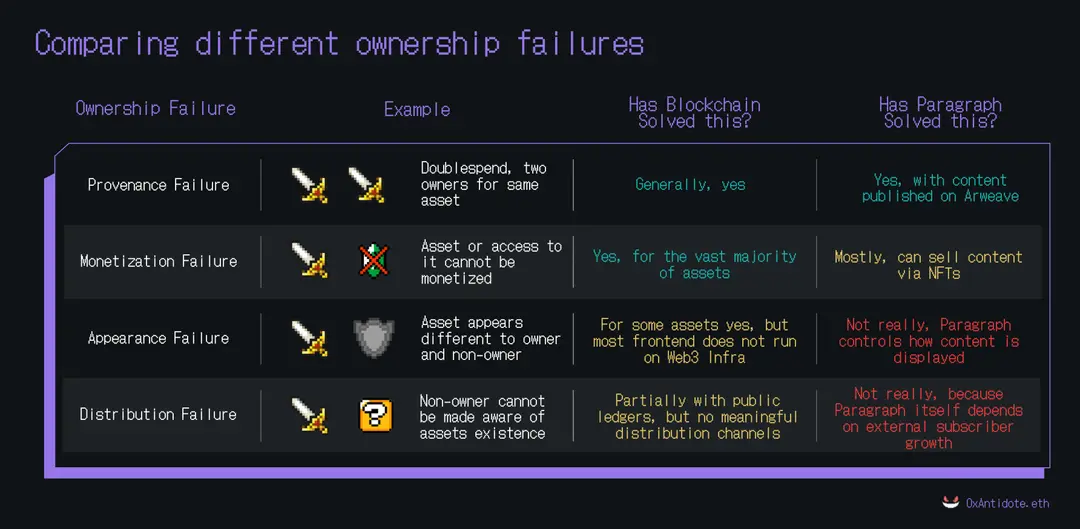
As can be seen from the above figure, Paragraph has made some progress in terms of ownership and monetization, but its contribution in terms of appearance and distribution is limited, or even negative.
Ownership compromises and trade-offs
Of course, perfect ownership is an ideal that may never be fully achieved. However, we can measure whether we are moving towards this ideal. I think we have generally been getting closer to it over the past decade. Blockchain plays a role in this, but other technological advances are equally important, such as decentralized energy production (mainly renewable energy) or Starlink ( which provides high-speed internet access around the world ) .
However, in its current state, everything is more or less a compromise. The question is, of the four aspects of ownership — Possession, Monetization, Appearance, and Distribution — which are you willing to compromise on?
Different assets and platforms compromise in different ways.
For example, for some assets, such as memecoins, teams are often willing to sacrifice "appearance" and "distribution" autonomy and use X (formerly Twitter) and Discord to promote their projects in exchange for greater market coverage. These projects are willing to make such compromises because these traditional social media platforms have a huge audience base, and even if they have restrictions on content, the coverage they bring is still far better than open platforms such as Farcaster or Lens that focus on ownership but are smaller in scale. The development of memecoin into a multi-billion dollar industry itself proves that this compromise works in reality.
However, for media content, the situation is different. X will limit the distribution of links to external media platforms, such as Substack. Writing memecoin-related content is TAM (total available market) expansion content for X, while linking to external media platforms is TAM contraction content. This is also the problem faced by many Web3 media platforms - their value gains will only be apparent after reaching a certain scale. Before that, for many digital asset creators, it may make more economic sense to sacrifice some aspects of ownership in exchange for better distribution effects than to adhere to the ideal state of ownership.
This is particularly evident in Web3 media platforms like Paragraph, which fail to fully optimize for ownership, monetization, appearance, and distribution, leaving them in an awkward middle ground: not providing enough additional ownership control for creators to be willing to sacrifice distribution advantages to use it.
What are the alternatives?
So where will my future content be published? I think there are a few possible paths that are more consistent with my philosophy of ownership.
- Switching to other writing platforms like Medium, Mirror, Substack, or Ghost all have their own pros and cons, but their compromises are not fundamentally better than Paragraph. Switching is more like a lateral movement than a fundamental optimization.
- Distribute on X and/or Farcaster, and host content elsewhere This means splitting different aspects of ownership across multiple platforms. A possible best practice is to publish content on X/Farcaster first to ensure better distribution, and then archive the posts on a blog with custom CSS to ensure quality of presentation and presentation.
- It might be a feasible solution to continue using Paragraph and expect it to improve product positioning, but it would add a lot of extra work if the content appearance needs to be re-adjusted in the future. Therefore, I will keep the Paragraph blog for now, but not as the main publishing channel unless there are substantial improvements in the product.
Currently, I prefer the second option.
Farcaster in particular offers a nice balance between the different aspects of ownership. Also, Frames could be a solution that allows publishing long-form content with full control over its appearance and monetization.


You May Also Like

XRP Price Frozen for a Month? A 130 Million Whale Move May Finally Crack It

Japan Introduces Comprehensive Crypto Regulations Including Insider Trading Prohibitions