Chainlink said it has strengthened its position as the industry-standard infrastructure for on-chain finance in 2025, as governments, banks, and asset managers Chainlink said it has strengthened its position as the industry-standard infrastructure for on-chain finance in 2025, as governments, banks, and asset managers

Chainlink Extends Lead in On-chain Finance as Institutional Adoption Grows

2026/01/02 00:21
3 min read
For feedback or concerns regarding this content, please contact us at crypto.news@mexc.com

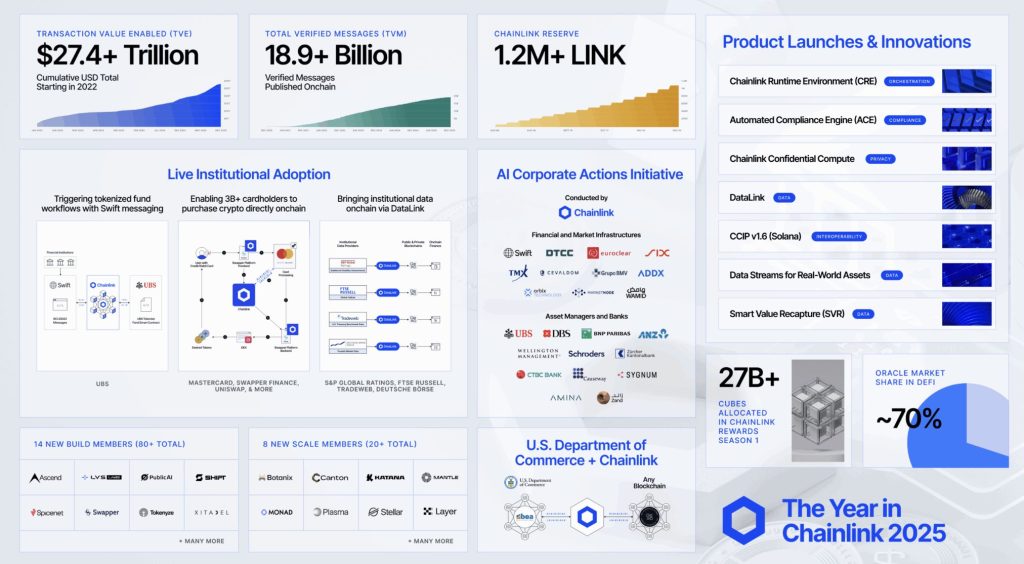
Chainlink said it has strengthened its position as the industry-standard infrastructure for on-chain finance in 2025, as governments, banks, and asset managers increasingly adopted its technology to move real-world financial activity onto blockchains, according to a blog post published by the company.

The report emphasized 2025 as an important year in which Chainlink’s oracle and interoperability standards became embedded across public- and private-sector financial systems used for everything from government data publication to institutional tokenized funds.

Government Adoption Accelerates

Government use of blockchain infrastructure marked progress during the year. Chainlink said the U.S. Department of Commerce partnered with the network to publish macroeconomic data on-chain using Chainlink Data Feeds sourced from the Bureau of Economic Analysis.
Chainlink co-founder Sergey Nazarov also participated in high-level policy discussions in Washington, including the White House Digital Asset Summit, as U.S. President Donald Trump signed the GENIUS Act into law.

The engagement reflects growing coordination between policymakers and blockchain infrastructure providers as regulatory clarity improves.

Banks and Capital Markets Move On-chain

In banking and capital markets, global financial institutions increasingly relied on Chainlink to execute production-grade on-chain workflows.

The research cites a partnership with Mastercard allowing more than three billion cardholders to purchase crypto assets directly on-chain via a Chainlink-powered application.

Asset managers also expanded tokenized offerings. UBS completed what Chainlink described as the world’s first live, end-to-end tokenized fund workflow using its Digital Transfer Agent standard, while firms such as WisdomTree and FTSE Russell began publishing institutional-grade net asset value and index data on-chain.

Financial market infrastructures, including DTCC, Euroclear, and SWIFT, collaborated with Chainlink to streamline corporate actions processing and cross-chain settlement using standardized messaging formats.

DeFi and Tokenization Scale Up

Decentralized finance and tokenization platforms also adopted Chainlink at scale in 2025. Coinbase selected Chainlink’s Cross-Chain Interoperability Protocol (CCIP) as the exclusive bridge infrastructure for its wrapped assets, while DeFi protocols, including Aave and Lido, upgraded their oracle and cross-chain infrastructure to support institutional-grade use cases.

Chainlink said the expansion of CCIP to non-EVM blockchains, including Solana, unlocked access to tens of billions of dollars in assets across multiple ecosystems.

Infrastructure Push Sets Stage for 2026

Beyond adoption, Chainlink said it also introduced new platform capabilities in 2025, including its Runtime Environment, Automated Compliance Engine, and Confidential Compute service intended to support privacy-preserving and compliant on-chain applications.

The report concludes that 2025 marked a turning point for on-chain finance, with 2026 expected to see tokenization adoption accelerate further as institutions standardize around shared infrastructure.

“Governments, financial institutions, and market infrastructures are increasingly aligning around Chainlink standards,” the company said, positioning its network as core plumbing for the global shift toward on-chain capital markets.


Disclaimer: The articles reposted on this site are sourced from public platforms and are provided for informational purposes only. They do not necessarily reflect the views of MEXC. All rights remain with the original authors. If you believe any content infringes on third-party rights, please contact crypto.news@mexc.com for removal. MEXC makes no guarantees regarding the accuracy, completeness, or timeliness of the content and is not responsible for any actions taken based on the information provided. The content does not constitute financial, legal, or other professional advice, nor should it be considered a recommendation or endorsement by MEXC.

You May Also Like

Troubling signs in new Trump intel report alarm expert: 'Raises real questions'

Troubling signs in new Trump intel report alarm expert: 'Raises real questions'

A new intelligence report on Iran's military capabilities alarmed an expert during a CNN interview. CNN reported, citing sources inside the Trump administration
Share
Rawstory2026/04/03 10:22
Top Analyst Uses Hydraulic Pipe Analogy to Project XRP Rally from Bitcoin Capital Rotation

Top Analyst Uses Hydraulic Pipe Analogy to Project XRP Rally from Bitcoin Capital Rotation

The post Top Analyst Uses Hydraulic Pipe Analogy to Project XRP Rally from Bitcoin Capital Rotation appeared on BitcoinEthereumNews.com. Marketing analyst compares Bitcoin to wide pipe and XRP to narrow pipe system Theory suggests 5% Bitcoin capital rotation could generate $115 billion XRP inflow Projected targets range from $6-15 for slow flows to $15-60 for rapid movements Marketing research analyst Dr. Jim Willie has presented a hydraulic pipe analogy to explain how capital flowing from Bitcoin into XRP could trigger explosive price movements. During an appearance on Black Swan Capitalist with host Versan Aljarrah, Willie used physics principles to illustrate potential market dynamics between the two cryptocurrencies. Willie compared Bitcoin’s large market capitalization to a wide hydraulic pipe and XRP’s smaller market to a much narrower tube. His theory suggests that when pressure transfers from larger to smaller pipes, force increases substantially because area scales with the square of radius measurements. Market Cap Ratios Drive Theoretical Price Impact The analyst established a framework where Bitcoin’s market capitalization equals approximately 13 times XRP’s valuation, creating a mathematical basis for his projections. Under this model, identical capital flows that barely affect Bitcoin’s price could generate 13 times greater impact on XRP due to liquidity depth differences. Willie noted that real trading environments create non-linear effects as order books thin during large transactions, spreads widen, and liquidity providers withdraw. In smaller markets like XRP, price movements can follow quadratic rather than linear patterns, potentially amplifying the 13-fold liquidity gap into price swings tens or hundreds of times more extreme than Bitcoin. The analyst outlined different scenarios based on rotation speed. Slow transitions over weeks would allow market makers time to adjust, potentially driving XRP 2-5x higher while Bitcoin declines orderly. Daily timeframes could produce 5-20x XRP gains with sharper Bitcoin drops, while hourly rotations might create vertical XRP spikes of 10-20x before rapid corrections. Willie identified several amplifying factors including XRP’s limited…
Share
BitcoinEthereumNews2025/09/23 06:20
Globalstar (GSAT) Stock Surges 15% on Amazon Acquisition Report

Globalstar (GSAT) Stock Surges 15% on Amazon Acquisition Report

TLDR Globalstar stock jumped more than 15% in after-hours trading following a Financial Times report that Amazon is in talks to acquire the satellite communications
Share
Coincentral2026/04/02 19:49

Trade GOLD, Share 1,000,000 USDT

Trade GOLD, Share 1,000,000 USDTTrade GOLD, Share 1,000,000 USDT

0 fees, up to 1,000x leverage, deep liquidity