Michael Saylor’s Bitcoin-focused company Strategy is once again edging toward a key valuation threshold, as its market-to-net-asset-value multiple, or mNAV, hoversMichael Saylor’s Bitcoin-focused company Strategy is once again edging toward a key valuation threshold, as its market-to-net-asset-value multiple, or mNAV, hovers

Michael Saylor’s Strategy Nears “Danger Zone” as mNAV Threatens to Slip Below 1

2026/01/03 04:44
3 min read
For feedback or concerns regarding this content, please contact us at crypto.news@mexc.com

Michael Saylor’s Bitcoin-focused company Strategy is once again edging toward a key valuation threshold, as its market-to-net-asset-value multiple, or mNAV, hovers just above levels that could undermine the logic of holding its stock as a proxy for Bitcoin exposure.

In early trading on January 2, Strategy shares rose modestly, offering brief relief after months of pressure.

Even with the bounce, the stock remains down roughly 66% from its July peak.

The company’s mNAV, a measure comparing its market valuation to the value of its Bitcoin holdings, stood near 1.02, leaving little margin before slipping below 1.0.

A move beneath that level would mean the market is valuing Strategy at less than the Bitcoin it owns.

Why Strategy’s Bitcoin Discount Is Raising Red Flags

The distinction matters because Strategy’s equity appeal has long rested on trading at a premium to its Bitcoin reserves.

When mNAV falls below 1.0, investors can theoretically buy Bitcoin more cheaply by purchasing the asset directly rather than holding a stock that represents it.

Historically, such conditions have triggered selling pressure, as the rationale for paying corporate risk, dilution, and management costs weakens.

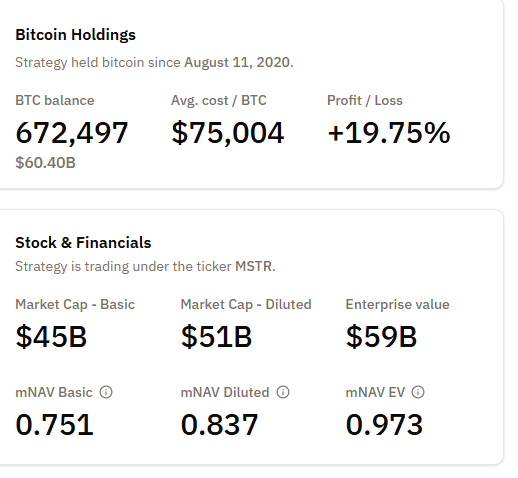
The company’s balance sheet reflects the tension. Strategy holds 672,497 bitcoin, the largest corporate stash in the world, accumulated since August 2020 at an average cost of about $75,000 per coin.

With Bitcoin trading around $90,000, those holdings are worth roughly $60.7 billion, leaving the company with an unrealized gain of about 20%.

Despite that, Strategy’s basic market capitalization sits closer to $45 billion, and its diluted valuation is around $50 billion, already implying a discount to the underlying assets.
Source: Bitcoin Treasuries

On an enterprise value basis, which accounts for debt and cash, Strategy’s mNAV is estimated just under 1.0. That proximity has sharpened scrutiny because the company relies on issuing equity at a premium to fund further Bitcoin purchases.

If the stock trades persistently below the value of its reserves, raising capital through share sales becomes more difficult and potentially dilutive.

Management has taken steps to reduce near-term funding risk. In recent weeks, Strategy raised $747.8 million through stock sales under its ATM program.

The company says the reserve now covers roughly 21 months of dividend and interest obligations, easing pressure to liquidate Bitcoin during periods of market stress.

Executives have described selling Bitcoin as a last resort, to be considered only if other financing options close and the firm’s valuation falls below its asset base.

Bitcoin Premium Shrinks as Strategy Stock Struggles

Still, another threshold looms below the mNAV line. If Bitcoin were to fall under Strategy’s average acquisition price near $74,000, the company’s holdings would drop below cost, potentially testing investor confidence.

While some shareholders view such scenarios as long-term buying opportunities, they can also amplify volatility among traders less committed to the strategy.

The stock’s recent performance reflects that uncertainty, with Strategy shares having fallen more than 60% over the past six months and ending 2025 down nearly 50%, making it the worst performer in the Nasdaq-100 last year.

Source: Google Finance

The decline followed a sharp rally earlier in 2025, when the stock surged alongside Bitcoin before reversing as risk sentiment shifted in the second half.

Bitcoin itself remains elevated, trading about 28% below its all-time high but up sharply in recent sessions on rising volume.

That divergence between Bitcoin’s resilience and Strategy’s equity weakness has fueled debate over whether the company now resembles an investment vehicle rather than an operating business.

Critics, including economist Peter Schiff, have pointed to the stock’s drawdown as evidence that aggressive Bitcoin accumulation has weighed on shareholders.


Disclaimer: The articles reposted on this site are sourced from public platforms and are provided for informational purposes only. They do not necessarily reflect the views of MEXC. All rights remain with the original authors. If you believe any content infringes on third-party rights, please contact crypto.news@mexc.com for removal. MEXC makes no guarantees regarding the accuracy, completeness, or timeliness of the content and is not responsible for any actions taken based on the information provided. The content does not constitute financial, legal, or other professional advice, nor should it be considered a recommendation or endorsement by MEXC.

You May Also Like

Navigating The Critical Sideways Bias With Safe-Haven Support

Navigating The Critical Sideways Bias With Safe-Haven Support

The post Navigating The Critical Sideways Bias With Safe-Haven Support appeared on BitcoinEthereumNews.com. USD/CAD Forecast: Navigating The Critical Sideways Bias
Share
BitcoinEthereumNews2026/03/09 17:39
Support at 1.15 under pressure – ING

Support at 1.15 under pressure – ING

The post Support at 1.15 under pressure – ING appeared on BitcoinEthereumNews.com. ING’s Chris Turner highlights that strong support just below 1.1500 in EUR/USD
Share
BitcoinEthereumNews2026/03/09 17:19
Crucial ETH Unstaking Period: Vitalik Buterin’s Unwavering Defense for Network Security

Crucial ETH Unstaking Period: Vitalik Buterin’s Unwavering Defense for Network Security

BitcoinWorld Crucial ETH Unstaking Period: Vitalik Buterin’s Unwavering Defense for Network Security Ever wondered why withdrawing your staked Ethereum (ETH) isn’t an instant process? It’s a question that often sparks debate within the crypto community. Ethereum founder Vitalik Buterin recently stepped forward to defend the network’s approximately 45-day ETH unstaking period, asserting its crucial role in safeguarding the network’s integrity. This lengthy waiting time, while sometimes seen as an inconvenience, is a deliberate design choice with profound implications for security. Why is the ETH Unstaking Period a Vital Security Measure? Vitalik Buterin’s defense comes amidst comparisons to other networks, like Solana, which boast significantly shorter unstaking times. He drew a compelling parallel to military operations, explaining that an army cannot function effectively if its soldiers can simply abandon their posts at a moment’s notice. Similarly, a blockchain network requires a stable and committed validator set to maintain its security. The current ETH unstaking period isn’t merely an arbitrary delay. It acts as a critical buffer, providing the network with sufficient time to detect and respond to potential malicious activities. If validators could instantly exit, it would open doors for sophisticated attacks, jeopardizing the entire system. Currently, Ethereum boasts over one million active validators, collectively staking approximately 35.6 million ETH, representing about 30% of the total supply. This massive commitment underpins the network’s robust security model, and the unstaking period helps preserve this stability. Network Security: Ethereum’s Paramount Concern A shorter ETH unstaking period might seem appealing for liquidity, but it introduces significant risks. Imagine a scenario where a large number of validators, potentially colluding, could quickly withdraw their stake after committing a malicious act. Without a substantial delay, the network would have limited time to penalize them or mitigate the damage. This “exit queue” mechanism is designed to prevent sudden validator exodus, which could lead to: Reduced decentralization: A rapid drop in active validators could concentrate power among fewer participants. Increased vulnerability to attacks: A smaller, less stable validator set is easier to compromise. Network instability: Frequent and unpredictable changes in validator numbers can lead to performance issues and consensus failures. Therefore, the extended period is not a bug; it’s a feature. It’s a calculated trade-off between immediate liquidity for stakers and the foundational security of the entire Ethereum ecosystem. Ethereum vs. Solana: Different Approaches to Unstaking When discussing the ETH unstaking period, many point to networks like Solana, which offers a much quicker two-day unstaking process. While this might seem like an advantage for stakers seeking rapid access to their funds, it reflects fundamental differences in network architecture and security philosophies. Solana’s design prioritizes speed and immediate liquidity, often relying on different consensus mechanisms and validator economics to manage security risks. Ethereum, on the other hand, with its proof-of-stake evolution from proof-of-work, has adopted a more cautious approach to ensure its transition and long-term stability are uncompromised. Each network makes design choices based on its unique goals and threat models. Ethereum’s substantial value and its role as a foundational layer for countless dApps necessitate an extremely robust security posture, making the current unstaking duration a deliberate and necessary component. What Does the ETH Unstaking Period Mean for Stakers? For individuals and institutions staking ETH, understanding the ETH unstaking period is crucial for managing expectations and investment strategies. It means that while staking offers attractive rewards, it also comes with a commitment to the network’s long-term health. Here are key considerations for stakers: Liquidity Planning: Stakers should view their staked ETH as a longer-term commitment, not immediately liquid capital. Risk Management: The delay inherently reduces the ability to react quickly to market volatility with staked assets. Network Contribution: By participating, stakers contribute directly to the security and decentralization of Ethereum, reinforcing its value proposition. While the current waiting period may not be “optimal” in every sense, as Buterin acknowledged, simply shortening it without addressing the underlying security implications would be a dangerous gamble for the network’s reliability. In conclusion, Vitalik Buterin’s defense of the lengthy ETH unstaking period underscores a fundamental principle: network security cannot be compromised for the sake of convenience. It is a vital mechanism that protects Ethereum’s integrity, ensuring its stability and trustworthiness as a leading blockchain platform. This deliberate design choice, while requiring patience from stakers, ultimately fortifies the entire ecosystem against potential threats, paving the way for a more secure and reliable decentralized future. Frequently Asked Questions (FAQs) Q1: What is the main reason for Ethereum’s long unstaking period? A1: The primary reason is network security. A lengthy ETH unstaking period prevents malicious actors from quickly withdrawing their stake after an attack, giving the network time to detect and penalize them, thus maintaining stability and integrity. Q2: How long is the current ETH unstaking period? A2: The current ETH unstaking period is approximately 45 days. This duration can fluctuate based on network conditions and the number of validators in the exit queue. Q3: How does Ethereum’s unstaking period compare to other blockchains? A3: Ethereum’s unstaking period is notably longer than some other networks, such as Solana, which has a two-day period. This difference reflects varying network architectures and security priorities. Q4: Does the unstaking period affect ETH stakers? A4: Yes, it means stakers need to plan their liquidity carefully, as their staked ETH is not immediately accessible. It encourages a longer-term commitment to the network, aligning staker interests with Ethereum’s stability. Q5: Could the ETH unstaking period be shortened in the future? A5: While Vitalik Buterin acknowledged the current period might not be “optimal,” any significant shortening would likely require extensive research and network upgrades to ensure security isn’t compromised. For now, the focus remains on maintaining robust network defenses. Found this article insightful? Share it with your friends and fellow crypto enthusiasts on social media to spread awareness about the critical role of the ETH unstaking period in Ethereum’s security! To learn more about the latest Ethereum trends, explore our article on key developments shaping Ethereum’s institutional adoption. This post Crucial ETH Unstaking Period: Vitalik Buterin’s Unwavering Defense for Network Security first appeared on BitcoinWorld.
Share
Coinstats2025/09/18 15:30




