

Best Anonymous Crypto Wallets in 2026: Top Picks for Maximum Privacy
The best anonymous crypto wallets are non-custodial tools that let you store, send, and receive cryptocurrencies without linking your identity to them. Unlike centralized wallets, these anonymous platforms give you full control over your private keys.
With tons of options in the crypto space and many platforms claiming anonymity, it can be challenging to choose the best privacy wallets. Hence, this guide covers top wallet picks, practical privacy tips, and legal considerations, helping you choose the right wallet for maximum security and anonymity in 2025.
But before we proceed, check out our full, in-depth analysis of the best crypto wallets, which compares features, supported assets, fees, and network security for a wide range of wallet types. Moving on, here’s a comprehensive rundown of the best privacy wallets for maximum privacy.
1. Tangem Wallet
Best for: Secure cold wallet storage without seed phrases.
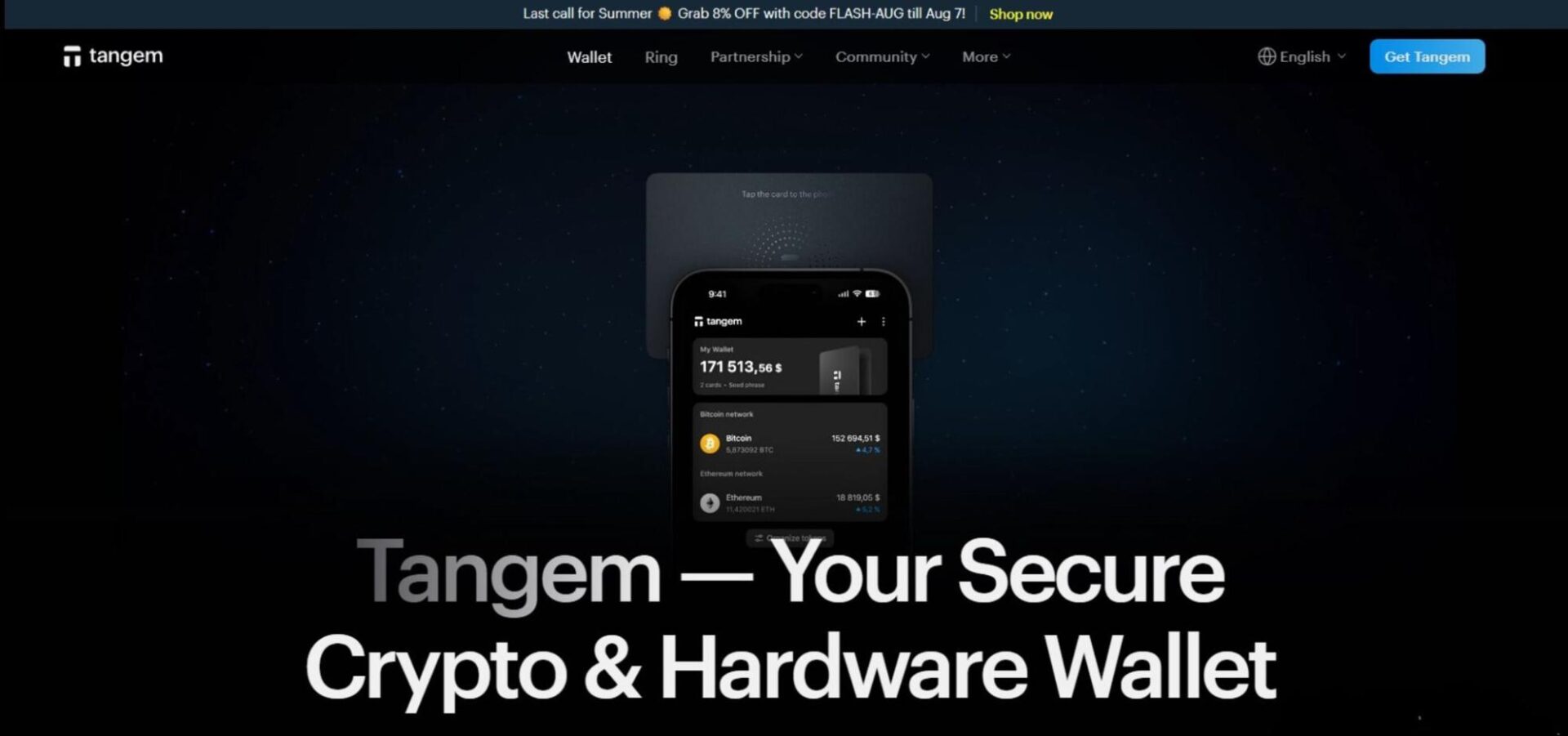 Tangem Wallet is a hardware-based crypto wallet that uses secure NFC cards instead of traditional recovery phrases. Unlike most wallets that require you to write down a 12 or 24-word seed, Tangem stores your private key inside a certified secure element chip embedded in the card.
Tangem is fully self-custodial and does not require KYC, account creation, or personal information. Wallet setup happens entirely offline using the Tangem mobile app, making it appealing to users who want simplicity without sacrificing ownership. While the app itself may have granular control over device-level data, Tangem does not store or associate personal identity with wallet addresses.
The Tangem Wallet also supports thousands of cryptocurrencies across multiple blockchains, including Bitcoin, Ethereum, and major altcoin networks. Swaps are available through integrated third-party providers, though those services apply their own compliance rules depending on jurisdiction.
Tangem Wallet Fees
Tangem Wallet does not charge fees for sending, receiving, or holding cryptocurrencies. Users only pay standard blockchain network fees, which vary by chain and congestion levels, such as higher fees on Ethereum during peak times.
Instead of standard transaction fees, Tangem requires a one-time purchase, and prices vary by pack size and type, including cards and the newer ring option.
Tangem Hardware pricing
- 2-card set: $54.90, includes two identical NFC cards for primary use and backup.
- 3-card set: $69.90, provides three cards for enhanced redundancy.
- Family Pack: This is a multi-user 6-card set for families or teams who want shared or individual wallets. The Family Pack is sold for $139.80.
- Tangem Rings start at around $160 for pre-order, serving as a wearable alternative that can replace a card in a set.
Fees are limited to the one-time hardware purchase and standard blockchain transaction fees. Swap fees vary by provider. Additionally, all packs include a 25-year warranty on the secure chip, with no subscription or maintenance fees.
Key Security Features of Tangem
Tangem Wallet offers robust hardware security through its NFC-enabled cards and rings, with emphasis on seedless private key generation and isolation. Key features include EAL6+ certified secure element chips that keep keys non-extractable and offline.
- Private keys are generated on-device using a hardware random number generator and never leave the chip. This eliminates exposure risks from apps or networks.
- Tamper-resistant: The tamper-resistant design withstands physical attacks, with firmware audited by Kudelski Security (2018) and Riscure (2023), confirming the absence of backdoors or vulnerabilities.
- NFC protocol limits remote attack vectors compared to Bluetooth/USB wallets. Meanwhile, proprietary, non-updatable firmware avoids update-related exploits.
- Additional safeguards: Recent updates add blind signing prevention, dApp risk screening via Blockade, and token approvals visibility.
- Durability and audits: Cards resist dust, water, and impacts, backed by a 25-year warranty. The Tangem app is also open-source, allowing crypto community verification, though the chip firmware remains proprietary for added protection.
Who should use Tangem Wallet?
Tangem is best suited for users who want easy, anonymous cold storage without technical complexity.
2. Trezor
Best for: Open-source hardware wallet users who want full anonymity, transparency, and self-custody.
Trezor is one of the earliest and most trusted hardware wallets in the crypto space. It is known for its open-source philosophy and strong emphasis on user-controlled security. Unlike custodial wallets, Trezor gives users complete ownership of their private keys, which are generated and stored locally on the device and never shared with Trezor or third parties.
Trezor wallets are fully self-custodial and do not require KYC, account registration, or personal information to use. Wallet initialization and onboarding happen offline, and users interact with their funds through Trezor Suite or compatible third-party wallets.
The wallet supports thousands of cryptocurrencies, including Bitcoin, Ethereum, Litecoin, and many ERC-20 tokens. While Trezor does not natively offer swaps or dApps, it integrates seamlessly with external tools such as MetaMask, Electrum, and Sparrow Wallet, allowing users to access DeFi, NFT marketplaces, and advanced Bitcoin privacy setups.
Trezor Wallet Fees
Trezor does not charge fees for storing or managing crypto. Users only pay standard blockchain network fees when making transactions, which vary by network activity. Additionally, there are no subscription costs. The only upfront cost is the hardware device itself.
Trezor Hardware pricing
- Trezor Model One: $49, entry-level option
- Trezor Model T: $129, premium touchscreen device
- Trezor Safe 3 / Safe 5 (Bitcoin-only wallets): Newer models with enhanced secure elements and modern design. The Safe 3 costs $79, while the Safe 5 costs $169 for both the Bitcoin-only wallets and the regular wallets.
Key Security Features of Trezor
Trezor’s security model is built around transparency and user verification rather than closed-source secure elements.
- Open-source firmware and software, allowing public audits
- Offline private key generation and storage
- PIN protection and optional passphrase for hidden wallets
- Shamir Backup (Model T and newer models) to split recovery into multiple parts
- Physical confirmation is required for transactions
Who should use Trezor Wallet?
Trezor is best suited for users who value open-source security, transparency, and long-term cold storage, especially those comfortable pairing hardware with advanced wallet software.
3. Ledger Stax
Best for: Long-term crypto holders managing large, multi-chain portfolios.
Ledger Stax is one of the most popular hardware wallets designed for users who hold a wide range of cryptocurrencies and NFTs. Built on Ledger’s established hardware security model, Ledger Stax keeps private keys isolated within a certified secure element chip, ensuring they never leave the device.
Ledger Stax is self-custodial and does not require KYC to store or transact crypto. However, interaction happens through Ledger Live, which may collect limited analytics data depending on user settings. Importantly, Ledger does not have access to private keys or wallet balances.
The wallet supports over 5,000 cryptocurrencies and tokens across major blockchains, including Bitcoin, Ethereum, Solana, Polygon, and more. Ledger Live includes built-in swaps, staking, and dApp access, though these services rely on third-party providers that may impose their own compliance requirements.
Ledger Stax Fees
Ledger does not charge fees for holding crypto. Users pay standard blockchain network fees for transactions and third-party service fees for swaps or staking. Ledger Stax Hardware pricing is $399 for a premium curved E-Ink touchscreen device.
Key Security Features of Ledger Stax
Ledger Stax focuses on hardware-level isolation and transaction verification.
- CC EAL5+ certified Secure Element chip
- Ledger BOLOS operating system for app isolation
- Offline private key storage
- Physical transaction confirmation on-device
- Clear-signing support to prevent malicious transactions
Who should use Ledger Stax?
Ledger Stax is ideal for users with diverse portfolios who want strong hardware security, modern UX, and broad ecosystem support.
4. Ellipal Wallet
Best for: Air-gapped cold storage with zero physical connectivity.
Ellipal Wallet is designed around complete network isolation. Unlike USB or Bluetooth hardware wallets, Ellipal operates entirely in air-gapped mode, using QR codes to sign transactions. This removes common attack possibilities associated with wired or wireless connections.
Ellipal is fully self-custodial and requires no KYC or account creation. Private keys are generated and stored offline within the device. The companion mobile app is used solely to prepare and broadcast transactions, ensuring the hardware wallet remains disconnected from the internet at all times.
Ellipal supports a wide range of blockchains, including Bitcoin, Ethereum, BNB Chain, Solana, and many ERC-20 and BEP-20 tokens. DeFi and dApp access is available via WalletConnect, relying on third-party protocols.
Ellipal Wallet Fees
Ellipal does not charge fees for storing or managing assets. Users pay standard network fees and any third-party service fees when interacting with swaps or dApps.
Ellipal Hardware pricing
- Ellipal Titan 2.0: $169, offers fully air‑gapped, QR‑based cold storage.
- Ellipal Titan Mini: $79, offering the same offline security in a more compact, budget‑friendly package.
Key Security Features of Ellipal
- Fully air-gapped design (no USB, Bluetooth, Wi-Fi)
- QR-code transaction signing
- Offline private key generation
- Secure metal casing resistant to tampering
- Self-destruct mechanism if physical breach is detected
Who should use the Ellipal Wallet?
Ellipal is best for users who want maximum isolation from online threats and prefer QR-based security over cables or wireless connections.
5. Sparrow Wallet
Best for: Bitcoin users who prioritize privacy, advanced transaction control, and multisig security.
Sparrow Wallet is a desktop-only, non-custodial wallet designed specifically for Bitcoin. It empowers users with complete control over private keys, UTXO management, and transaction construction. This makes it a favourite among privacy-conscious, technically savvy Bitcoin holders.
Sparrow does not require KYC, account creation, or personal information, allowing users to manage their funds anonymously while maintaining full ownership. The wallet supports advanced Bitcoin privacy tools, including CoinJoin integration to mix Bitcoin and improve transaction anonymity, Tor routing to hide IP addresses, and multisignature wallet setups for shared custody or added security.
While Sparrow focuses exclusively on Bitcoin, it offers powerful features like customizable transaction fees, offline signing, and watch-only wallets for monitoring funds without exposing keys. Sparrow Wallet does not have native swap or dApp functionality, but it can integrate with external services for exchanging Bitcoin.
Sparrow Wallet Fees
Sparrow Wallet does not charge fees for holding Bitcoin. Users pay only the standard Bitcoin network fees, which vary with network congestion. Optional CoinJoin sessions may involve additional fees, but these are transparent and entirely under user control.
Key Security Features of Sparrow Wallet
- Non-custodial: Private keys are generated and stored locally.
- Multisig support: Enables wallets with multiple signatures for greater security.
- Cold storage workflows: Supports offline signing and air-gapped setups.
- Privacy enhancements: Tor routing, CoinJoin for anonymized transactions, and full UTXO control.
- Auditability: Detailed transaction review and fee customization for maximum transparency.
Who Should Use Sparrow Wallet?
Sparrow Wallet is best suited for Bitcoin users who value privacy and control. It is ideal for long-term holders who want to secure large balances, traders managing complex Bitcoin transactions, and anyone interested in leveraging advanced privacy tools without sacrificing self-custody.
6. Wasabi Wallet
Best for: Bitcoin users seeking on-chain transaction privacy.
Wasabi Wallet is one of the best anonymous Bitcoin wallets known for implementing CoinJoin for privacy. It allows users to mix their Bitcoin with others, making it significantly harder to trace transaction history on the blockchain.
Wasabi is non-custodial, requires no KYC, and runs over Tor by default. While it is highly effective for privacy, CoinJoin transactions involve additional fees and require patience, making it better suited for advanced users. The wallet supports Bitcoin only and does not offer swaps or dApp integrations.
Wasabi Wallet Fees
Users pay standard Bitcoin network fees and CoinJoin coordination fees when using privacy features.
Key Security Features of Wasabi
Wasabi prioritizes transaction-level anonymity.
- Built-in privacy tools (CoinJoin)
- Tor routing by default
- Non-custodial private key control
- Network and blockchain privacy protections
Who should use Wasabi Wallet?
Wasabi is ideal for users who prioritize Bitcoin anonymity over convenience or multi-chain support.
7. Electrum Wallet
Best for: Lightweight Bitcoin wallet with advanced customization.
Electrum Wallet is a veteran in the Bitcoin space, known for its lightweight desktop software that offers speed, flexibility, and advanced functionality. It is fully non-custodial and does not require KYC or personal information. Electrum is compatible with Windows, macOS, Linux, and Android and integrates with hardware wallets like Trezor, Ledger, and Coldcard for enhanced security.
The wallet focuses exclusively on Bitcoin, supporting complex transactions such as multisignature setups, offline signing, and custom fee settings. Privacy-conscious users can route connections through Tor to obfuscate IP addresses and maintain transaction anonymity.
While Electrum does not offer built-in swaps or dApps, it allows advanced users to construct raw transactions, import/export wallets, and customize network connections.
Electrum Wallet Fees
Electrum does not charge any fees for storing or receiving Bitcoin. Users pay only network transaction fees, which vary based on the desired confirmation speed. Using hardware wallets with Electrum does not incur additional fees beyond network costs.
Key Security Features of Electrum Wallet
- Non-custodial private key storage: Keys remain on your device at all times.
- Hardware wallet integration: Supports Trezor, Ledger, and Coldcard for offline key security.
- Multisig support: Enables shared custody wallets and advanced setups.
- Offline signing and watch-only wallets keep funds safe from network exposure.
- Tor routing and server choice: Protects user IP addresses and reduces tracking.
- Custom transaction management: Full control over fees, inputs, and outputs.
Who Should Use Electrum Wallet?
Electrum Wallet is ideal for advanced Bitcoin users, including traders, long-term holders, and anyone requiring multisig or offline signing. It is ideal for investors who are comfortable with technical interfaces and who want control over every aspect of their transactions.
8. Nunchuk Wallet
Best for: Bitcoin multisig and shared custody setups.
Nunchuk is the best anonymous Bitcoin wallet for multisignature security. It allows users to require multiple keys or devices to approve transactions, reducing single points of failure. The wallet is self-custodial and does not require KYC for basic use, though optional assisted-custody services may involve identity verification. Nunchuk integrates with major hardware wallets and supports offline signing.
Nunchuk Wallet Fees
Basic self-custody usage is free. Users pay Bitcoin network fees and optional service fees for premium features.
Key Security Features of Nunchuk
Nunchuk focuses on collaborative and institutional-grade security.
- Native multisignature support
- Hardware wallet integration
- Offline signing workflows
- Distributed key management
Who should use the Nunchuk Wallet?
Nunchuk is best for long-term Bitcoin holders, families, and organizations using multisig security.
9. Exodus Wallet
Best for: Private, beginner-friendly wallet with built-in swaps and portfolio management.
Exodus Wallet is a non-custodial software wallet designed to make crypto ownership accessible without requiring accounts, KYC, or identity verification. From the moment of setup, users retain full control over their private keys, which are generated and stored locally on their devices rather than on Exodus servers.
The wallet is available on desktop (Windows, macOS, Linux) and mobile (iOS, Android), with seamless syncing across devices. While Exodus does not require personal information to create or use a wallet, it collects limited anonymised usage data to improve app performance.
Exodus supports hundreds of cryptocurrencies across major blockchains, including Bitcoin, Ethereum, Solana, Polygon, BNB Chain, Avalanche, Tron, and many others. One of Exodus’s standout features is its built-in exchange functionality, which allows users to swap crypto assets directly within the wallet.
Beyond swaps, Exodus offers staking services for select assets and real-time portfolio management tools to track transactions. It also supports NFTs on approved chains, and a built-in Web3 browser on mobile for accessing dApps. You can learn more about this privacy wallet in this full Exodus Wallet review to see how it provides a balance between usability and self-custody.
Exodus Wallet Fees
Exodus does not charge fees for creating or maintaining a wallet. Users only pay standard blockchain network fees when sending transactions.
For built-in swaps and staking, fees are included in the exchange rate provided by third-party partners rather than displayed as a separate line item. These fees can be higher than using decentralized exchanges directly, reflecting the convenience and aggregation service Exodus provides.
Key Security Features of Exodus
Exodus focuses on local device security and ease of use rather than advanced on-chain privacy tools.
- Non-custodial architecture with locally stored private keys
- AES-256 encryption of wallet data on the user’s device
- Password-protected access and automatic lock features
- Secure backup and recovery using a standard 12-word recovery phrase
- Hardware wallet integration with Trezor for cold storage security
While Exodus is not fully open-source, it publishes portions of its codebase and maintains regular security updates.
Who should use Exodus Wallet?
Exodus is best suited for users who want private, no-KYC access to multiple blockchains, built-in swaps, and a smooth user experience.
10. Atomic Wallet
Best for: Anonymous, all-in-one crypto management with swaps, staking, and broad asset support.
Atomic Wallet is a non-custodial software wallet that allows users to store, exchange, and stake cryptocurrencies without creating an account or completing KYC. Private keys are generated locally and encrypted on the user’s device, ensuring that Atomic Wallet does not have access to your funds.
The wallet is available on desktop and mobile platforms, making it accessible for users who want a single interface for managing a wide range of crypto assets. The platform does not require personal details such as name, email, or ID to function, making it ideal for privacy-conscious users.
Atomic Wallet supports hundreds of cryptocurrencies and tokens across multiple networks, including Bitcoin, Ethereum, Litecoin, XRP, BNB Chain, Polygon, and many others. One of its core features is built-in atomic swaps and instant exchanges, which allow users to trade assets directly within the wallet using integrated third-party services.
In addition to swaps, Atomic Wallet offers staking for several supported assets, enabling users to earn passive income without transferring funds to custodial platforms. The wallet also includes token management tools, portfolio tracking, and price monitoring.
Atomic Wallet Fees
Atomic Wallet does not charge fees for holding or receiving crypto. Users pay standard fees on the blockchain network for transactions. For swaps and staking, Atomic Wallet earns a commission embedded within the exchange rate or staking reward structure, alongside third-party service fees. These costs vary depending on the asset and network conditions.
Key Security Features of Atomic Wallet
Atomic Wallet focuses on encrypted local control rather than hardware-level isolation.
- Non-custodial private key ownership
- Strong encryption for locally stored wallet data
- Backup and recovery using a 12-word seed phrase
- Password-based wallet access
- No centralized storage of keys or user data
While Atomic Wallet emphasizes convenience, it is still a hot wallet, meaning security largely depends on your device, operating system, and overall security measures.
Who should use the Atomic Wallet?
Atomic Wallet is best for users who want anonymous access to a wide range of cryptocurrencies, along with built-in swaps and staking, without registering accounts or relying on centralized exchanges.
What Is An Anonymous Crypto Wallet?
An anonymous crypto wallet is a self-custodial wallet designed to minimize personal data exposure. These platforms allow users to store, send, and receive cryptocurrencies without linking their identities to their wallets.
Unlike custodial platforms or KYC exchanges, anonymous cryptocurrency wallets do not require users to submit personal details, such as names, email addresses, phone numbers, or government-issued IDs, to function.
These crypto wallets give you direct ownership of your private keys, meaning only the wallet holder controls access to the funds. Transactions occur directly on the blockchain, without an intermediary holding custody or enforcing identity checks at the wallet level.
How Anonymous Crypto Wallets Differ From Normal Crypto Wallets
The main difference between privacy crypto wallets and “normal” crypto wallets is in custody, data collection, and identity requirements.
A normal crypto wallet, especially those offered by centralized exchanges, is often custodial. This means the platform holds the user’s private keys on its behalf. To access these wallets, you must complete Know Your Customer (KYC) verification, providing personal and sometimes biometric data. Transactions may also be monitored, restricted, or frozen in accordance with compliance rules.
On the other hand, anonymous crypto wallets are non-custodial. The user controls the private keys directly, and no identity verification is required to create or use the wallet. Additionally, there is no central authority capable of freezing funds, reversing transactions, or linking wallet activity to a verified identity.
In terms of data handling, normal wallets (KYC exchanges and protocols) may collect emails, IP addresses, device fingerprints, and usage analytics tied to user accounts. Anonymous cryptocurrency wallets either collect no data at all or limit data collection to non-identifiable technical metrics that are not linked to wallet ownership.
Key Differences Between Anonymous and Normal Crypto Wallets
| Feature | Anonymous Crypto Wallets | Normal Crypto Wallets |
| Custody | Self-custodial. Users fully control their private keys and funds. | Often custodial, especially exchange wallets, where the platform holds the keys. |
| KYC and Identity Requirements | No KYC or account registration required to create or use the wallet. | Usually requires KYC, including personal and government-issued identification. |
| Data Collection | Minimal to none; no personal data linked to wallet addresses. | Collects personal data, including email, phone number, IP address, and usage history. |
| Control Over Funds | Full control with no third-party ability to freeze or restrict assets. | Platforms may freeze, limit, or reverse access under compliance rules. |
| Privacy Level | Higher privacy by removing identity-to-wallet linkage. | Lower privacy due to identity-linked accounts and monitoring. |
| Transaction Visibility | Transactions are public on-chain, but not tied to a verified identity. | Transactions may be linked to verified user profiles and activity logs. |
| Security Model | Security depends on user-controlled keys, hardware wallets, or local encryption. | Security depends on platform infrastructure and internal controls. |
| Regulatory Control | No direct oversight at the wallet level. | Direct regulatory and compliance oversight by service providers. |
| Ideal Use Case | Users prioritizing privacy, self-sovereignty, and censorship resistance. | Users prioritizing convenience, fiat access, and customer support. |
How to Choose the Best Anonymous Wallet
Below are the key criteria to consider when choosing an anonymous cryptocurrency wallet, followed by wallet recommendations for different user profiles.
- No-KYC and Identity Requirements: The most important factor is whether the wallet requires identity verification. A privacy wallet provider allows you to create and use a wallet without submitting personal details. While many non-custodial wallets meet this standard, some still require account creation for certain features, so it’s important to check how far the no-KYC policy actually goes.
- Non-Custodial Ownership: A wallet is only private if you control the private keys. Non-custodial wallets store keys locally on your device or hardware wallet, not on centralized servers. This removes the risk of third-party freezes, censorship, or account shutdowns and ensures that wallet access isn’t tied to an external account.
- Security: Security varies widely between wallets. Hardware wallets provide the strongest protection by keeping private keys offline, while software wallets rely on device-level security. Look for features such as secure element chips, offline signing, PIN or password protection, and physical transaction confirmation.
- Supported Assets and Blockchains: Not all anonymous wallets support the same crypto assets. Some wallets focus exclusively on Bitcoin, while others support thousands of tokens across multiple blockchains. Your choice should reflect whether you need simple Bitcoin storage, access to DeFi ecosystems, NFT support, or multi-chain asset management.
- Privacy Tools and Network Protection: Some wallets go beyond basic anonymity by including privacy-enhancing tools. These may include Tor support for IP address hiding, coin control to manage transaction outputs, CoinJoin for Bitcoin mixing, or air-gapped transaction signing.
- Backup and Recovery Options: Traditional wallets use 12 or 24-word recovery phrases, while newer wallets may offer seedless designs, multisignature recovery, or split backups. The right recovery model should match your technical comfort level and risk tolerance.
- Fees and Cost Structure: Anonymous cryptocurrency wallets do not charge account fees, but costs still exist. Hardware wallets require an upfront purchase. Meanwhile, software wallets embed fees into swaps or staking services. You should also consider blockchain network fees, which vary by asset and congestion levels.
- Ease of Use vs. Control: There is often a trade-off between usability and control. Beginner-friendly wallets prioritize clean interfaces and automated features, while advanced wallets expose detailed controls over transactions and privacy. The best wallet is one you can use confidently without making costly mistakes.
Here are some wallet recommendations based on user profiles:
- Beginners New to Crypto: Beginners should prioritize simplicity, safety, and minimal setup. Wallets that remove seed phrase complexity or provide guided interfaces reduce the risk of user error. Some recommended wallets for beginners are Tangem Wallet for seedless cold storage and Exodus Wallet for easy multi-chain access.
- Long-Term Holders (HODLers): Long-term holders benefit most from cold storage and strong recovery options. Hardware wallets are ideal here, especially for users holding large balances. Some recommended wallet options for long-term holders are Trezor Wallet for open-source transparency, Ledger Stax for large, diverse portfolios, and Ellipal Wallet for air-gapped security.
- Privacy-Focused Bitcoin Users: Bitcoin users who care deeply about transaction privacy should use wallets with advanced privacy tooling rather than general-purpose wallets. Some recommended wallet options for privacy-focused users include Wasabi Wallet for CoinJoin privacy, Sparrow Wallet for full UTXO control, and Electrum Wallet with Tor and hardware integration.
- Active Traders and DeFi Users: Users who frequently swap tokens, interact with dApps, or manage multiple chains need convenience without full custodial exposure. Recommended wallet options for Exodus Wallet for built-in swaps and staking, and Atomic Wallet for all-in-one trading and staking.
- Multisig and Shared Custody Users: Families, teams, businesses, and DAOs benefit from wallets that support multisignature setups and shared control. Recommended wallet options for multi-sig and shared custody users: Nunchuk Wallet for Bitcoin multisig setups and Tangem Wallet Family Pack for shared or individual setups.
Are Anonymous Crypto Wallets Reliable?
Anonymous/privacy wallets can be highly reliable and secure, but their security depends more on the user than on the wallet provider. Unlike custodial wallets or exchanges that manage security on behalf of users, anonymous wallets operate on a self-custody model. This means you control your private keys, but you also assume full responsibility for protecting them.
When used correctly, reputable anonymous wallets offer strong security through encryption, offline key storage, and privacy-focused designs. However, because there is no central authority to reverse transactions or recover lost access, mistakes and security lapses can result in permanent loss of funds.
Common Risks of Using Wallets Anonymously
The common risks associated with anonymous cryptocurrency wallets are explained below:
- Phishing attacks remain one of the most common threats. Attackers often create fake wallet websites, browser extensions, or emails designed to trick users into entering recovery phrases or approving malicious transactions. Once a seed phrase is compromised, funds can be withdrawn instantly.
- Malware and keyloggers pose another major risk, especially for software wallets. Compromised devices can capture passwords, clipboard data, or keystrokes, giving attackers access to wallet credentials or private keys.
- Seed phrase loss: If a recovery phrase is lost, destroyed, or exposed, there is no way to recover the wallet. Seedless wallets reduce this risk but introduce other trade-offs that users must understand.
- Fake apps and clones are particularly dangerous on mobile app stores. Some malicious apps closely mimic legitimate wallets and are designed solely to steal private keys upon setup.
- Device compromise: Stolen phones, hacked computers, or unsecured cloud backups can expose wallet data if proper encryption and access controls are not in place.
Safety Checklist for Using Privacy Wallets
To reduce risk and improve reliability, follow this strict security checklist:
- Use a hardware wallet for large amounts: Hardware wallets keep private keys offline and protected from malware. For long-term storage or high-value holdings, this is one of the most effective security measures.
- Always verify URLs and app sources: Download wallets only from official websites or verified app store listings. Double-check domain names and avoid links from emails, ads, or social media.
- Protect your recovery phrase properly: Store seed phrases offline, never digitally or in cloud storage. Consider using multisignature setups for added safety.
- Use strong passwords, device encryption, and biometric locks where available. Keep operating systems and wallet software up to date to patch vulnerabilities.
- Always review transaction details before approving them, especially when interacting with dApps.
How to Use An Anonymous Crypto Wallet Safely
Below is a clear, practical step-by-step guide to help users protect their funds while maintaining privacy.
Step 1: Choose the right wallet for your use case
Before setting anything up, decide whether you need a hot wallet (software-based) or a cold wallet (hardware-based). Hot wallets are suitable for daily transactions and smaller balances, while cold crypto wallets are better for long-term storage and larger amounts. You can also combine both, using a hot wallet for spending and a hardware wallet for savings.
Step 2: Download or buy a hardware wallet only from official sources
Download the wallet on the Play or App Stores or visit the provider’s official website to open a new wallet or connect an existing one. For hardware wallets, buy directly from the manufacturer or authorized resellers to avoid tampered devices.
Step 3: Set up the wallet
During setup, ensure you are on a secure, private network. For hardware wallets, initialization should happen offline by default. For software wallets, generate your private keys or recovery phrase and store them in a secure place.
Step 4: Lock down device and wallet access
Protect your wallet with a strong password, PIN, or biometric lock. Ensure your phone or computer uses full-disk encryption and automatic locking. Keep your operating system and wallet software up to date to reduce exposure to known vulnerabilities.
Step 5: Test with a small transaction first
Before moving large amounts of crypto, always send a small test transaction. This confirms that the wallet is set up correctly, and once you confirm, proceed with larger transfers.
Final Thoughts: What is the Best Anonymous Crypto Wallet in 2025?
When it comes to anonymous crypto wallets in 2025, Trezor Wallet stands out as the top pick. It combines strong self-custody, offline key storage, multi-chain support, and open-source security, giving users control and privacy without KYC requirements.
However, depending on your needs, other wallets may be better suited. Wasabi Wallet for Bitcoin users prioritizing maximum transaction privacy, Exodus Wallet for beginners or multi-chain users who want built-in swaps, and Atomic Wallet for traders seeking all-in-one asset management and staking.
For long-term storage of larger balances, Ledger Stax or Ellipal Wallet will be more suitable since they offer hardware-level isolation and air-gapped security. Above all, it’s important to remember that anonymity in crypto is a spectrum. No wallet alone guarantees complete privacy because blockchains are transparent, and activity can still be analyzed.
Therefore, the safest approach combines privacy-focused tools with disciplined habits. Some of these habits include securing your recovery phrases offline, using trusted networks, and separating spending wallets from long-term holdings.
The post Best Anonymous Crypto Wallets in 2026: Top Picks for Maximum Privacy appeared first on CryptoNinjas.


You May Also Like

Lazarus Group Targets Crypto Investors on Telegram With Stealthy Malware

New Zealand Dollar declines due to increasing risk aversion

SEC Halts Innovation Exemption For Tokenized Stocks



