

Ethereum To Hit $15,000 In 2026 As ‘Wall Street’s Default Chain’: Vivek Raman
Ethereum could reprice to $15,000 in 2026 as traditional finance accelerates into tokenization, stablecoins, and bespoke Layer 2 blockchains built on Ethereum, according to Vivek Raman, CEO and co-founder of Etherealize.
In a Jan. 5 guest post, Raman framed 2026 as the point where ETH shifts from a decade-long credibility build to a commercial deployment era, arguing that “from 2026 onward – Ethereum will become the best place to do business,” as regulatory posture, institutional precedent, and infrastructure maturity converge.
Institutions Will Tokenize On Ethereum
Raman’s core claim is that tokenization is moving from proof-of-concept into scaled product deployment, with Ethereum increasingly serving as the base layer institutions choose when the assets are high value and the operational requirements are strict. He describes tokenization as a business-process upgrade that collapses assets, data, and payments onto shared infrastructure, and he leaned heavily on the idea that once institutions experience the efficiencies, they will not revert.
“Tokenization upgrades entire business processes by digitizing assets, data, and payments onto the same infrastructure,” Raman wrote. “Assets (like stocks, bonds, real estate) and money will be able to move at the speed of the Internet. This is an obvious upgrade to the financial system that should have happened decades ago; public global blockchains like Ethereum enable this today.”
The post cites examples of institutional tokenization activity on Ethereum, including money market fund initiatives from JPMorgan and Fidelity, BlackRock’s tokenized fund BUIDL, Apollo’s private credit fund ACRED (with liquidity concentrated on Ethereum and its L2s), and European participation such as Amundi tokenizing a euro-denominated money market fund. Raman also pointed to tokenized products from BNY Mellon and a planned tokenized bond fund tied to Baillie Gifford that would span Ethereum and an L2 network.
Stablecoins As The “Green Light” Moment
Raman positioned stablecoins as the clearest product-market fit for onchain finance, citing “$10T+ in stablecoin transfer volumes in 2025” and claiming that “60% of all stablecoins are on Ethereum and its Layer 2 networks.” He argued that regulatory developments in the US have de-risked deployment for institutions, describing the passage of the GENIUS Act in 2025 as the moment public-chain stablecoin rails effectively received formal clearance.
As a near-term datapoint, Raman highlighted SoFi’s reported launch of a bank-issued stablecoin, SoFiUSD, on a “public, permissionless blockchain,” adding that the bank chose Ethereum. He suggested this is the start of a broader wave where investment banks, neobanks, and fintechs explore stablecoin issuance—either solo or via consortium structures—inside a single public-chain ecosystem to maximize network effects.
Layer 2s As The Institutional Business ModelA major part of Raman’s thesis hinges on the idea that institutions will not converge on a single chain, but will converge on a single interconnected network, Ethereum plus its Layer 2 ecosystem. He argued that L2s provide customization by jurisdiction and customer base while inheriting Ethereum’s security and liquidity, and he described L2 economics as unusually attractive for operators, citing “90+% profit margins” as a reason businesses will want their own chains.
Raman listed examples including Coinbase’s Base, Robinhood’s plans for an Ethereum L2 featuring tokenized stocks and other assets, SWIFT’s use of the Ethereum L2 Linea for settlements, JPMorgan deploying tokenized deposits on Base, and Deutsche Bank building a public, permissioned network as an Ethereum L2.
The $15,000 Ethereum Price TargetRaman also argued ETH is emerging as an institutional treasury asset alongside bitcoin, describing BTC as “digital gold” and ETH as “digital oil”, a productive store of value tied to ecosystem economic activity.
He pointed to four public-company “MicroStrategy-equivalents” accumulating ETH: BitMine Immersion (BMNR), Sharplink Gaming (SBET), The Ether Machine (ETHM), and Bit Digital (BTBT) and claimed they have collectively purchased roughly 4.5% of ETH supply in the last six months, comparing that to MicroStrategy’s 3.2% of BTC ownership.
Those dynamics underpin his 2026 “5x” forecast set: tokenized assets rising to nearly $100 billion (from an estimated $18 billion after growing from ~$6 billion in 2025, with “66%…on Ethereum and its L2s”), stablecoin market cap expanding to $1.5 trillion (from $308 billion), and ETH appreciating 5x to $15,000—an implied $2 trillion market cap in his framing.
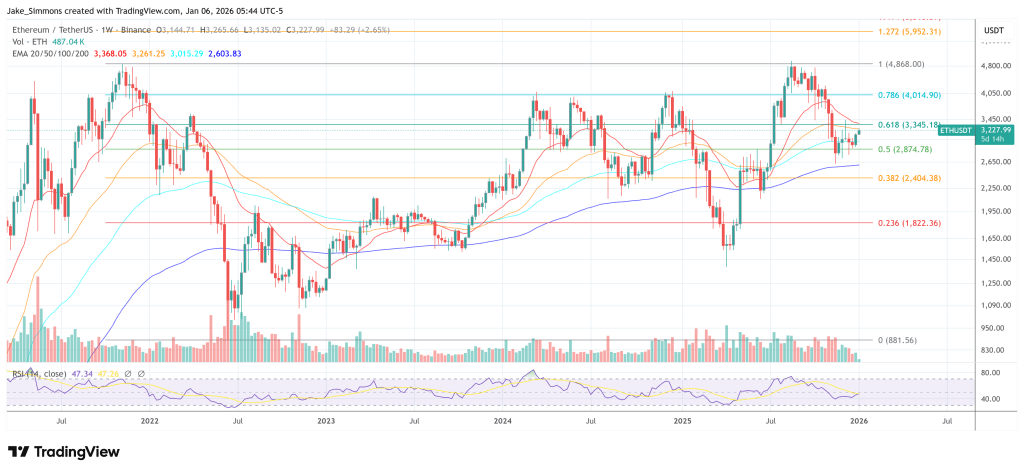
At press time, ETH traded at $3,227.


You May Also Like

Algorand quietly beat Bitcoin and Ethereum due to quantum risks

Bitcoin is now front-running the Fed rather than reacting to it. ETFs are the cause




