The Solana network is still demonstrating notable activity and performance in a volatile market state, with its price facing sideways movements. With a recent uptickThe Solana network is still demonstrating notable activity and performance in a volatile market state, with its price facing sideways movements. With a recent uptick

Solana On-Chain Liquidity Leadership Widens As DEX Volume Stays Robust Across The Network

2026/01/09 21:30
3 min read
For feedback or concerns regarding this content, please contact us at crypto.news@mexc.com

The Solana network is still demonstrating notable activity and performance in a volatile market state, with its price facing sideways movements. With a recent uptick in user participation and demand, the SOL network remains a dominant force in the blockchain sector, ramping up substantial DEX volume over the past few weeks.

Resilient DEX Volume Keeps Solana At The Top

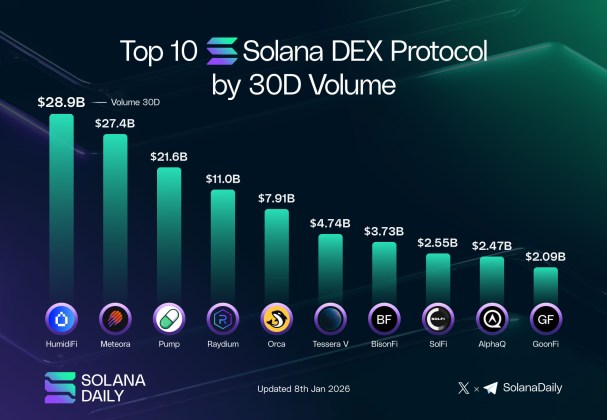
As the cryptocurrency market cools, the Solana network is showing signs of strength. This strength is seen in the network’s on-chain liquidity, which appears to be leading the charge across the dynamic blockchain sector. Solana Daily’s post reveals that Solana’s position at the forefront of on-chain liquidity keeps growing, with Decentralized Exchange (DEX) activity on the network exhibiting notable resilience despite broader market conditions fluctuating.

The chart from Solana Daily shows that the network is processing $6.7 billion in DEX volume. Interestingly, this figure surpasses that of all other layer 1 and layer 2 solutions, reflecting SOL’s strong trading volumes, deep liquidity pools, and sustained user engagement. 
Solana

As SOL improves in these areas, it expands its lead over competing layer 1 and layer 2 ecosystems. With active market makers, robust DeFi protocols, and high transaction throughput, the network’s liquidity infrastructure seems to be maturing rather than withering after previous spikes in activity.

Another notable development highlighted by Solana Daily is the rise in SOL’s derivatives market as open interest broadens. At the time of the report, the altcoin’s open interest had reached a staggering $3.35 billion, indicating a fresh wave of trader engagement and risk-taking around the asset.

Increasing open interest usually indicates a new capital inflow into futures and perpetual markets, and in SOL’s case, it coincides with growing on-chain activity and a resurgence of speculative activity. 

A Milestone In On-Chain Performance Into 2026

In another X post, Solana Daily reported that the SOL network closed 2025 with record on-chain performance, reflecting steady growth in real economic activity across applications, liquidity, and users. Traders, developers, and capital are not just testing Solana. They seem to be committing to the network, cementing its position as one of the most active centers in the cryptocurrency field.

This rise in on-chain performance underscores strong revenue metrics, increasing stablecoin supply, and growing institutional participation, which outline an evolving ecosystem heading into the next cycle. As the network further advances into 2026, narratives about Real World Assets (RWAs), payments, AI-native finance, and privacy infrastructure are beginning to emerge throughout the robust ecosystem.

SOL is slowly becoming an on-chain finance prodigy, which is indicated by the surge in stablecoin supply on the network. The Kobeissi Letter has outlined SOL’s stablecoin growth following a supply spike of over +$900 million in 24 hours. 

According to the leading commentary, this is a result of Jupiter, the world’s largest on-chain platform, launching its on-chain focused stablecoin. During the period, Morgan Stanley also filed for a Spot Solana Exchange-Traded Fund (ETF). These moves point to a resurgence in crypto flows.


Solana
Disclaimer: The articles reposted on this site are sourced from public platforms and are provided for informational purposes only. They do not necessarily reflect the views of MEXC. All rights remain with the original authors. If you believe any content infringes on third-party rights, please contact crypto.news@mexc.com for removal. MEXC makes no guarantees regarding the accuracy, completeness, or timeliness of the content and is not responsible for any actions taken based on the information provided. The content does not constitute financial, legal, or other professional advice, nor should it be considered a recommendation or endorsement by MEXC.

You May Also Like

Zcash is Predicted to Reach $215.89 By Mar 12, 2026

Zcash is Predicted to Reach $215.89 By Mar 12, 2026

The post Zcash is Predicted to Reach $215.89 By Mar 12, 2026 appeared on BitcoinEthereumNews.com. Disclaimer: This is not investment advice. The information provided
Share
BitcoinEthereumNews2026/03/08 08:09
Why Is Crypto Down in 2026? Binance Leverage Hits Exhaustion Lows as Pepeto Lines Up a Moonshot

Why Is Crypto Down in 2026? Binance Leverage Hits Exhaustion Lows as Pepeto Lines Up a Moonshot

Here is something the fear headlines are not telling you. The Binance estimated leverage ratio dropped to 0.146 in early March 2026, its lowest reading since April
Share
Techbullion2026/03/08 08:18
Headwind Helps Best Wallet Token

Headwind Helps Best Wallet Token

The post Headwind Helps Best Wallet Token appeared on BitcoinEthereumNews.com. Google has announced the launch of a new open-source protocol called Agent Payments Protocol (AP2) in partnership with Coinbase, the Ethereum Foundation, and 60 other organizations. This allows AI agents to make payments on behalf of users using various methods such as real-time bank transfers, credit and debit cards, and, most importantly, stablecoins. Let’s explore in detail what this could mean for the broader cryptocurrency markets, and also highlight a presale crypto (Best Wallet Token) that could explode as a result of this development. Google’s Push for Stablecoins Agent Payments Protocol (AP2) uses digital contracts known as ‘Intent Mandates’ and ‘Verifiable Credentials’ to ensure that AI agents undertake only those payments authorized by the user. Mandates, by the way, are cryptographically signed, tamper-proof digital contracts that act as verifiable proof of a user’s instruction. For example, let’s say you instruct an AI agent to never spend more than $200 in a single transaction. This instruction is written into an Intent Mandate, which serves as a digital contract. Now, whenever the AI agent tries to make a payment, it must present this mandate as proof of authorization, which will then be verified via the AP2 protocol. Alongside this, Google has also launched the A2A x402 extension to accelerate support for the Web3 ecosystem. This production-ready solution enables agent-based crypto payments and will help reshape the growth of cryptocurrency integration within the AP2 protocol. Google’s inclusion of stablecoins in AP2 is a massive vote of confidence in dollar-pegged cryptocurrencies and a huge step toward making them a mainstream payment option. This widens stablecoin usage beyond trading and speculation, positioning them at the center of the consumption economy. The recent enactment of the GENIUS Act in the U.S. gives stablecoins more structure and legal support. Imagine paying for things like data crawls, per-task…
Share
BitcoinEthereumNews2025/09/18 01:27



