

The Valuation Case for LiquidChain ($LIQUID): Why a $1 Price Level Is Not Out of Reach In the 2026 Bull Run

The crypto market is crowded with new launches, isn’t it?. At any given moment, there are dozens of crypto presales competing for attention, each promising innovation, adoption, and upside. History shows, however, that only a small number of these projects actually deliver when the market turns bullish.
The ones that succeed usually share a few common traits: they solve a real problem, they sit at the infrastructure level, and they launch before that problem becomes obvious to the wider market.
That is why LiquidChain ($LIQUID) is starting to stand out. Positioned as a Layer-3 network focused on unifying liquidity across Bitcoin, Ethereum, and Solana, LiquidChain aligns closely with where crypto usage is already heading. The project is currently priced at just $0.013 in its presale phase and has already raised over $360,000.
As we head deeper into 2026, many investors are rethinking what the best crypto to buy now actually looks like. Increasingly, the answer points toward infrastructure rather than short-term narratives. LiquidChain fits that profile.
How LiquidChain Works and Why Liquidity Is the Key Variable
LiquidChain is built to address one of crypto’s most persistent inefficiencies: fragmented liquidity. While users routinely interact with multiple chains, capital remains trapped in isolated ecosystems, relying on bridges, wrapped assets, and complex workflows to move between them.

Instead of introducing another standalone blockchain, LiquidChain operates above existing networks. It coordinates execution and liquidity through a unified layer that can reference and verify external chain states directly. Bitcoin UTXOs, Ethereum smart contracts, and Solana accounts are all accessible within LiquidChain’s execution environment without forcing users to manually migrate assets.
This allows liquidity to behave as if it were part of a single system. For traders, this means faster execution and deeper liquidity. For developers, it means deploying once and reaching users across multiple ecosystems. For the broader market, it means infrastructure that finally matches how crypto is actually being used.
As multi-chain activity continues to grow, protocols that reduce friction at this level tend to capture outsized value. This role is a major reason LiquidChain is discussed among altcoins to buy ahead of the next cycle.
$LIQUID Price Prediction: Why $1 Is a Realistic 2026 Scenario
At first glance, a move from $0.013 to $1 may seem ambitious. In practice, this type of expansion is not unusual for early-stage infrastructure tokens when adoption and narrative align. A $1 price level would imply a meaningful increase in market capitalization, but not an unrealistic one given the scale of liquidity flowing across chains today.
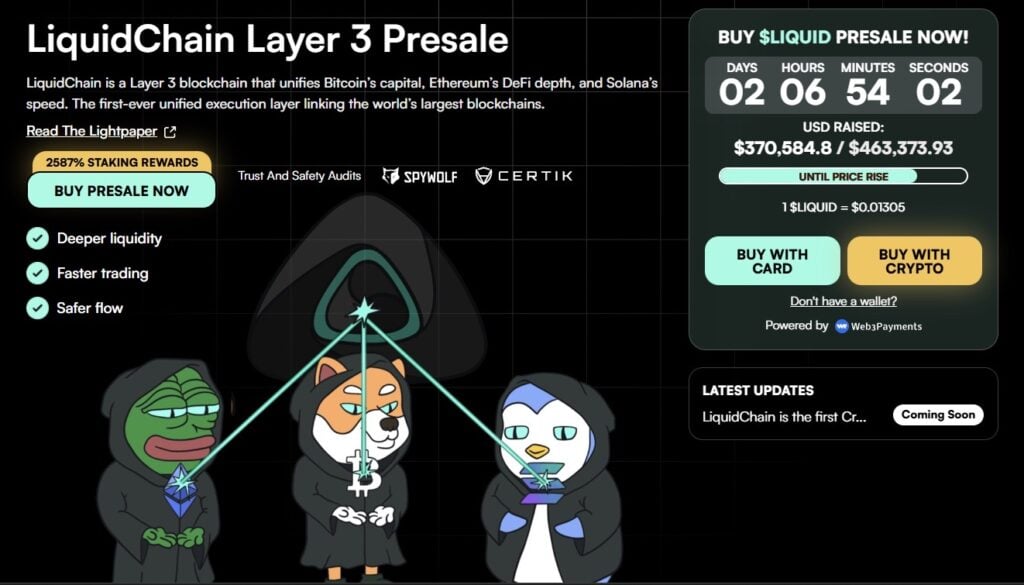
LiquidChain’s token utility plays a central role in this scenario. The $LIQUID token is used for transaction fees, governance, and staking, making it integral to network participation rather than a passive asset. As network usage grows, demand for the token grows with it.
Staking adds another layer to the equation. Incentives encourage early participation and reduce circulating supply with the current APY for staking. As more tokens are locked, sell pressure decreases while network commitment increases. This has historically supported price appreciation for infrastructure-focused projects during bull markets.
Combined with growing cross-chain demand, expanding staking participation, and early presale positioning, a $1 price level in 2026 becomes a scenario that many consider achievable rather than speculative. This is especially true if LiquidChain succeeds in becoming a core coordination layer for liquidity.
Why $LIQUID Is Emerging as One of the Best Crypto Presales
Timing often matters more than perfection. LiquidChain’s crypto presale phase offers exposure at a price point that reflects early risk, not mature adoption. With $LIQUID still available at $0.013, and the next price increase expected in the coming days, the current window is increasingly viewed as a short one.
Infrastructure projects tend to be ignored early and chased later. As liquidity fragmentation becomes more visible across DeFi, trading, and on-chain settlement, solutions operating at the coordination layer gain relevance quickly. LiquidChain is positioning itself directly in that path.
For those chasing the best crypto to buy now, LiquidChain combines early-stage pricing, real utility, staking incentives, and a problem that affects the entire market. Among current altcoins to buy, few sit as close to the core of multi-chain activity.
With the presale price still at $0.013 and momentum building, LiquidChain is entering a phase where early conviction may matter most. If adoption follows infrastructure demand in 2026, $LIQUID’s current valuation could look increasingly disconnected from where the market ultimately prices unified liquidity.
Explore LiquidChain and its ongoing crypto presale:
Presale: https://liquidchain.com/
Social: https://x.com/getliquidchain
Whitepaper: https://liquidchain.com/whitepaper
This article has been provided by one of our commercial partners and does not reflect Cryptonomist’s opinion. Please be aware our commercial partners may use affiliate programs to generate revenues through the links on this article.


You May Also Like

Schwab to launch spot Bitcoin and Ethereum trading in early 2026

'I'm sorry, what?' White House faith advisor stuns with gaffe about Trump at Sunday school




