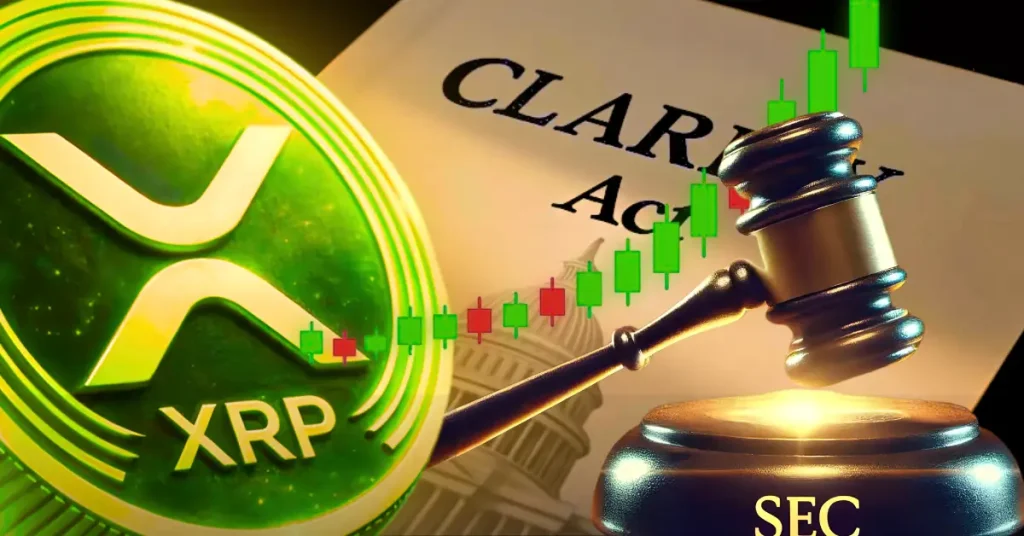
Congress is back to pushing a market structure bill that could finally decide how crypto will work in the U.S. After stalling last year, the legislation is aliveCongress is back to pushing a market structure bill that could finally decide how crypto will work in the U.S. After stalling last year, the legislation is alive

Congress is reviving a major crypto bill to set clear rules for digital assets in the U.S.

2026/01/12 01:40
4 min read
For feedback or concerns regarding this content, please contact us at crypto.news@mexc.com

Congress is back to pushing a market structure bill that could finally decide how crypto will work in the U.S. After stalling last year, the legislation is alive again.

Hearings are set for Thursday, and the Senate Agriculture and Banking Committees will review and possibly revise their own sections. If they pull this off, it could set the first real legal rules for crypto in the country.

This Clarity Act is supposed to make it easier for digital asset firms to stay in the U.S. without getting buried in legal mess. The bill could change how the Securities and Exchange Commission and the Commodities Futures Trading Commission divide up the job of regulating crypto. It also lays out rules for who needs to register, what kind of tokens exist, and what exchanges and brokerages have to do to stay compliant.

Lawmakers will fight over stablecoins, DeFi, and Trump-linked profits

Three issues are guaranteed to cause problems this week. First, stablecoin rewards. Second, the treatment of DeFi platforms and their developers. Third, whether elected officials like President Donald Trump should be banned from making money off crypto while in office. Trump-linked groups have already launched both a memecoin and NFTs.

Cody Carbone, head of the Digital Chamber, said the stablecoin reward issue is the “biggest outstanding issue” on Capitol Hill. He said, “Stablecoin rewards, interest, yields, whatever you want to call it, will be addressed in the bill. Both Republicans and Democrats have come to that conclusion.”

Earlier this year, the Community Bankers Council from the American Bankers Association told senators that stablecoin firms are offering rewards in a way that dodges rules from the GENIUS Act, which passed last year.

That law bans dollar-linked tokens from offering yields, but these new schemes are slipping through the cracks and competing with traditional savings accounts.

On the DeFi side, people are worried that coders and developers will get punished when others use their tools for crimes like money laundering. Amanda Tuminelli, the top lawyer at the DeFi Education Fund, said they are “very conscious of how illicit finance is treated in the bill,” but want to make sure that obligations “aren’t put on codes instead of person.”

She said the goal is to protect developers from being blamed when their tools are misused.DeFi supporters also want the bill to give people the right to hold their own crypto, without needing a third party.

They’re pushing for language from the Blockchain Regulatory Certainty Act that would let software developers and service providers off the hook if they don’t control or hold customer funds.

Senate expected to merge committee drafts and push to vote before midterms

The Senate Agriculture and Banking Committees are supposed to finish their parts and release updated drafts this Thursday. After that, the two sections will be merged into one full version of the market structure bill. That combined bill will head to the Senate floor.

Lawmakers expect this process to drag out for several weeks before it even has a shot at becoming law.

Senator Elizabeth Warren and some of her colleagues want the final draft to include strict rules banning public officials from profiting off crypto while they’re in office. Summer Mersinger from the Blockchain Association said this was dropped in the House, but the Senate is “not going to punt on this issue.”

She also warned that time is running out. With the 2026 midterm elections coming fast, lawmakers might lose key allies. “There’s a lot of other priorities Congress has on the books for this year,” Mersinger said. “This is kind of the key window that they see to get something to move out of committee onto the floor and have the time that’s needed to get it done.”

Supporters of the bill know they’re in a race. If this doesn’t pass before November, everything could fall apart. With so much riding on it, and both parties still clashing over key parts, the future of crypto in America is hanging by a thread.

Claim your free seat in an exclusive crypto trading community - limited to 1,000 members.

Market Opportunity
Major Logo
Major Price(MAJOR)
$0.06104
$0.06104$0.06104
+3.96%
USD
Major (MAJOR) Live Price Chart
Disclaimer: The articles reposted on this site are sourced from public platforms and are provided for informational purposes only. They do not necessarily reflect the views of MEXC. All rights remain with the original authors. If you believe any content infringes on third-party rights, please contact crypto.news@mexc.com for removal. MEXC makes no guarantees regarding the accuracy, completeness, or timeliness of the content and is not responsible for any actions taken based on the information provided. The content does not constitute financial, legal, or other professional advice, nor should it be considered a recommendation or endorsement by MEXC.

You May Also Like

The Channel Factories We’ve Been Waiting For

The Channel Factories We’ve Been Waiting For

The post The Channel Factories We’ve Been Waiting For appeared on BitcoinEthereumNews.com. Visions of future technology are often prescient about the broad strokes while flubbing the details. The tablets in “2001: A Space Odyssey” do indeed look like iPads, but you never see the astronauts paying for subscriptions or wasting hours on Candy Crush.  Channel factories are one vision that arose early in the history of the Lightning Network to address some challenges that Lightning has faced from the beginning. Despite having grown to become Bitcoin’s most successful layer-2 scaling solution, with instant and low-fee payments, Lightning’s scale is limited by its reliance on payment channels. Although Lightning shifts most transactions off-chain, each payment channel still requires an on-chain transaction to open and (usually) another to close. As adoption grows, pressure on the blockchain grows with it. The need for a more scalable approach to managing channels is clear. Channel factories were supposed to meet this need, but where are they? In 2025, subnetworks are emerging that revive the impetus of channel factories with some new details that vastly increase their potential. They are natively interoperable with Lightning and achieve greater scale by allowing a group of participants to open a shared multisig UTXO and create multiple bilateral channels, which reduces the number of on-chain transactions and improves capital efficiency. Achieving greater scale by reducing complexity, Ark and Spark perform the same function as traditional channel factories with new designs and additional capabilities based on shared UTXOs.  Channel Factories 101 Channel factories have been around since the inception of Lightning. A factory is a multiparty contract where multiple users (not just two, as in a Dryja-Poon channel) cooperatively lock funds in a single multisig UTXO. They can open, close and update channels off-chain without updating the blockchain for each operation. Only when participants leave or the factory dissolves is an on-chain transaction…
Share
BitcoinEthereumNews2025/09/18 00:09
IP Hits $11.75, HYPE Climbs to $55, BlockDAG Surpasses Both with $407M Presale Surge!

IP Hits $11.75, HYPE Climbs to $55, BlockDAG Surpasses Both with $407M Presale Surge!

The post IP Hits $11.75, HYPE Climbs to $55, BlockDAG Surpasses Both with $407M Presale Surge! appeared on BitcoinEthereumNews.com. Crypto News 17 September 2025 | 18:00 Discover why BlockDAG’s upcoming Awakening Testnet launch makes it the best crypto to buy today as Story (IP) price jumps to $11.75 and Hyperliquid hits new highs. Recent crypto market numbers show strength but also some limits. The Story (IP) price jump has been sharp, fueled by big buybacks and speculation, yet critics point out that revenue still lags far behind its valuation. The Hyperliquid (HYPE) price looks solid around the mid-$50s after a new all-time high, but questions remain about sustainability once the hype around USDH proposals cools down. So the obvious question is: why chase coins that are either stretched thin or at risk of retracing when you could back a network that’s already proving itself on the ground? That’s where BlockDAG comes in. While other chains are stuck dealing with validator congestion or outages, BlockDAG’s upcoming Awakening Testnet will be stress-testing its EVM-compatible smart chain with real miners before listing. For anyone looking for the best crypto coin to buy, the choice between waiting on fixes or joining live progress feels like an easy one. BlockDAG: Smart Chain Running Before Launch Ethereum continues to wrestle with gas congestion, and Solana is still known for network freezes, yet BlockDAG is already showing a different picture. Its upcoming Awakening Testnet, set to launch on September 25, isn’t just a demo; it’s a live rollout where the chain’s base protocols are being stress-tested with miners connected globally. EVM compatibility is active, account abstraction is built in, and tools like updated vesting contracts and Stratum integration are already functional. Instead of waiting for fixes like other networks, BlockDAG is proving its infrastructure in real time. What makes this even more important is that the technology is operational before the coin even hits exchanges. That…
Share
BitcoinEthereumNews2025/09/18 00:32
Ripple Concludes 700 Million XRP Escrow Lock for March

Ripple Concludes 700 Million XRP Escrow Lock for March

The post Ripple Concludes 700 Million XRP Escrow Lock for March appeared on BitcoinEthereumNews.com. XRP reacts with mild price surge  Ripple to relock 700 million
Share
BitcoinEthereumNews2026/03/04 05:34