Bitwise Chief Investment Officer Matt Hougan has pushed back sharply against renewed concerns that Bitcoin is too volatile to be considered for retirement accountsBitwise Chief Investment Officer Matt Hougan has pushed back sharply against renewed concerns that Bitcoin is too volatile to be considered for retirement accounts

Bitwise CIO Blasts “Ridiculous” Bitcoin 401(k) Fears: “Less Volatile Than Nvidia”

Bitwise Chief Investment Officer Matt Hougan has pushed back sharply against renewed concerns that Bitcoin is too volatile to be considered for retirement accounts.

He called efforts to block the asset from 401(k) plans “ridiculous” and out of step with how risk is treated elsewhere in financial markets.

Hougan’s comments came during an interview with Investopedia Express Live, on the same day US Senator Elizabeth Warren pressed the Securities and Exchange Commission for clarity on how it plans to protect retirement savers if cryptocurrencies are allowed into defined-contribution plans.

The timing shows a growing divide between crypto industry leaders and policymakers over whether Bitcoin’s price swings make it unsuitable for long-term retirement investing.

Bitcoin Was Less Volatile Than Nvidia, Hougan Says

At the center of Hougan’s argument is a comparison he says regulators and plan administrators often avoid.

Over the past year, Bitcoin has been less volatile than Nvidia, one of the most widely held stocks in US retirement portfolios.

Nvidia shares fell to around $94 in April 2025 before surging past $207 by October, a move of roughly 120%. Bitcoin, by contrast, traded between about $76,000 and $126,080 over the same period, a swing of around 65%.
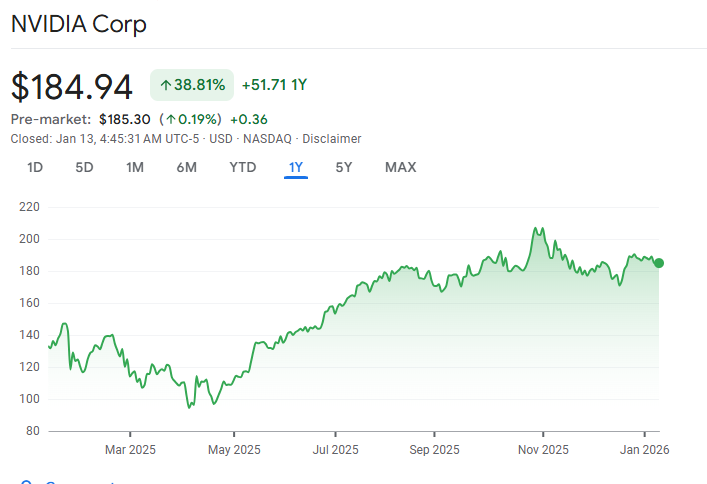
Source: Google Finance

Despite that difference, Hougan noted, there are no calls to ban 401(k) providers from offering Nvidia stock.

“This is just another asset,” Hougan said during the interview, adding that while Bitcoin clearly carries risk, that risk is often overstated relative to familiar equities.

His remarks directly challenge a long-standing narrative that crypto volatility alone should disqualify it from retirement plans. The debate has gained urgency following a series of regulatory shifts in the United States.

Last August, President Trump issued an executive order directing the Department of Labor to reconsider limiting the inclusion of alternative assets in defined-contribution plans, which has again made cryptocurrencies a possibility in 401(k)s.

The Employee Benefits Security Administration of the Labor Department had previously canceled 2022 guidance encouraging plan fiduciaries to be extremely cautious with crypto and adopted a more neutral position on it, neither approving nor discouraging its inclusion.

Bitcoin Access in Retirement Plans Remains Limited

Despite those changes, access to Bitcoin in retirement accounts remains limited. For most workers, exposure is only possible through self-directed brokerage accounts, where the investment decision fall squarely on the individual.

Only a small number of providers, including Fidelity and ForUsAll, currently offer pathways to Bitcoin exposure, often through spot Bitcoin ETFs. Large firms such as Vanguard have stayed on the sidelines.

Warren has been one of the most vocal critics of expanding crypto’s role in retirement savings.

In an open letter published Monday, she warned that allowing crypto into 401(k)s could expose workers to higher fees, market manipulation, and sharp price swings that undermine retirement security.

She argued that for many Americans, retirement accounts are a financial lifeline rather than a place for speculative bets.

Warren has asked SEC Chair Paul Atkins to explain how the agency accounts for crypto volatility in valuations and whether it is studying manipulative practices in digital asset markets, with responses requested by Jan. 27.

Hougan acknowledged that widespread adoption will not happen overnight.

He said 401(k) providers are slow-moving institutions constrained by fiduciary risk and regulatory uncertainty, but he expects Bitcoin exposure to become normalized over time.

He pointed to increased institutional participation, particularly through spot Bitcoin ETFs, as a stabilizing force that has already reduced Bitcoin’s extreme volatility compared with earlier cycles.

Bitcoin’s price history still shows larger drawdowns than broad market indices like the S&P 500, which typically sees annualized volatility of around 15% to 20%.


Market Opportunity
Sidekick Logo
Sidekick Price(K)
$0.004288
$0.004288$0.004288
+3.00%
USD
Sidekick (K) Live Price Chart
Disclaimer: The articles reposted on this site are sourced from public platforms and are provided for informational purposes only. They do not necessarily reflect the views of MEXC. All rights remain with the original authors. If you believe any content infringes on third-party rights, please contact service@support.mexc.com for removal. MEXC makes no guarantees regarding the accuracy, completeness, or timeliness of the content and is not responsible for any actions taken based on the information provided. The content does not constitute financial, legal, or other professional advice, nor should it be considered a recommendation or endorsement by MEXC.

You May Also Like

Franklin Templeton CEO Dismisses 50bps Rate Cut Ahead FOMC

Franklin Templeton CEO Dismisses 50bps Rate Cut Ahead FOMC

The post Franklin Templeton CEO Dismisses 50bps Rate Cut Ahead FOMC appeared on BitcoinEthereumNews.com. Franklin Templeton CEO Jenny Johnson has weighed in on whether the Federal Reserve should make a 25 basis points (bps) Fed rate cut or 50 bps cut. This comes ahead of the Fed decision today at today’s FOMC meeting, with the market pricing in a 25 bps cut. Bitcoin and the broader crypto market are currently trading flat ahead of the rate cut decision. Franklin Templeton CEO Weighs In On Potential FOMC Decision In a CNBC interview, Jenny Johnson said that she expects the Fed to make a 25 bps cut today instead of a 50 bps cut. She acknowledged the jobs data, which suggested that the labor market is weakening. However, she noted that this data is backward-looking, indicating that it doesn’t show the current state of the economy. She alluded to the wage growth, which she remarked is an indication of a robust labor market. She added that retail sales are up and that consumers are still spending, despite inflation being sticky at 3%, which makes a case for why the FOMC should opt against a 50-basis-point Fed rate cut. In line with this, the Franklin Templeton CEO said that she would go with a 25 bps rate cut if she were Jerome Powell. She remarked that the Fed still has the October and December FOMC meetings to make further cuts if the incoming data warrants it. Johnson also asserted that the data show a robust economy. However, she noted that there can’t be an argument for no Fed rate cut since Powell already signaled at Jackson Hole that they were likely to lower interest rates at this meeting due to concerns over a weakening labor market. Notably, her comment comes as experts argue for both sides on why the Fed should make a 25 bps cut or…
Share
BitcoinEthereumNews2025/09/18 00:36
WIF price reclaims 200-day moving average

WIF price reclaims 200-day moving average

WIF (WIF) price is entering a critical technical phase as price action reclaims the 200-day moving average, a level that often separates bearish control from bullish
Share
Crypto.news2026/01/13 23:44
China Blocks Nvidia’s RTX Pro 6000D as Local Chips Rise

China Blocks Nvidia’s RTX Pro 6000D as Local Chips Rise

The post China Blocks Nvidia’s RTX Pro 6000D as Local Chips Rise appeared on BitcoinEthereumNews.com. China Blocks Nvidia’s RTX Pro 6000D as Local Chips Rise China’s internet regulator has ordered the country’s biggest technology firms, including Alibaba and ByteDance, to stop purchasing Nvidia’s RTX Pro 6000D GPUs. According to the Financial Times, the move shuts down the last major channel for mass supplies of American chips to the Chinese market. Why Beijing Halted Nvidia Purchases Chinese companies had planned to buy tens of thousands of RTX Pro 6000D accelerators and had already begun testing them in servers. But regulators intervened, halting the purchases and signaling stricter controls than earlier measures placed on Nvidia’s H20 chip. Image: Nvidia An audit compared Huawei and Cambricon processors, along with chips developed by Alibaba and Baidu, against Nvidia’s export-approved products. Regulators concluded that Chinese chips had reached performance levels comparable to the restricted U.S. models. This assessment pushed authorities to advise firms to rely more heavily on domestic processors, further tightening Nvidia’s already limited position in China. China’s Drive Toward Tech Independence The decision highlights Beijing’s focus on import substitution — developing self-sufficient chip production to reduce reliance on U.S. supplies. “The signal is now clear: all attention is focused on building a domestic ecosystem,” said a representative of a leading Chinese tech company. Nvidia had unveiled the RTX Pro 6000D in July 2025 during CEO Jensen Huang’s visit to Beijing, in an attempt to keep a foothold in China after Washington restricted exports of its most advanced chips. But momentum is shifting. Industry sources told the Financial Times that Chinese manufacturers plan to triple AI chip production next year to meet growing demand. They believe “domestic supply will now be sufficient without Nvidia.” What It Means for the Future With Huawei, Cambricon, Alibaba, and Baidu stepping up, China is positioning itself for long-term technological independence. Nvidia, meanwhile, faces…
Share
BitcoinEthereumNews2025/09/18 01:37



