Injective has published new research that positions its blockchain as a full-stack platform for regulated real-world asset tokenization. The adoption is increasingInjective has published new research that positions its blockchain as a full-stack platform for regulated real-world asset tokenization. The adoption is increasing

Injective Highlights How Tokenization Could Unlock $30 Trillion in Asset Markets

  • Injective has published new research that positions its blockchain as a full-stack platform for regulated real-world asset tokenization.
  • The adoption is increasing, with growing tokenized RWA volumes and consistent on-chain activity throughout Injective’s ecosystem.

Injective has released new research outlining how its blockchain is structured to support real-world asset tokenization at an institutional level. The report frames tokenization as a direct evolution of traditional securitization, where ownership claims on assets such as equities, bonds, treasuries, real estate, and fiat instruments are moved onto programmable blockchain rails.

According to the research, tokenization is a more advanced version of conventional securitization models that integrates programmability with faster settlement and near-instant settlement, while reducing the need for intermediaries. As a result, issuers can automate corporate action and compliance logic on-chain. Investors, in turn, benefit from immutable records and transparent settlement flows.

In addition, Injective brings back the structural benefit of liquidity. Fractional ownership allows for smaller capital investments, and 24/7 trading eliminates time zone restrictions that are prevalent in traditional markets.

According to the report, these features enable the more efficient circulation of assets without compromising overviews by auditors and regulators. Injective argues that these features solve real frictions that have existed in the capital markets for a long time, rather than merely putting existing systems on blockchain rails.

Permissioned Token Standards Embed Compliance At Issuance

As per the report, the permissioned token standard is at the heart of the Injective model because the standard inherently inscribes access rules within smart contracts. Issuers are able to implement allowlists and transfer restrictions without off-chain enforcement. The study observes that such a strategy has multiple asset classes and is flexible across jurisdictions.

Injective also provides direct integration with custody and compliance providers. That design choice is meant to minimize onboarding friction for banks, asset managers, and other regulated entities entering tokenization markets.

Once issued, assets can flow into different liquidity environments. Public liquidity networks utilize automated smart contracts, whereas institutional networks employ professional market makers that facilitate greater volume trading. 

Tokenized Asset Demand Rises

Injective’s research cites its operational history as a sign of institutional readiness. Injective has processed over 1.1 billion transactions since the mainnet launch in 2021 and has yet to experience downtime or security breaches. In 2024, the ecosystem broadened with more stablecoin integrations and tokenized financial products., which the report views as indicators of institutional readiness.

According to Securitize, tokenized real-world assets have passed the $20 billion mark for cumulative asset value. Excluding stablecoins, the sector grew to $18.2 billion by the end of 2025, up from about $5.5 billion at the start of the year. Tokenized treasuries went from $4 billion to $9 billion in the same period.
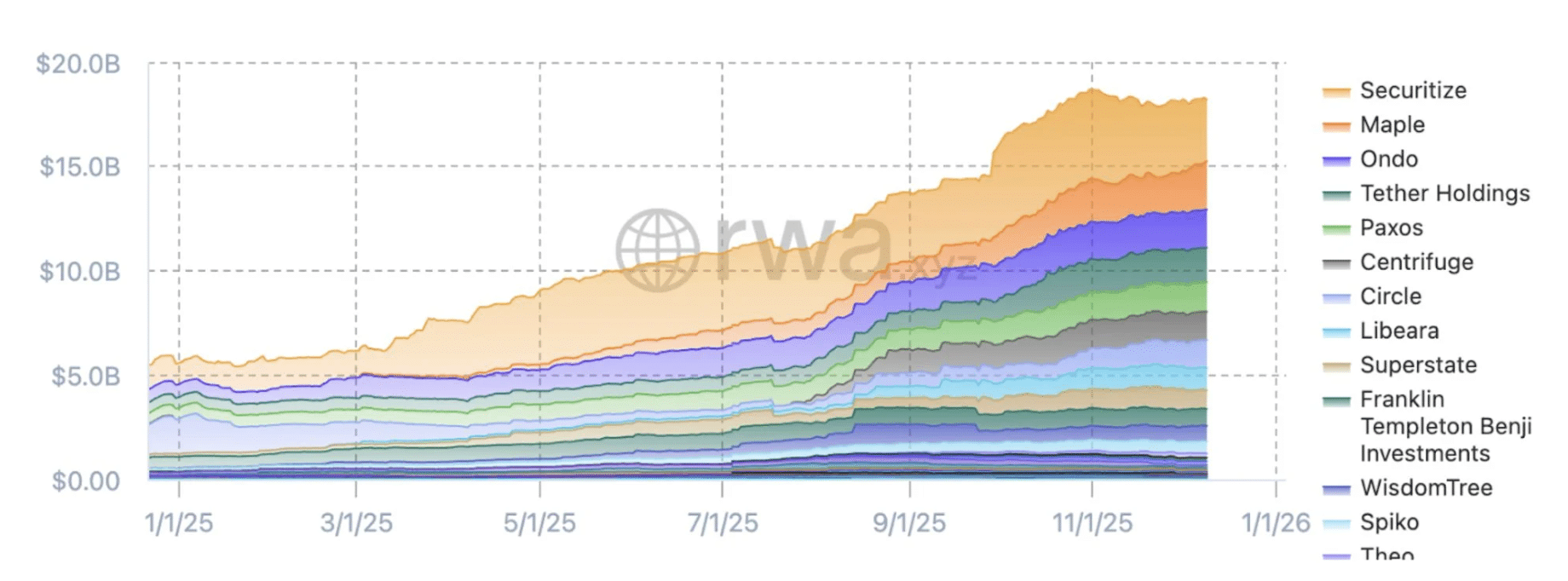
Source: Securitize

Separately, Messari reported that Injective hit $6 billion in perpetual real-world asset trading volume. As of press time, INJ is trading at around $5.64, up 9.74% in the last 24 hours and 2% in the last seven days.

]]>


Market Opportunity
RealLink Logo
RealLink Price(REAL)
$0,0788
$0,0788$0,0788
+%2,57
USD
RealLink (REAL) Live Price Chart
Disclaimer: The articles reposted on this site are sourced from public platforms and are provided for informational purposes only. They do not necessarily reflect the views of MEXC. All rights remain with the original authors. If you believe any content infringes on third-party rights, please contact service@support.mexc.com for removal. MEXC makes no guarantees regarding the accuracy, completeness, or timeliness of the content and is not responsible for any actions taken based on the information provided. The content does not constitute financial, legal, or other professional advice, nor should it be considered a recommendation or endorsement by MEXC.

You May Also Like

Aave DAO to Shut Down 50% of L2s While Doubling Down on GHO

Aave DAO to Shut Down 50% of L2s While Doubling Down on GHO

The post Aave DAO to Shut Down 50% of L2s While Doubling Down on GHO appeared on BitcoinEthereumNews.com. Aave DAO is gearing up for a significant overhaul by shutting down over 50% of underperforming L2 instances. It is also restructuring its governance framework and deploying over $100 million to boost GHO. This could be a pivotal moment that propels Aave back to the forefront of on-chain lending or sparks unprecedented controversy within the DeFi community. Sponsored Sponsored ACI Proposes Shutting Down 50% of L2s The “State of the Union” report by the Aave Chan Initiative (ACI) paints a candid picture. After a turbulent period in the DeFi market and internal challenges, Aave (AAVE) now leads in key metrics: TVL, revenue, market share, and borrowing volume. Aave’s annual revenue of $130 million surpasses the combined cash reserves of its competitors. Tokenomics improvements and the AAVE token buyback program have also contributed to the ecosystem’s growth. Aave global metrics. Source: Aave However, the ACI’s report also highlights several pain points. First, regarding the Layer-2 (L2) strategy. While Aave’s L2 strategy was once a key driver of success, it is no longer fit for purpose. Over half of Aave’s instances on L2s and alt-L1s are not economically viable. Based on year-to-date data, over 86.6% of Aave’s revenue comes from the mainnet, indicating that everything else is a side quest. On this basis, ACI proposes closing underperforming networks. The DAO should invest in key networks with significant differentiators. Second, ACI is pushing for a complete overhaul of the “friendly fork” framework, as most have been unimpressive regarding TVL and revenue. In some cases, attackers have exploited them to Aave’s detriment, as seen with Spark. Sponsored Sponsored “The friendly fork model had a good intention but bad execution where the DAO was too friendly towards these forks, allowing the DAO only little upside,” the report states. Third, the instance model, once a smart…
Share
BitcoinEthereumNews2025/09/18 02:28
Academic Publishing and Fairness: A Game-Theoretic Model of Peer-Review Bias

Academic Publishing and Fairness: A Game-Theoretic Model of Peer-Review Bias

Exploring how biases in the peer-review system impact researchers' choices, showing how principles of fairness relate to the production of scientific knowledge based on topic importance and hardness.
Share
Hackernoon2025/09/17 23:15
Why Is Crypto Up Today? – January 14, 2026

Why Is Crypto Up Today? – January 14, 2026

The crypto market is up today, with the cryptocurrency market capitalisation rising by 3.6% to $3.33 trillion. At the time of writing, 95 of the top 100 coins have
Share
CryptoNews2026/01/14 20:04