Bitcoin Adoption Surges in Iran Amid Protests and Rial Collapse
Bitcoin Magazine
Bitcoin Adoption Surges in Iran Amid Protests and Rial Collapse
A new report from blockchain analytics firm Chainalysis shows that Iran’s crypto ecosystem boomed in 2025, with Bitcoin playing a growing central role for both ordinary citizens seeking financial refuge and the Islamic Revolutionary Guard Corps (IRGC), which now dominates much of the country’s on-chain activity.
According to the report, Iran’s crypto economy processed more than $7.78 billion in value in 2025, growing faster for most of the year than in 2024.
The report found that crypto activity in Iran is closely correlated with major political shocks, regional conflict, and domestic unrest, making blockchain data a real-time barometer of instability inside the country.
Bitcoin as a flight to safety
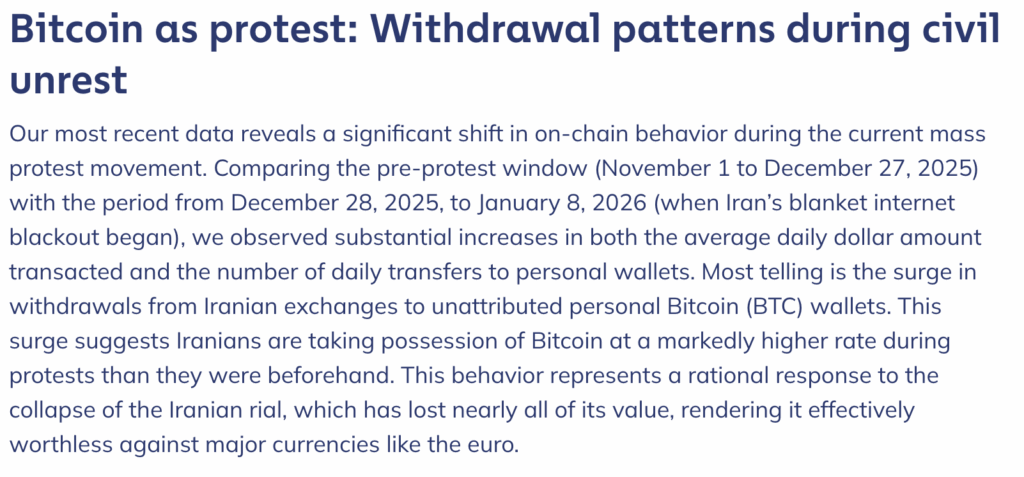
One of the clearest trends identified in the report is a surge in Bitcoin withdrawals to personal wallets during mass protests in late 2025 and early 2026. Comparing activity before protests began with the period leading up to Iran’s nationwide internet blackout on January 8, Chainalysis observed sharp increases in both transaction volumes and transfers from Iranian exchanges to self-custodied Bitcoin wallets.
The behavior suggests Iranians are using Bitcoin as a flight to safety amid accelerating currency collapse and political uncertainty.
The Iranian rial has lost roughly 90% of its value since 2018, with inflation running between 40% and 50%. In that environment, Bitcoin’s censorship resistance and portability offer a rare form of financial optionality — especially during protests, capital controls, or the risk of needing to flee the country.
Chainalysis notes that this pattern mirrors Bitcoin adoption during crises elsewhere, where citizens turn to self-custody when trust in state-controlled financial systems breaks down.
The report shows pronounced spikes in Iranian crypto activity following major geopolitical and domestic events, including, the January 2024 Kerman bombings, which killed nearly 100 people at a memorial for IRGC-Quds Force commander Qasem Soleimani.
The report also marked a spike in activity after Iran’s October 2024 missile strikes against Israel, following the assassinations of Hamas and Hezbollah leaders and during the 12-day war in June 2025, which included the U.S.-Israeli strikes on Iranian military infrastructure, cyberattacks on Iran’s largest crypto exchange Nobitex, and disruptions at Bank Sepah, a key IRGC-linked financial institution.
IRGC is dominating Iran’s crypto economy
While Bitcoin has become a lifeline for many civilians, Chainalysis warns that Iran’s crypto ecosystem is increasingly dominated by the IRGC. Addresses linked to IRGC-affiliated networks accounted for around 50% of all crypto value received in Iran in Q4 2025, a share that has steadily grown over time.
IRGC-linked wallets received more than $3 billion on-chain in 2025, up from over $2 billion in 2024.
Chainalysis said this figure is a lower-bound estimate, based only on wallets publicly identified through sanctions designations by the U.S. Treasury’s OFAC and Israel’s National Bureau for Counter Terror Financing.
The true scale is likely larger, given the use of shell companies, facilitators, and undisclosed wallets.
These networks span multiple countries and are used to move illicit oil revenues, launder funds, evade sanctions, and finance Iran’s regional proxy groups.
Bitcoin, sanctions, and resistance
Chainalysis concluded in their report that crypto, particularly Bitcoin, is playing somewhat of a dual role in Iran: its a financial escape valve for citizens and a sanctions-evasion tool for the state and its security apparatus.
As Iran faces mounting internal dissent, economic dysfunction, and external pressure, on-chain data shows Bitcoin increasingly being used outside government control, especially during moments of crisis.
These findings underscore how Bitcoin’s permissionless design cuts both ways — serving as a lifeline for civilians facing political instability while also enabling state and paramilitary actors, reinforcing the case that Bitcoin itself is neutral infrastructure for a couple different actors.
 Snippet from the report
This post Bitcoin Adoption Surges in Iran Amid Protests and Rial Collapse first appeared on Bitcoin Magazine and is written by Micah Zimmerman.


You May Also Like

SHIB and Pi Move Sideways, BlockDAG Takes the Market Lead With a Live Casino and Utility Stack! Is It the Best Crypto to Buy Now?

Sui (SUI) Jumps 50% on Staking Surge and Stablecoin Plans