New research cited by The Wall Street Journal suggests US tariffs are quietly weighing on the domestic economy. That drag may help explain why crypto markets haveNew research cited by The Wall Street Journal suggests US tariffs are quietly weighing on the domestic economy. That drag may help explain why crypto markets have

New Tariff Data Shows Why the Crypto Market Has Been Stuck for Months

New research cited by The Wall Street Journal suggests US tariffs are quietly weighing on the domestic economy. That drag may help explain why crypto markets have struggled to gain momentum since the October sell-off.

A study by Germany’s Kiel Institute for the World Economy found that for tariffs imposed between January 2024 and November 2025, 96% of the costs were absorbed by US consumers and importers, while foreign exporters bore just 4%. 

Nearly $200 billion in tariff revenue was paid almost entirely inside the US economy.

Tariffs are Acting Like a Domestic Consumption Tax

The research challenges a core political claim that tariffs are paid by foreign producers. In practice, US importers pay tariffs at the border, then absorb or pass on the costs.

Foreign exporters largely kept prices steady. Instead, they shipped fewer goods or redirected supply to other markets. The result was lower trade volumes, not cheaper imports.

Economists describe this effect as a slow-moving consumption tax. Prices do not jump immediately. Costs seep into supply chains over time.
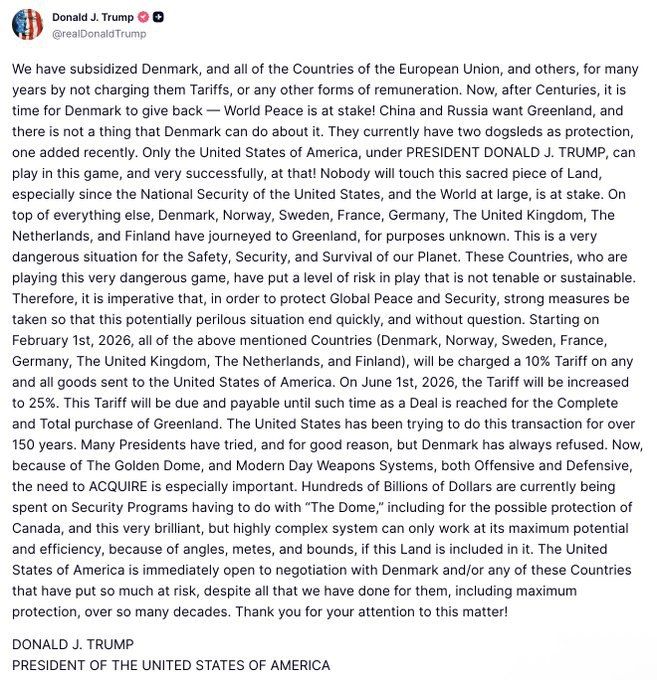
US President Trump Imposes New Tariffs on Several European Countries For Opposing His Greenland Purchase Offer. Source: Truth Social

US Inflation Stayed Moderate, but Pressure Built

US inflation remained relatively contained through 2025. That led some to conclude tariffs had little impact.

However, studies cited by the WSJ show only about 20% of tariff costs reached consumer prices within six months. The rest sat with importers and retailers, squeezing margins.

This delayed pass-through explains why inflation stayed moderate while purchasing power eroded quietly. The pressure accumulated rather than exploded.

Crypto markets depend on discretionary liquidity. They rise when households and businesses feel confident deploying excess capital.

Tariffs drained that excess slowly. Consumers paid more. Businesses absorbed costs. Cash became less available for speculative assets.

This helps explain why crypto did not collapse after October, but also failed to trend higher. The market entered a liquidity plateau, not a bear market.

The October downturn flushed leverage and stalled ETF inflows. Under normal conditions, easing inflation might have restarted risk appetite.

Instead, tariffs kept financial conditions quietly tight. Inflation stayed above target. The Federal Reserve remained cautious. Liquidity did not expand.

Crypto prices moved sideways as a result. There was no panic, but also no fuel for sustained upside.

Overall, the new tariff data does not explain crypto’s volatility on its own. But it helps explain why the market stayed stuck. 

Tariffs quietly tightened the system, drained discretionary capital, and delayed the return of risk appetite.


Market Opportunity
Notcoin Logo
Notcoin Price(NOT)
$0.0005509
$0.0005509$0.0005509
+1.30%
USD
Notcoin (NOT) Live Price Chart
Disclaimer: The articles reposted on this site are sourced from public platforms and are provided for informational purposes only. They do not necessarily reflect the views of MEXC. All rights remain with the original authors. If you believe any content infringes on third-party rights, please contact service@support.mexc.com for removal. MEXC makes no guarantees regarding the accuracy, completeness, or timeliness of the content and is not responsible for any actions taken based on the information provided. The content does not constitute financial, legal, or other professional advice, nor should it be considered a recommendation or endorsement by MEXC.

You May Also Like

Trade War Headlines Trigger $800M In Liquidations Overnight: Longs Get Wiped Out Across Crypto Markets

Trade War Headlines Trigger $800M In Liquidations Overnight: Longs Get Wiped Out Across Crypto Markets

The crypto market faced a sharp selloff overnight as renewed trade conflict fears between the United States and the European Union shook global risk sentiment.
Share
NewsBTC2026/01/20 11:00
Rokid Ai Glasses Style Now Available Globally

Rokid Ai Glasses Style Now Available Globally

The world’s first open ecosystem AI smart glasses—ultra-light, prescription-first, and built for ChatGPT, Qwen, DeepSeek, and more—are now shipping worldwide, starting
Share
AI Journal2026/01/20 11:45
FCA, crackdown on crypto

FCA, crackdown on crypto

The post FCA, crackdown on crypto appeared on BitcoinEthereumNews.com. The regulation of cryptocurrencies in the United Kingdom enters a decisive phase. The Financial Conduct Authority (FCA) has initiated a consultation to set minimum standards on transparency, consumer protection, and digital custody, in order to strengthen market confidence and ensure safer operations for exchanges, wallets, and crypto service providers. The consultation was published on May 2, 2025, and opened a public discussion on operational responsibilities and safeguarding requirements for digital assets (CoinDesk). The goal is to make the rules clearer without hindering the sector’s evolution. According to the data collected by our regulatory monitoring team, in the first weeks following the publication, the feedback received from professionals and operators focused mainly on custody, incident reporting, and insurance requirements. Industry analysts note that many responses require technical clarifications on multi-sig, asset segregation, and recovery protocols, as well as proposals to scale obligations based on the size of the operator. FCA Consultation: What’s on the Table The consultation document clarifies how to apply rules inspired by traditional finance to the crypto perimeter, balancing innovation, market integrity, and user protection. In this context, the goal is to introduce minimum standards for all firms under the supervision of the FCA, an essential step for a more transparent and secure sector, with measurable benefits for users. The proposed pillars Obligations towards consumers: assessment on the extension of the Consumer Duty – a requirement that mandates companies to provide “good outcomes” – to crypto services, with outcomes for users that are traceable and verifiable. Operational resilience: introduction of continuity requirements, incident response plans, and periodic testing to ensure the operational stability of platforms even in adverse scenarios. Financial Crime Prevention: strengthening AML/CFT measures through more stringent transaction monitoring and structured counterpart checks. Custody and safeguarding: definition of operational methods for the segregation of client assets, secure…
Share
BitcoinEthereumNews2025/09/18 05:40