

What Is a Tokenized ETF? Inside F/m’s SEC Application
This article was first published on The Bit Journal.
The rise of interest in the Tokenized ETF market has taken a new direction as a major filing pushes blockchain technology deeper into regulated finance. The development has gained sharp attention among crypto readers, analysts, and students who follow the shift toward digital ownership.
According to the source, F/m Investments submitted a formal request to the United States securities regulator to tokenize shares of its well-known 3-Month T-Bill ETF. The move reflects how traditional finance is adjusting to blockchain-driven systems.
A First-of-Its-Kind Filing Reshapes ETF Ownership
F/m Investments filed the exemptive application on January 21. The request seeks approval to tokenize shares of its $6.3 billion TBIL fund. The proposal allows tokenized and traditional shares to operate under the same ticker, CUSIP, rights, and fees.
No change affects the fund’s strategy, holdings, or trading mechanics. The only difference lies in how ownership records are maintained. The company aims to record TBIL shares on a permissioned blockchain, creating the first regulated Tokenized ETF in the United States.
 Tokenized ETF Filing By F/m Investments Sends Signals Across ETFs
Compliance Strengthens the Case for Blockchain Adoption
The Tokenized ETF structure remains fully compliant with the Investment Company Act of 1940 and Rule 6c-11. F/m Investments explained that investors would continue receiving the same protections. These include board oversight, daily transparency, third-party custody, and independent audits.
The company stressed that tokenization enhances ownership records without reducing safeguards. CEO Alexander Morris noted that tokenization is coming to securities markets. He questioned whether this change should happen inside the regulatory framework that investors have trusted for decades.
Co-Founder David Littleton added that the long-term aim is to link traditional brokerage systems with blockchain settlement platforms. This blended structure would allow the ETF to operate as usual while offering optional blockchain settlement for investors who prefer digital infrastructure.
Analysts See a Milestone Moment for Regulated Tokenization
Industry analysts reacted quickly to the filing. This may become a turning point for blockchain in regulated markets.
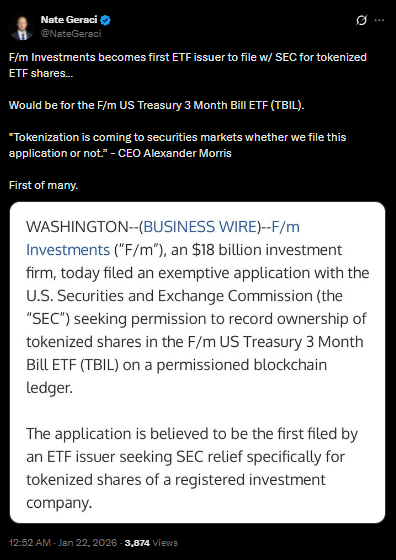 Source: X
A recent financial study shows that blockchain settlement can improve transfer accuracy by reducing reconciliation issues. These findings support the idea that Tokenized ETF structures can help regulated markets operate with more clarity and efficiency.
Rising Interest in Real-World Asset Tokenization
The timing of the filing aligns with a growing trend in tokenizing real-world assets. Large institutions have been experimenting with blockchain-based versions of financial products. BlackRock’s digital liquidity fund has grown fast on Ethereum, signaling strong demand for tokenized investment vehicles.
JPMorgan has introduced a tokenized money-market fund that is specifically targeted at institutional clients. Major exchanges have also announced tokenization programs, reflecting rising interest in blockchain-based settlement and recordkeeping tied to traditional instruments.
The approach from F/m Investments keeps everything inside existing securities laws, unlike unregistered digital tokens or stablecoins.
A New Model for ETF Settlement and Market Infrastructure
If approved, the Tokenized ETF could offer a blueprint for future ETFs and fixed-income products. The process would allow both brokerage and blockchain settlement within a single share class. Many market strategists see this as a practical way to modernize ownership systems.
It may influence how short-term U.S. Treasuries and other regulated assets adopt tokenization in the years ahead. The SEC has not yet issued a decision, but the filing shows how traditional firms are leaning toward blockchain to strengthen market infrastructure.
Conclusion
The Tokenized ETF proposal by F/m Investments marks a defining moment in the shift toward regulated digital ownership. The filing blends innovation with long-standing investor protections. If approved, it may shape how future ETFs operate and guide the next wave of real-world asset tokenization.
Glossary of Key Terms
Tokenization: Converting real-world assets into digital units on blockchain.
ETF: A traded fund holding a structured basket of assets.
Permissioned Blockchain: A controlled blockchain where access is restricted.
Treasury Bills: Short-term U.S. government debt considered low-risk.
FAQs About Tokenized ETF
What is a Tokenized ETF?
It is an ETF whose ownership is recorded on the blockchain rather than solely in brokerage systems.
Why did F/m Investments file this request?
The firm aims to introduce digital ownership while keeping full regulatory compliance.
Does tokenization change how TBIL trades?
No, trading, fees, and holdings remain the same.
Is this the first regulated filing of its kind?
Yes, analysts say it is the first known request for tokenized ETF shares.
Sources / References
Businesswire
Reuters
Bloomberg
Read More: What Is a Tokenized ETF? Inside F/m’s SEC Application">What Is a Tokenized ETF? Inside F/m’s SEC Application


You May Also Like

What Is “Real Pi”? Understanding Mainnet Migration and Ownership in Pi Network

Hyperliquid Price Soars 2.5% as Perp Market Share Grows




