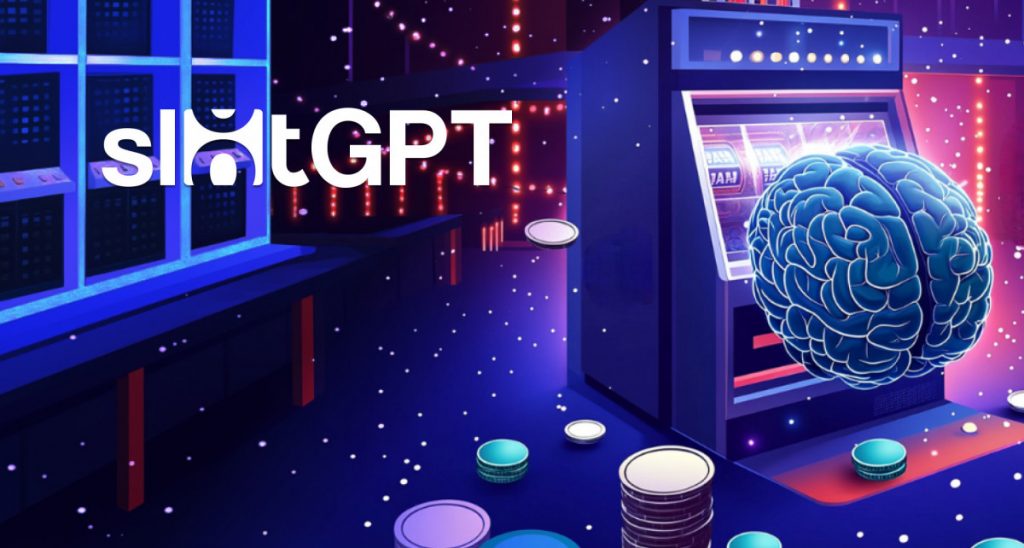
SlotGPT exemplifies how generative AI is transforming gaming by enabling players to create, personalize, and share fully customized slot games, reflecting the broaderSlotGPT exemplifies how generative AI is transforming gaming by enabling players to create, personalize, and share fully customized slot games, reflecting the broader

Gaming For Everyone: How AI Is Personalizing The Player Experience
Gaming For Everyone: How AI Is Personalizing The Player Experience

SlotGPT released an overview of its AI-powered platform, highlighting its role in advancing AI-powered gaming by enabling players to design and publish fully customized slot games using simple text prompts, illustrating the growing impact of generative AI on game personalization and creation.

Generative AI has demonstrated its effectiveness in performing basic tasks such as writing reports and summaries. However, its applications are expanding into more complex and lucrative sectors, including gaming. Industry projections estimate that the global AI gaming market could reach $23.44 billion by 2027. Gaming has traditionally been defined by choice, with players deciding which quests to pursue, which modes to play, and which in-game rewards to seek. Developers have historically curated a wide array of experiences to meet these preferences. AI, however, is enabling a shift in this dynamic, allowing games to adapt to individual player styles, histories, and preferences. Surveys indicate that 65% of gamers are now more interested in AI-driven personalized experiences.

In the current generative AI landscape, creating a personalized game has become increasingly accessible. As of July 2025, nearly 8,000 games on Steam, approximately 7% of the library, incorporate generative AI in their design. Platforms such as SlotGPT exemplify this trend by allowing players to conceptualize a slot game, provide a prompt describing its theme, mood, and artistic style, and automatically generate the game. SlotGPT also enables users to share their creations with a wider community, extending the reach of player-driven content.

Other examples of AI integration in gaming include Roblox’s AI 3D asset generator, which allows users to create full environments and objects from simple prompts, reducing the need for manual modeling. Similarly, AI Dungeon leverages large language models to generate narrative-driven adventures that are dynamically tailored to each player’s actions, demonstrating the increasing sophistication of AI in creating unique and personalized gaming experiences.

AI In Gaming: How Adaptive Systems, Procedural Generation, And Intelligent NPCs Are Redefining Player Experiences

AI has been a component of game development for decades, tracing back to the 1980s and 1990s when titles such as Super Mario Bros. and Pac-Man used basic algorithmic patterns to simulate intelligent enemy behavior. Over time, AI integration has advanced beyond simple mechanics to influence the core elements that make games adaptive and personalized.

Dynamic difficulty adjustment has become a standard feature in many modern games. Titles like Resident Evil 4 and Left 4 Dead employ AI systems that monitor player performance and subtly adjust enemy behavior to align with skill and play style. With advancements in data collection and analysis, AI now evaluates in-game actions—such as clicks, pauses, messages, and achievements—to refine difficulty in real time and enhance overall engagement.

Procedural content generation (PCG) has also benefited significantly from AI. Traditionally guided by fixed rules and randomness, PCG now incorporates machine learning to create levels, stories, challenges, items, and characters as players interact with a game. This evolution allows games like No Man’s Sky to generate billions of unique planets, expanding the possibilities of virtual worlds far beyond human-driven design.

Non-player characters (NPCs) have similarly grown more sophisticated. Moving past scripted dialogues and rigid routines, AI-enabled NPCs can learn player preferences, adapt combat strategies, develop rivalries, and acquire new traits or weaknesses over time. Companies including Ubisoft, Monolith, and Nvidia are actively developing these intelligent systems to enhance interactive gameplay.

AI continues to reshape the gaming industry, introducing deeper personalization, adaptability, and complexity into game design. The rise of generative AI is further expanding creative opportunities, enabling players—not just professional developers—to influence game creation and customize experiences in ways previously impossible.

The post Gaming For Everyone: How AI Is Personalizing The Player Experience appeared first on Metaverse Post.


Disclaimer: The articles reposted on this site are sourced from public platforms and are provided for informational purposes only. They do not necessarily reflect the views of MEXC. All rights remain with the original authors. If you believe any content infringes on third-party rights, please contact service@support.mexc.com for removal. MEXC makes no guarantees regarding the accuracy, completeness, or timeliness of the content and is not responsible for any actions taken based on the information provided. The content does not constitute financial, legal, or other professional advice, nor should it be considered a recommendation or endorsement by MEXC.

You May Also Like

Horror Thriller ‘Bring Her Back’ Gets HBO Max Premiere Date

Horror Thriller ‘Bring Her Back’ Gets HBO Max Premiere Date

The post Horror Thriller ‘Bring Her Back’ Gets HBO Max Premiere Date appeared on BitcoinEthereumNews.com. Jonah Wren Phillips in “Bring Her Back.” A24 Bring Her Back, a new A24 horror movie from the filmmakers of the smash hit Talk to Me, is coming soon to HBO Max. Bring Her Back opened in theaters on May 30 before debuting on digital streaming via premium video on demand on July 1. The official logline for Bring Her Back reads, “A brother and sister uncover a terrifying ritual at the secluded home of their new foster mother.” Forbes‘South Park’ Season 27 Updated Release Schedule: When Do New Episodes Come Out?By Tim Lammers Directed by twin brothers Danny Philippou and Michael Philippou, Bring Her Back stars Billy Barratt, Sora Wong, Jonah Wren Philips, Sally–Anne Upton, Stephen Philips, Mischa Heywood and Sally Hawkins. Warner Bros. Discovery announced on Wednesday that Bring Her Back will arrive on streaming on HBO Max on Friday, Oct. 3, and on HBO linear on Saturday, Oct. 4, at 8 p.m. ET. Prior to the debut of Bring Her Back on HBO on Oct. 4, the cable outlet will air the Philippou brothers’ 2022 horror hit Talk to Me. ForbesHit Horror Thriller ’28 Years Later’ Is New On Netflix This WeekBy Tim Lammers For viewers who don’t have HBO Max, the streaming platform offers three tiers: The ad-based tier costs $9.99 per month, while an ad-free tier is $16.99 per month. Additionally, an ad-free tier with 4K Ultra HD programming costs $20.99 per month. The Success Of ‘Talk To Me’ Weighed On The Minds Of Philippou Brothers While Making ‘Bring Her Back’ During the film’s theatrical run, Bring Her Back earned $19.3 million domestically and nearly $19.8 million internationally for a worldwide box office tally of $39.1 million. Bring Her Back had a production budget of $17 million before prints and advertising, according to The Numbers.…
Share
BitcoinEthereumNews2025/09/18 09:23
XRP Hits ‘Extreme Fear’ Levels - Why This Is Secretly Bullish

XRP Hits ‘Extreme Fear’ Levels - Why This Is Secretly Bullish

Ripple’s native token XRP is still battling out with the bears at the $1.90 territory on Friday afternoon. The support-turned-resistance at $1.90 is particularly
Share
Coinstats2026/01/24 03:25
Is Hyperliquid the new frontier for innovation?

Is Hyperliquid the new frontier for innovation?

The post Is Hyperliquid the new frontier for innovation? appeared on BitcoinEthereumNews.com. This is a segment from the 0xResearch newsletter. To read full editions, subscribe. One of the key things I like to track in crypto is a subjective criterion I call “where are new interesting developments and proposals taking place.” There are plenty of dashboards and analytics sites for this, the most popular being the Electric Capital site. The issue is that it still shows Polkadot as having a lot of developers. (At Blockworks we solved the noise problem with active users; maybe we can try the same for active developers.) Because of this noise, I prefer to track two simple observations: What is the velocity of new products launching, and how much mindshare are these products capturing? Are many people getting nerdsniped into discussing the novelties and intricacies of the chain? A related point is the caliber of people being attracted to new ecosystems. For example, over the past few years, Solana (and Ethereum) attracted the majority of talent. Talent generally goes where: It can solve interesting problems or create interesting projects. It can make a lot of money. In a podcast I did with Icebergy about a year ago, we discussed how crypto still wasn’t attracting talent at the levels AI was, despite offering faster exits and more money. AI was (and probably still is) more interesting to most talent and seen as more prestigious. After FTX, crypto lost a lot of credibility and has only recently started recovering as larger institutional players re-entered. Apart from FTX, crypto has also been criticized for being full of low-effort forks and limited utility products. This dynamic isn’t unique to crypto though. Many AI companies are also just building wrappers around GPT, which is as uninteresting as some projects in crypto. Anyway, to the point: Historically, Solana has captured the majority of…
Share
BitcoinEthereumNews2025/09/18 08:13