

Bitcoin Whales Flip From Distribution To Early Re-Accumulation – Details
Bitcoin remains under pressure, struggling to reclaim the $88,000 level as uncertainty and persistent selling continue to dominate market sentiment. Price action reflects hesitation rather than panic, but the inability to attract sustained demand highlights a fragile short-term structure. According to a recent CryptoQuant analysis, on-chain data tracking large holders offers critical context for this weakness.
Data focusing on wallets holding between 1,000 and 10,000 BTC, excluding exchanges and mining pools, points to a clear behavioral shift among whales after an extended distribution phase in late 2025. Following a local peak around mid-2025, aggregate whale balances declined steadily while Bitcoin traded at elevated levels.
This pattern is consistent with distribution into strength, not forced liquidation, suggesting that large holders were reducing exposure opportunistically as price momentum matured.
The 30-day balance change metric reinforces this view. Throughout the third quarter and into early Q4, whale balances repeatedly printed negative monthly changes, even as prices attempted to push higher. This divergence coincided with rising volatility and fading upside momentum, signaling that rallies were increasingly sustained by marginal buyers rather than committed institutional-scale accumulation.
Whale Behavior Signals Early Stabilization After Prolonged Distribution
However, the same report highlights an important shift beneath the surface. Recent on-chain data shows a clear inflection in whale behavior, with both short-term (7-day) and medium-term (30-day) balance changes turning positive. After months of persistent outflows, total whale holdings are no longer declining and have begun to stabilize, gradually recovering from their local lows. This change suggests that large holders are no longer actively distributing into rallies.

Historically, transitions from net distribution to early accumulation tend to emerge during periods of price compression or after corrective phases, rather than near market peaks. The current environment fits that pattern. Bitcoin is trading in a tight range after a sharp drawdown, and volatility has compressed, creating conditions where strategic repositioning becomes more attractive for larger players.
From a broader macro on-chain perspective, the 1-year change in whale holdings remains relatively flat. This indicates that the market has not yet entered a full-scale accumulation regime typically associated with strong bull market expansions. Instead, the behavior observed so far is more consistent with tactical positioning and selective re-entry, rather than high-conviction, long-term buying.
Importantly, whale activity is no longer adding sustained sell-side pressure to Bitcoin’s supply. While this shift does not guarantee an immediate upside breakout, it materially reduces downside risk.
The market appears to be transitioning into a stabilization phase, where the next directional move will depend on whether accumulation meaningfully accelerates or fades at current levels.
Bitcoin Consolidates Around Weekly Demand Level
Bitcoin’s weekly chart shows price consolidating just below the $90,000 zone, highlighting a market caught between stabilization and unresolved downside risk. After the sharp correction from the $120K–$125K peak, BTC has entered a broad consolidation range, with recent candles clustering around the mid-to-high $80K area. This zone is increasingly acting as a critical demand region rather than a launchpad for immediate upside.
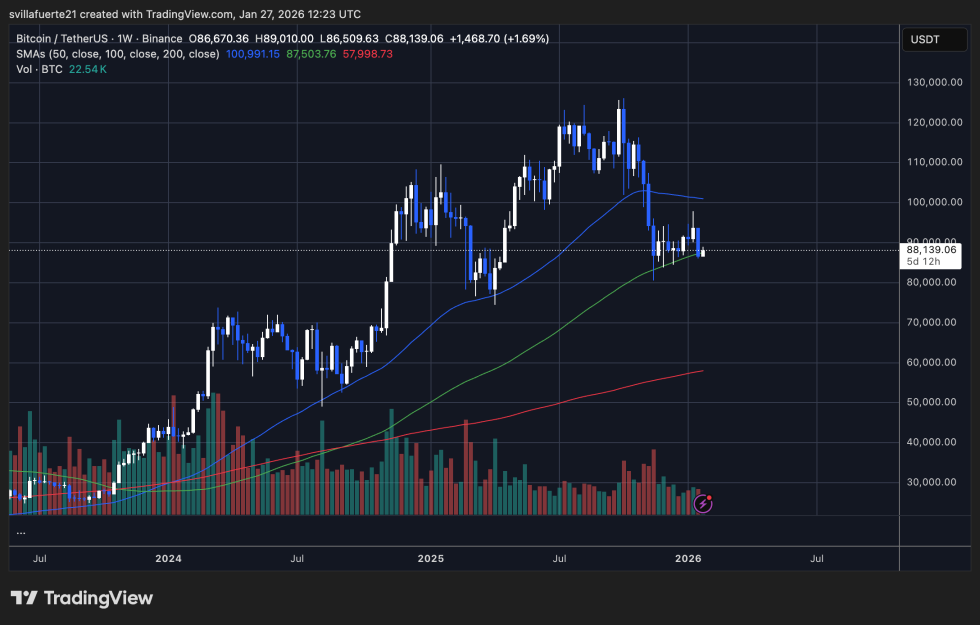
From a trend perspective, the structure has clearly weakened. Price remains below the 50-period moving average (blue), which has rolled over and now acts as dynamic resistance near the low $90Ks. The 100-period moving average (green) continues to slope upward and currently provides medium-term support just below the current price, reinforcing the idea of compression rather than free fall.
Meanwhile, the 200-period moving average (red) remains well below the price and rising steadily, confirming that the broader long-term uptrend is still intact despite the correction.
Volume dynamics also support a stabilization narrative. Selling pressure has eased compared to the distribution phase seen near the highs, and recent weekly candles show reduced downside momentum. However, the lack of strong bullish follow-through suggests buyers are selective rather than aggressive.
Bitcoin is transitioning into a decision zone. Holding above the 100-week moving average keeps the market in a corrective but constructive phase. Failure to do so would open the door to deeper mean reversion, while a reclaim of the 50-week average would be an early signal of trend repair.
Featured image from ChatGPT, chart from TradingView.com


You May Also Like

Trump biographer predicts next 3 Cabinet members on the chopping block

Kalshi hires ex-Democratic strategist amid legal troubles




