

Ripple Enters Corporate Treasury via GTreasury-Based Platform
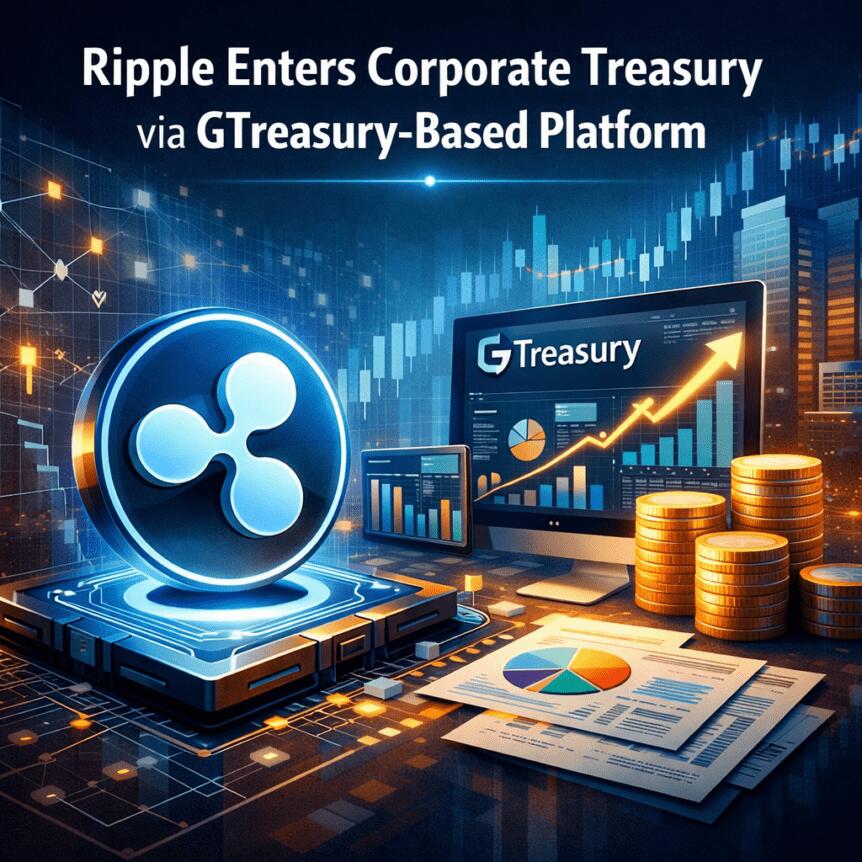
Ripple is expanding its enterprise finance push with a corporate treasury platform that blends traditional cash-management tools with digital asset rails. The offering weaves GTreasury’s treasury management software with Ripple’s blockchain and stablecoin rails to give treasurers a single interface for managing cash, payments, and liquidity while preserving existing controls and workflows. The aim is to tackle long-standing treasury frictions—multi-day settlement cycles and fragmented visibility across accounts—by shortening settlement times and reducing cross-border friction through programmable digital rails. The move signals a deeper push by Ripple into mainstream corporate finance, pairing familiar treasury processes with the efficiency and transparency offered by on-chain settlement.
Key takeaways
- Unification of cash management and digital-asset rails: GTreasury’s platform is now integrated with Ripple’s blockchain and stablecoin rails, enabling cash, payments, and liquidity to be managed in a single system.
- Settlement efficiency and cross-border clarity: the solution targets shorter settlement windows and clearer visibility across accounts to minimize reconciliation complexity in multinational operations.
- Idle cash can earn yields outside banking hours: the platform supports yield strategies for cash that would otherwise sit idle, without compromising risk controls and policy constraints.
- Stability and FX risk reduction: stablecoins are used for settlement to reduce foreign exchange exposure in cross-border transactions.
- Strategic milestone in Ripple’s corporate-treasury push: the collaboration follows Ripple’s $1 billion acquisition of GTreasury and positions RLUSD as a key asset in on-chain treasury operations (CRYPTO: RLUSD).
- Broader market context: the deployment aligns with a wave of tokenization efforts and 24/7 settlement initiatives across traditional finance infrastructure.
Tickers mentioned: $RLUSD
Market context: The rollout comes as institutional finance explores tokenization and around-the-clock settlement, with tokenization moves highlighting how traditional assets could be settled and managed more efficiently on-chain. The Securities and Exchange Commission has signaled openness to on-chain infrastructure, even as industry participants pursue approvals for tokenized securities and cross-border settlement platforms. In parallel, major clearinghouses and exchanges have advanced tokenization pilots for government and private securities, underscoring a broader shift toward digital-asset-enabled workflows.
Why it matters
The collaboration between Ripple and GTreasury is noteworthy because it embeds digital asset rails directly into established treasury workflows. By connecting GTreasury’s enterprise-grade cash-management capabilities with Ripple’s blockchain and stablecoins, enterprises can, in theory, run both traditional payments and digital-asset settlements from a single pane of glass. This is a meaningful step for treasuries seeking to consolidate liquidity management, payment execution, and compliance controls without ripping out existing governance frameworks.
One of the core advantages highlighted by the project is the potential to convert dormant cash into productive capital activity during off-hours. A corporate treasury head remarks that “there’s a huge amount of cash sitting with our corporate clients that doesn’t move nights and weekends.” If settlement times shrink to minutes rather than days, non-active cash could be deployed while maintaining policy constraints—an outcome that could improve overall liquidity efficiency and return on idle balances. The emphasis on visibility across both fiat and digital assets in a single platform responds to a long-standing pain point for treasurers who must reconcile disparate systems and data streams across borders and entities.
The platform’s design also targets a practical use case: cross-border settlements and liquidity management. By leveraging stablecoins for settlement, the solution aims to reduce foreign exchange exposure and settlement latency in multinational operations. The broader objective is to create a more seamless bridge between digital assets and fiat currencies, enabling a more transparent and auditable flow of funds within a single, auditable interface.
Ripple’s role as issuer of Ripple USD (RLUSD)—a US dollar-denominated stablecoin—underscores the emphasis on stable, predictable settlement rails. The token’s on-chain presence is complemented by a growing ecosystem around asset tokenization and on-chain settlement, a trend that regulators and industry participants are actively observing. RLUSD’s market footprint has grown to a notable size, with DefiLlama reporting a substantial market capitalization, illustrating how stablecoins are increasingly embedded in corporate treasury workflows as credible settlement assets.
Ripple USD market capitalization. Source: DefilLamaIn announcing the platform, Ripple framed the integration as a natural extension of its broader enterprise strategy, which includes expanding the utility of its digital-asset rails beyond payments into cash management, liquidity optimization, and yield generation. The combination of GTreasury’s workflow-centric platform with Ripple’s rails is designed to preserve existing controls, approvals, and compliance policies while enabling faster settlement, better visibility, and more flexible cash deployment. The aim is not to disrupt established treasury practices but to augment them with a digital layer that can operate in tandem with traditional banking rails.
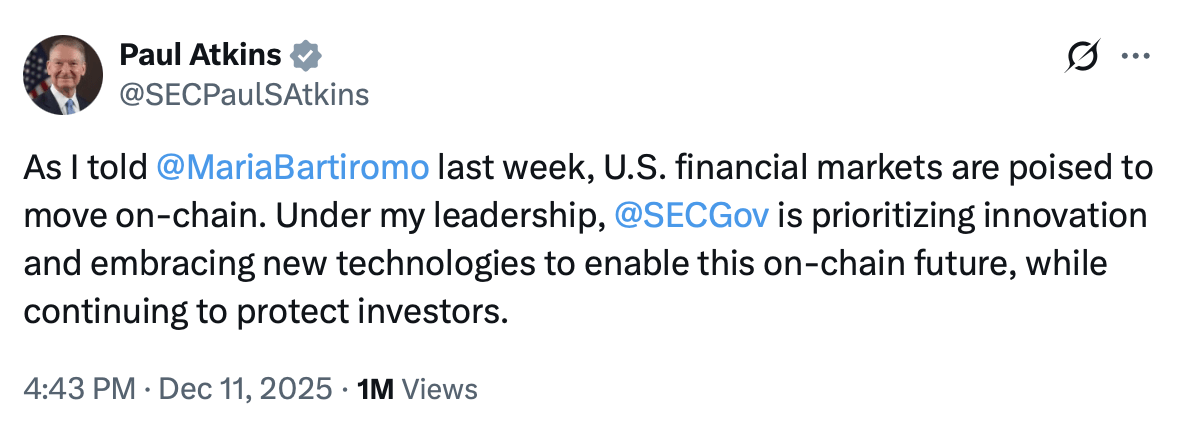 Source: Paul Atkins
The move sits within a wider industry cadence toward tokenization and on-chain settlement, evidenced by public regulatory and corporate actions described by industry participants. In December, the US Securities and Exchange Commission issued a no-action letter enabling a subsidiary of the Depository Trust & Clearing Corporation to launch a tokenization service for securities. SEC Chair Paul Atkins subsequently signaled a regulatory environment increasingly receptive to on-chain approaches, stating that U.S. financial markets are “poised to move on-chain” and that the agency is prioritizing innovation to enable this future. Meanwhile, the DTCC has outlined plans to tokenize US Treasurys on the Canton Network, a step it described as an initial phase with potential expansion to more asset classes over time.
Nasdaq has also prioritized tokenized securities, with leadership citing active moves to seek SEC approvals and accelerate the digitization of listed stocks. The New York Stock Exchange has likewise explored a platform for trading tokenized stocks and exchange-traded funds, including 24/7 trading and blockchain-backed settlement. Taken together, these developments illustrate a broader ecosystem shift toward on-chain settlement, with Ripple’s treasury platform nestled within a wave of corporate-finance and market-structure innovations.
What to watch next
- DTCC Canton Network expansion to tokenized assets and the pace of regulatory approvals for on-chain securities (dates and milestones to verify).
- Nasdaq and NYSE progress on tokenized equities and 24/7 settlement platforms (regulatory filings and pilot outcomes).
- Enterprise adoption of Ripple Treasury powered by GTreasury: number of pilot customers and product rollout timelines.
- Regulatory developments surrounding stablecoins in corporate treasury and cross-border settlements (policy updates and any notices affecting RLUSD).
Sources & verification
- Blog post announcing Ripple Treasury powered by GTreasury features and integration.
- GTreasury event page discussing the Ripple Treasury collaboration.
- DefiLlama data on Ripple USD (RLUSD) market capitalization.
- Announcement of Ripple’s GTreasury acquisition in October.
- SEC and DTCC tokenization developments and related public statements.
Corporate treasury goes digital: Ripple’s new platform and the push toward 24/7 settlement
Ripple’s latest enterprise-facing platform marks a notable milestone in the convergence of traditional treasury management and digital-asset infrastructure. By embedding digital rails directly into GTreasury’s operational framework, the solution seeks to deliver a unified operating environment where corporate treasuries can execute payments, optimize liquidity, and deploy idle cash without leaving their established governance paths. The emphasis on minimizing settlement latency—whether for cross-border transactions or routine intrafirm transfers—aligns with a market-wide hunger for faster, more transparent settlement cycles that can operate beyond normal business hours.
The joint vision leverages stablecoins for settlement to maintain predictable price exposure and mitigate FX risk, a feature that could be especially attractive to multinational corporations with complex treasury footprints. The platform’s yield capabilities for idle funds promise to improve cash utilization by enabling disciplined, policy-compliant deployment during off-peak hours. While the technology enables new efficiencies, it also foregrounds the importance of governance, risk controls, and regulatory clarity—areas that Ripple and its partners emphasize as non-negotiable in enterprise-scale deployments.
Crucially, the latest development is set against a broader macro backdrop in which tokenization and 24/7 settlement are moving from aspiration to near-term feasibility across major institutions. The industry’s transition toward on-chain settlement is supported by high-profile regulatory moves, such as tokenization pilots led by DTCC and progress by Nasdaq and the NYSE. For treasurers, this means an ecosystem in which the boundary between fiat and digital assets becomes increasingly porous, but within a framework that preserves auditable controls and corporate governance standards. The result could be a more resilient, transparent, and responsive treasury function capable of driving liquidity efficiency in a global, real-time payments landscape.
This article was originally published as Ripple Enters Corporate Treasury via GTreasury-Based Platform on Crypto Breaking News – your trusted source for crypto news, Bitcoin news, and blockchain updates.


You May Also Like

Litecoin (LTC) Price Prediction: Multi-Year Base Formation Revives Bullish Breakout Outlook Above $60

Exclusive interview with Smokey The Bera, co-founder of Berachain: How the innovative PoL public chain solves the liquidity problem and may be launched in a few months




