

Chainlink price retests August 2024 support at $9.65: Relief bounce next?
Chainlink price has accelerated into a major historical support zone at $9.65 after losing key value levels, placing the market at a critical inflection point where a relief bounce may develop if demand returns.
- LINK accelerated lower after losing value area high near $21
- Price is retesting strong August 2024 and multi-year support at $9.65
- Bullish volume could fuel a relief rally toward the POC and $21 resistance
Chainlink (LINK) price action has entered a decisive technical zone after an aggressive corrective move to the downside. Following the loss of key volume-based support earlier in the cycle, LINK has rapidly rotated lower and is now retesting a historically significant support level that last held firm in August 2024.
This region around $9.65 represents not only a higher-timeframe demand zone, but also an area where price has repeatedly triggered bullish reactions in the past.
Chainlink price key technical points
- Impulsive sell-off after losing value area high: The breakdown below $21 accelerated downside momentum.
- $9.65 marks multi-year and August 2024 support: Strong historical demand exists at this level.
- Bullish volume needed for confirmation: Any relief rally depends on renewed buyer participation.
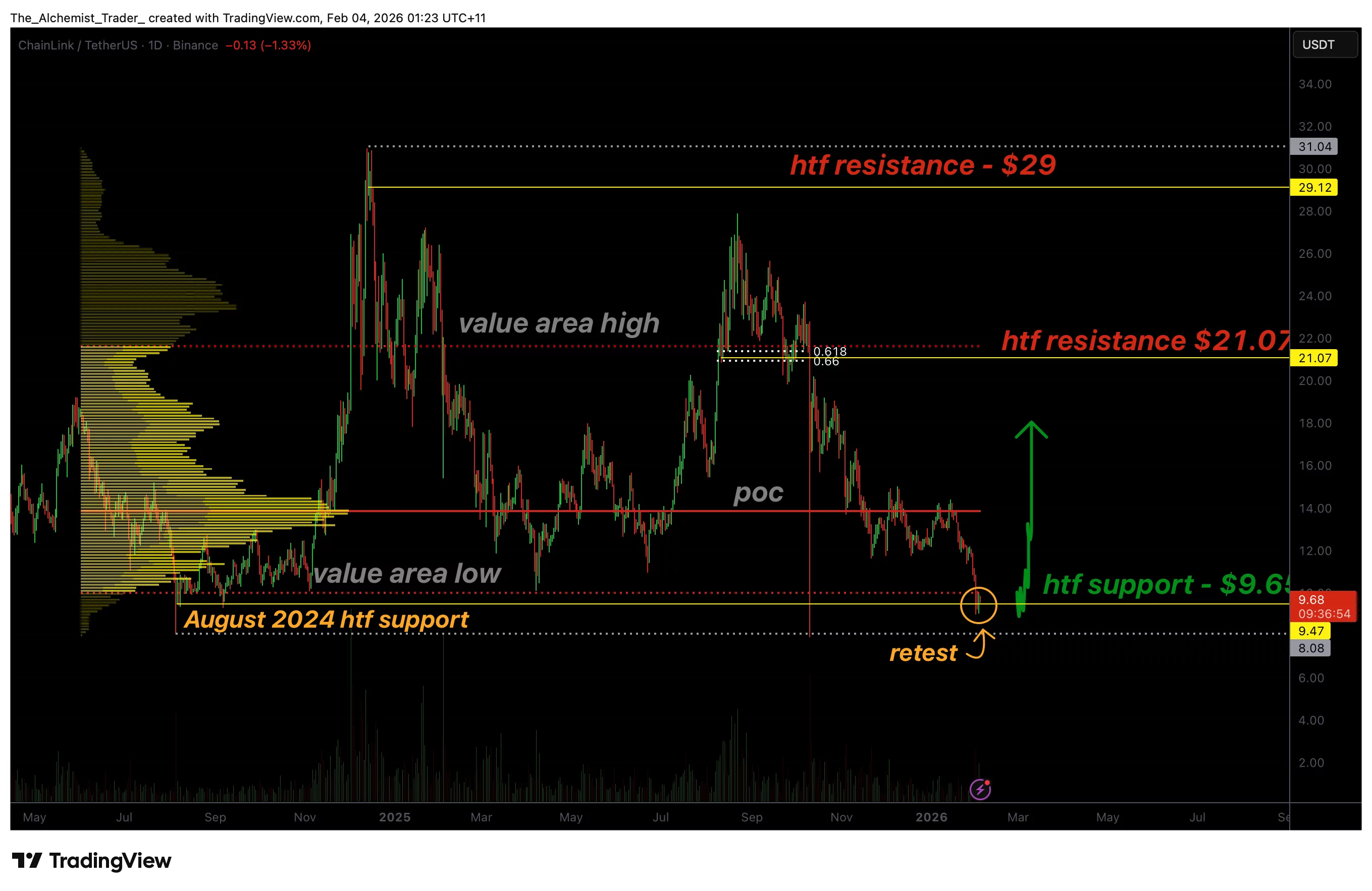
The current corrective phase on LINK began once the price lost acceptance below the value area high, which was situated near the $21 region.
This level previously served as a balance point between buyers and sellers, and its failure signaled a shift in control toward sellers.
Once value was lost, price transitioned from a balanced auction environment into a trending corrective move, resulting in accelerated selling pressure.
As is typical in such scenarios, LINK did not spend much time consolidating below the value area high. Instead, price moved swiftly through lower liquidity zones, targeting the next major area of historical interest.
This behavior reflects a lack of meaningful demand between $21 and the current support, reinforcing the importance of the $9.65 region as a potential stopping point for the decline.
Why the $9.65 level matters
The $9.65 level stands out as a critical support zone for several reasons. First, it represents a higher-timeframe support that has been defended multiple times over the past market cycles. Each prior interaction with this region has led to a bullish response, ranging from short-term relief rallies to more sustained upside rotations.
Second, the value area low is in close confluence with this level, increasing its technical relevance. When price reaches the value area low after an impulsive move, it often signals that the market has explored the lower boundary of fair value. At this stage, two outcomes are typically observed: either strong demand enters the market, leading to mean reversion, or price fails to attract buyers and continues into deeper discount zones.
Finally, the $9.65 area carries psychological importance as a long-standing reference point for market participants. Levels with this degree of historical interaction tend to attract attention from longer-term buyers, increasing the probability of at least a temporary reaction.
Upside targets a relief rally scenario
Should LINK successfully hold above $9.65 and attract sustained buying interest, the next upside targets are clearly defined. The first area of interest sits near the point of control (POC), where the highest volume has previously traded.
A move back toward the POC would represent a classic mean reversion following an impulsive sell-off.
Beyond that, the $21.07 resistance level stands out as a major higher-timeframe objective. This zone aligns closely with the previously lost value area high and would likely act as a significant test for any recovery attempt.
While a move from $9.65 to $21 would still be considered corrective within the broader structure, it would represent a substantial relief rally and a meaningful reset in market conditions.
What to expect in the coming price action
From a technical, price-action, and market-structure perspective, LINK is currently at a major decision point.
The $9.65 support level has strong historical significance and has previously produced bullish reactions, giving the market a credible foundation for a relief bounce.
If bullish volume begins to flow and price consolidates above this support, a rotation toward the POC and potentially the $21.07 resistance becomes increasingly likely.
Conversely, failure to attract demand would weaken the bullish case and expose LINK to further downside risk.
For now, all eyes remain on how price behaves at this long-term support, as the next sessions are likely to determine whether LINK stages a relief rally or continues its broader corrective trend.


You May Also Like

Tom Lee’s Bitmine Buys $82M ETH in Fresh Accumulation

Oil Prices Soar Past $111 as US-Iran War Threatens Bab el-Mandeb Strait




