Arbitrum has issued an urgent security alert after its ArbitrumDAO governance X account was compromised, with attackers posting phishing links disguised as airdropArbitrum has issued an urgent security alert after its ArbitrumDAO governance X account was compromised, with attackers posting phishing links disguised as airdrop

Arbitrum Issues Urgent Warning After Official X Account Compromised

4 min read

Arbitrum has issued an urgent security alert after its ArbitrumDAO governance X account was compromised, with attackers posting phishing links disguised as airdrop promotions.

The breach joins a relentless wave of social media takeovers targeting major crypto projects in early 2026.

The compromised account directed followers to a fraudulent link at gov-arbitrum[dot]com, claiming a confirmed “snapshot” would reward long-term participants for bridging, swapping, and governance activity.

Arbitrum’s official channels immediately urged the community to avoid all posts and interactions from the account until full access is restored.

Fake Airdrop Bait and the Anatomy of the Attack

The posts framed eligibility as exclusive to “real users,” separating long-term participants from “farmers” and “opportunists,” while reassuring latecomers that “this isn’t the end of airdrop season.

The language closely mimicked legitimate project communications, making the phishing link especially dangerous for active ecosystem members.
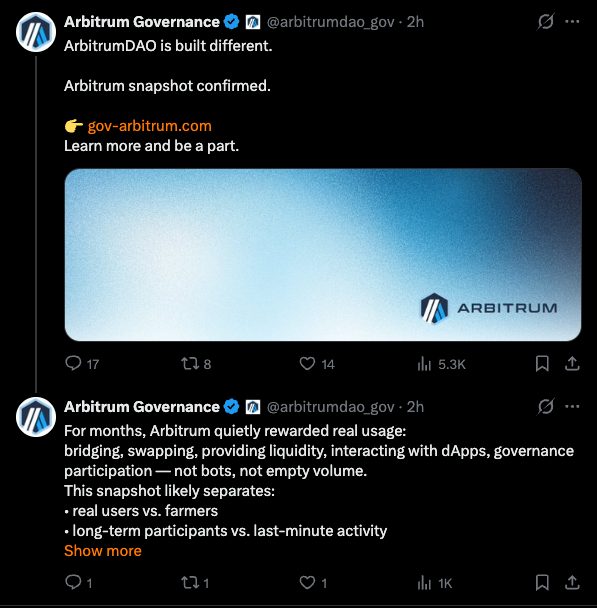
Arbitrum X Account Breach - X Post ImageX Post Screenshot

McKenna, managing partner at Arete Capital, has been on the front lines of these breaches.

I think I’ve helped around 5-7 people with X account hacks over the last month including Plasma and now Arbitrum,” he said, adding that the connection he made at X, following North Korean hacking his account, is helping in these instances.

His recommendation was pointed: “Please ensure you use a password manager with physical YubiKeys to secure everything. Don’t wait, do it today.

This latest account takeover comes as North Korean hackers have pushed cumulative crypto theft to $6.75 billion, personal wallet compromises have surged to 158,000 incidents in 2025, tripling the 2022 figure.

Arbitrum X Account Breach - Personal Wallet Theft Metrics ChartSource: Chainalysis

In fact, as reported by Cryptonews, wallet drainer losses, despite falling 83% to $84 million, remain a persistent threat.

High-Profile Crypto Accounts Breached Across Platforms

The Arbitrum hack follows a string of devastating compromises across the industry.

Scroll co-founder Ye Chen’s X account was hijacked in January, with attackers reshaping his profile to mimic X’s official branding and flooding his extensive network of crypto executives and developers with phishing messages disguised as copyright violation warnings.

BNB Chain’s official account was also breached in October, prompting Binance co-founder CZ to warn followers to “Please do not click on any links recently posted from this account.

Binance co-CEO Yi He’s WeChat account was separately hijacked in December, with attackers executing a pump-and-dump on the meme token MUBARA that netted roughly $55,000 before retail buyers were left exposed to a sharp price reversal.

ZKsync and Matter Labs were breached via delegated accounts, with attackers posting fake claims of an SEC investigation that sent ZK’s price down 5% despite a prior 38.5% weekly rally.

Watcher.Guru fell separately after fake Ripple-SWIFT partnership claims spread across Telegram, Discord, and Facebook via automated content bots.

Phishing Dominates as 2026 Opens With Record Losses

These attacks are unfolding against historic crypto crime levels, with the U.S. Marshals Service also confirming an investigation into a hack of federal digital-asset accounts.

TRM Labs reported $158 billion in illicit crypto activity in 2025, up 145% year-over-year, while Chainalysis documented over $3.4 billion in outright theft, with North Korean state hackers responsible for $2.02 billion.

Arbitrum X Account Breach - Total Value Received by Illicit Wallets ChartSource: TRM

2026 started even worse, with CertiK confirming roughly $370.3 million lost to exploits in January alone.

Phishing accounted for $311.3 million of that total, dwarfing the $51.5 million attributed to code vulnerabilities, as IPOR Labs’ $336,000 Arbitrum vault exploit compounded the damage.

A $282 million hardware wallet social engineering theft also set a new individual record, with the attacker converting stolen Bitcoin and Litecoin into Monero to obscure the trail.

Phishing has been a particular problem, with a December victim losing $50 million to address poisoning, while a separate $3.05 million USDT theft stemmed from signing a malicious transaction.

Beyond individual targets, hijacked YouTube accounts netted attackers over $939,000 through fake trading bot promotions. Even worse, Betterment users received phishing notifications promising to triple their Bitcoin and Ethereum deposits.

February also started with a massive hack, with Step Finance confirming multiple breaches of treasury and fee wallets that resulted in $30 million stolen.


Disclaimer: The articles reposted on this site are sourced from public platforms and are provided for informational purposes only. They do not necessarily reflect the views of MEXC. All rights remain with the original authors. If you believe any content infringes on third-party rights, please contact service@support.mexc.com for removal. MEXC makes no guarantees regarding the accuracy, completeness, or timeliness of the content and is not responsible for any actions taken based on the information provided. The content does not constitute financial, legal, or other professional advice, nor should it be considered a recommendation or endorsement by MEXC.

You May Also Like

The Role of Blockchain in Building Safer Web3 Gaming Ecosystems

The Role of Blockchain in Building Safer Web3 Gaming Ecosystems

The gaming industry is in the midst of a historic shift, driven by the rise of Web3. Unlike traditional games, where developers and publishers control assets and dictate in-game economies, Web3 gaming empowers players with ownership and influence. Built on blockchain technology, these ecosystems are decentralized by design, enabling true digital asset ownership, transparent economies, and a future where players help shape the games they play. However, as Web3 gaming grows, security becomes a focal point. The range of security concerns, from hacking to asset theft to vulnerabilities in smart contracts, is a significant issue that will undermine or erode trust in this ecosystem, limiting or stopping adoption. Blockchain technology could be used to create security processes around secure, transparent, and fair Web3 gaming ecosystems. We will explore how security is increasing within gaming ecosystems, which challenges are being overcome, and what the future of security looks like. Why is Security Important in Web3 Gaming? Web3 gaming differs from traditional gaming in that players engage with both the game and assets with real value attached. Players own in-game assets that exist as tokens or NFTs (Non-Fungible Tokens), and can trade and sell them. These game assets usually represent significant financial value, meaning security failure could represent real monetary loss. In essence, without security, the promises of owning “something” in Web3, decentralized economies within games, and all that comes with the term “fair” gameplay can easily be eroded by fraud, hacking, and exploitation. This is precisely why the uniqueness of blockchain should be emphasized in securing Web3 gaming. How Blockchain Ensures Security in Web3 Gaming?
  1. Immutable Ownership of Assets Blockchain records can be manipulated by anyone. If a player owns a sword, skin, or plot of land as an NFT, it is verifiably in their ownership, and it cannot be altered or deleted by the developer or even hacked. This has created a proven track record of ownership, providing control back to the players, unlike any centralised gaming platform where assets can be revoked.
  2. Decentralized Infrastructure Blockchain networks also have a distributed architecture where game data is stored in a worldwide network of nodes, making them much less susceptible to centralised points of failure and attacks. This decentralised approach makes it exponentially more difficult to hijack systems or even shut off the game’s economy.
  3. Secure Transactions with Cryptography Whether a player buys an NFT or trades their in-game tokens for other items or tokens, the transactions are enforced by cryptographic algorithms, ensuring secure, verifiable, and irreversible transactions and eliminating the risks of double-spending or fraudulent trades.
  4. Smart Contract Automation Smart contracts automate the enforcement of game rules and players’ economic exchanges for the developer, eliminating the need for intermediaries or middlemen, and trust for the developer. For example, if a player completes a quest that promises a reward, the smart contract will execute and distribute what was promised.
  5. Anti-Cheating and Fair Gameplay The naturally transparent nature of blockchain makes it extremely simple for anyone to examine a specific instance of gameplay and verify the economic outcomes from that play. Furthermore, multi-player games that enforce smart contracts on things like loot sharing or win sharing can automate and measure trustlessness and avoid cheating, manipulations, and fraud by developers.
  6. Cross-Platform Security Many Web3 games feature asset interoperability across platforms. This interoperability is made viable by blockchain, which guarantees ownership is maintained whenever assets transition from one game or marketplace to another, thereby offering protection to players who rely on transfers for security against fraud. Key Security Dangers in Web3 Gaming Although blockchain provides sound first principles of security, the Web3 gaming ecosystem is susceptible to threats. Some of the most serious threats include:
Smart Contract Vulnerabilities: Smart contracts that are poorly written or lack auditing will leave openings for exploitation and thereby result in asset loss. Phishing Attacks: Unintentionally exposing or revealing private keys or signing transactions that are not possible to reverse, under the assumption they were genuine transaction requests. Bridge Hacks: Cross-chain bridges, which allow players to move their assets between their respective blockchains, continually face hacks, requiring vigilance from players and developers. Scams and Rug Pulls: Rug pulls occur when a game project raises money and leaves, leaving player assets worthless. Regulatory Ambiguity: Global regulations remain unclear; risks exist for players and developers alike. While blockchain alone won’t resolve every issue, it remediates the responsibility of the first principles, more so when joined by processes such as auditing, education, and the right governance, which can improve their contribution to the security landscapes in game ecosystems. Real Life Examples of Blockchain Security in Web3 Gaming Axie Infinity (Ronin Hack): The Axie Infinity game and several projects suffered one of the biggest hacks thus far on its Ronin bridge; however, it demonstrated the effectiveness of multi-sig security and the effective utilization of decentralization. The industry benefited through learning and reflection, thus, as projects have implemented changes to reduce the risks of future hacks or misappropriation. Immutable X: This Ethereum scaling solution aims to ensure secure NFT transactions for gaming, allowing players to trade an asset without the burden of exorbitant fees and fears of being a victim of fraud. Enjin: Enjin is providing a trusted infrastructure for Web3 games, offering secure NFT creation and transfer while reiterating that ownership and an asset securely belong to the player. These examples indubitably illustrate that despite challenges to overcome, blockchain remains the foundational layer on which to build more secure Web3 gaming environments. Benefits of Blockchain Security for Players and Developers For Players: Confidence in true ownership of assets Transparency in in-game economies Protection against nefarious trades/scams For Developers: More trust between players and the platform Less reliance on centralized infrastructure Ability to attract wealth and players based on provable fairness By incorporating blockchain security within the mechanics of game design, developers can create and enforce resilient ecosystems where players feel reassured in investing time, money, and ownership within virtual worlds. The Future of Secure Web3 Gaming Ecosystems As the wisdom of blockchain technology and industry knowledge improves, the future for secure Web3 gaming looks bright. New growing trends include: Zero-Knowledge Proofs (ZKPs): A new wave of protocols that enable private transactions and secure smart contracts while managing user privacy with an element of transparency. Decentralized Identity Solutions (DID): Helping players control their identities and decrease account theft risks. AI-Enhanced Security: Identifying irregularities in user interactions by sampling pattern anomalies to avert hacks and fraud by time-stamping critical events. Interoperable Security Standards: Allowing secured and seamless asset transfers across blockchains and games. With these innovations, blockchain will not only secure gaming assets but also enhance the overall trust and longevity of Web3 gaming ecosystems. Conclusion Blockchain is more than a buzzword in Web3; it is the only way to host security, fairness, and transparency. With blockchain, players confirm immutable ownership of digital assets, there is a decentralized infrastructure, and finally, it supports smart contracts to automate code that protects players and developers from the challenges of digital economies. The threats, vulnerabilities, and scams that come from smart contracts still persist, but the industry is maturing with better security practices, cross-chain solutions, and increased formal cryptographic tools. In the coming years, blockchain will remain the base to digital economies and drive Web3 gaming environments that allow players to safely own, trade, and enjoy their digital experiences free from fraud and exploitation. While blockchain and gaming alone entertain, we will usher in an era of secure digital worlds where trust complements innovation. The Role of Blockchain in Building Safer Web3 Gaming Ecosystems was originally published in Coinmonks on Medium, where people are continuing the conversation by highlighting and responding to this story
Share
Medium2025/09/18 14:40
Vitalik Buterin Challenges Ethereum’s Layer 2 Paradigm

Vitalik Buterin Challenges Ethereum’s Layer 2 Paradigm

Vitalik Buterin challenges the role of layer 2 solutions in Ethereum's ecosystem. Layer 2's slow progress and Ethereum’s L1 scaling impact future strategies.
Share
Coinstats2026/02/04 04:08
USAA Names Dan Griffiths Chief Information Officer to Drive Secure, Simplified Digital Member Experiences

USAA Names Dan Griffiths Chief Information Officer to Drive Secure, Simplified Digital Member Experiences

SAN ANTONIO–(BUSINESS WIRE)–USAA today announced the appointment of Dan Griffiths as Chief Information Officer, effective February 5, 2026. A proven financial‑services
Share
AI Journal2026/02/04 04:15




