XRP has entered a critical phase after losing the $1.80 level and sliding toward the $1.60 zone, where price is now attempting to find short-term support. The moveXRP has entered a critical phase after losing the $1.80 level and sliding toward the $1.60 zone, where price is now attempting to find short-term support. The move

XRP Open Interest Falls to Lowest Level Since 2024: Market Reset Or Warning Signal?

4 min read

XRP has entered a critical phase after losing the $1.80 level and sliding toward the $1.60 zone, where price is now attempting to find short-term support. The move comes amid broader weakness across the crypto market, but XRP’s structure shows an additional layer of stress that goes beyond spot price action. According to a recent report from CryptoQuant, the derivatives side of the XRP market is undergoing a sharp contraction in leverage, signaling a meaningful shift in trader behavior.

Data shows that open interest across all XRP derivatives platforms has fallen to roughly 902 million, marking its lowest level since 2024. This is a stark contrast to conditions seen during 2025, when open interest consistently hovered between 2.5 and 3.0 billion. The magnitude of this decline suggests that leverage is being actively unwound rather than merely rotating between exchanges, pointing to a broader risk-off adjustment.

XRP Ledger Open Interest | Source: CryptoQuant

Such contractions often reflect a market that is de-risking after extended volatility. With fewer leveraged positions in play, price movements tend to become slower but more deliberate, as speculative excess is flushed out. As XRP tests the $1.60 area, analysts are closely watching whether this leverage reset lays the groundwork for stabilization—or signals deeper downside still ahead.

Leverage Reset Signals a Potential Base-Building Phase

The report adds important color by breaking down where the leverage reduction is taking place. On Binance, open interest in XRP derivatives has fallen to around 458 million. While this figure remains above the levels observed last December, it still represents a sharp contraction from the highs seen earlier in the cycle.

Crucially, this decline on Binance mirrors what is happening across other major trading venues, reinforcing the view that the market is undergoing a broad deleveraging phase rather than a simple migration of positions between exchanges.

From a structural standpoint, this matters. When open interest compresses simultaneously across platforms, it typically reflects traders actively reducing risk and closing leveraged exposure. This kind of environment often precedes periods of price consolidation, as the market digests prior volatility and searches for a new equilibrium. In past cycles, these phases have frequently led to the formation of base structures, particularly when selling pressure fades and volatility compresses.

Looking ahead, analysts note that any recovery in open interest will be critical to monitor. A rebound in leverage that coincides with improving price momentum could serve as an early signal that a new trend is developing.

For now, however, the drop in open interest to its lowest level since 2024 points to a clear market cleanup. While this reset may appear quiet on the surface, it can provide a healthier foundation for future moves—provided risk management remains front and center in the next phase of XRP’s market evolution.

XRP Price Showing Weakness

XRP price action continues to reflect structural weakness as the asset trades decisively below its key moving averages and tests the $1.60 zone for support. The chart shows a clear transition from a prior uptrend into a sustained downtrend, marked by lower highs and lower lows since the October peak near the $3.50–$3.60 region. Momentum has steadily deteriorated, with each rebound failing below the declining short- and medium-term moving averages, signaling persistent seller control.
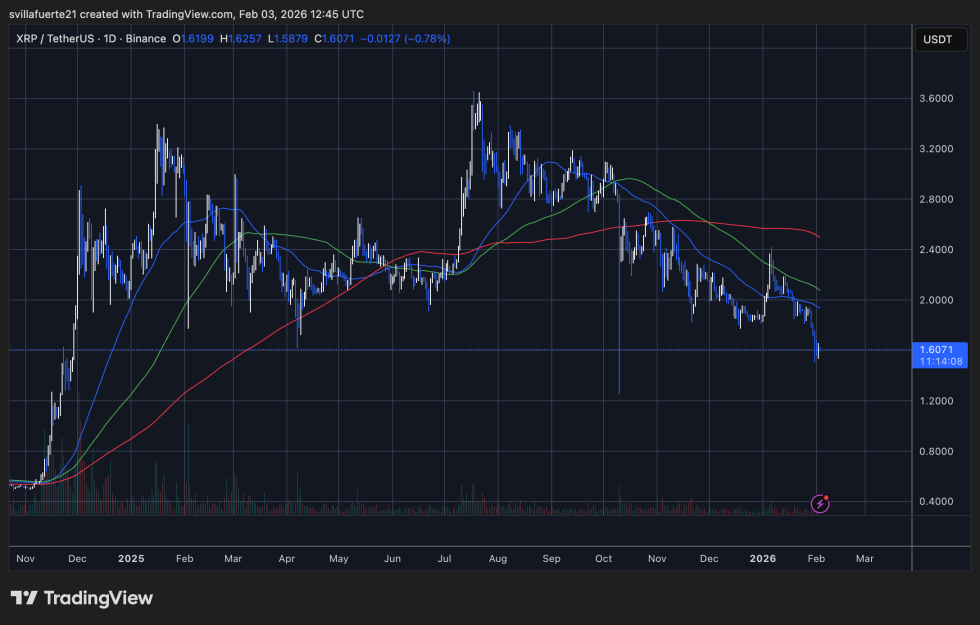
XRP testing critical demand level | Source: XRPUSDT chart on TradingView

The loss of the $1.80 level is technically significant. This zone previously acted as a consolidation base and demand area, but the clean breakdown suggests that buyers have stepped aside rather than aggressively defending the price. XRP is now trading below the 50-day and 100-day moving averages, while the 200-day moving average above continues to slope downward, reinforcing a bearish medium-term structure.

Volume remains relatively muted compared to earlier distribution phases, which aligns with the derivatives data showing a contraction in leverage rather than panic-driven liquidation. This supports the view that the current move is more of a controlled unwind than a capitulation event.

As long as price holds the $1.55–$1.60 region, XRP may attempt to stabilize and form a base. However, a failure to hold this area would expose the market to a deeper retracement toward prior demand zones near $1.30–$1.40.

Featured image from ChatGPT, chart from TradingView.com 

Disclaimer: The articles reposted on this site are sourced from public platforms and are provided for informational purposes only. They do not necessarily reflect the views of MEXC. All rights remain with the original authors. If you believe any content infringes on third-party rights, please contact service@support.mexc.com for removal. MEXC makes no guarantees regarding the accuracy, completeness, or timeliness of the content and is not responsible for any actions taken based on the information provided. The content does not constitute financial, legal, or other professional advice, nor should it be considered a recommendation or endorsement by MEXC.

You May Also Like

Regulatory Clarity Could Drive 40% of Americans to Adopt DeFi Protocols, Survey Shows

Regulatory Clarity Could Drive 40% of Americans to Adopt DeFi Protocols, Survey Shows

Over 40% of Americans express willingness to use decentralized finance (DeFi) protocols once regulatory clarity on crypto privacy emerges, according to a recent survey from crypto advocacy organization the DeFi Education Fund (DEF). The survey, released on September 18, revealed that many Americans feel frustrated with traditional financial institutions and seek greater control over their financial assets and data. Respondents believe DeFi innovations can deliver this change by providing affordability, equity, and consumer protection. The survey was conducted with Ipsos on KnowledgePanel and included supplementary in-depth interviews in the Bronx and Queens between August 18 and 21, polling 1,321 US adults. Survey Results Show Americans Ready to Adopt DeFi Protocols The findings demonstrate that many Americans are curious about DeFi despite its early stage. 42% of Americans indicated they would likely try DeFi if proposed legislation becomes law (9% extremely/very likely and 33% somewhat likely). 84% said they would use it to “make purchases online,” while 78% would use it to “pay bills.” According to the survey, 77% would use DeFi protocols to “save money,” and 12% of Americans are “extremely” and “very” interested in learning about DeFi. Moreover, nearly 4 in 10 Americans believe that DeFi can address high transaction and service fees found in traditional finance (39%). Consistent with other probability-based sample surveys, the Ipsos x DEF research shows that almost 1 in 5 Americans (18%) have owned or used crypto at some point in their lifetime. Nearly a quarter of Americans (22%) said they’re interested in learning more about nontraditional forms of finance, such as blockchain, crypto, or decentralized finance.Source: DEF The research shows that more than half (56%) of Americans want to reclaim control of their finances. Americans are interested in having control over their money at all times, and many seek ways to send or receive money without intermediaries. One Bronx, NY resident shared his experience of needing to transfer money between accounts, but the bank required him to certify the transfer and visit in person because he couldn’t move the amount he needed remotely. He expressed frustration about the situation because “it was my money… I didn’t understand why I was given a hard time.“ More than half of surveyed Americans agree there should be a way to digitally send money to people without third-party involvement, and this number rises notably for foreign-born Americans (66%). The researchers concluded that Americans are interested in DeFi and believe DeFi can reduce friction points in today’s financial system. Regulatory Developments on DeFi Adoption in the U.S Last month, DeFi Education Fund called on the US Senate Banking Committee to rethink how it plans to regulate the decentralized finance industry after reviewing its recently published discussion draft on a key crypto market-structure bill. The response, signed on behalf of DeFi Education Fund (DEF) members including a16z Crypto, Uniswap Labs, and Paradigm, argued the Responsible Financial Innovation Act of 2025 (RFA) bill should be crafted in a more tech-neutral manner. The group also emphasized that crypto developers should be protected from “inappropriate regulation meant for intermediaries,” and that self-custody rights for all Americans are “essential.” The banking committee is now working on the discussion draft to help ensure it builds on the Digital Asset Market Clarity Act of 2025. The goal is to promote innovation in the $162 billion DeFi industry without compromising consumer protections or financial stability. On September 5, US Federal Reserve Governor Christopher Waller said there was “nothing to be afraid of” about crypto payments operating outside the traditional banking system. This statement has raised hopes among many that DeFi would soon become the new financial infrastructure for Americans and the world
Share
CryptoNews2025/09/18 21:29
Michael Burry’s Bitcoin Warning: Crypto Crash Could Drag Down Gold and Silver Markets

Michael Burry’s Bitcoin Warning: Crypto Crash Could Drag Down Gold and Silver Markets

TLDR Michael Burry warned that bitcoin’s drop below $73,000 may have forced institutions to sell up to $1 billion in gold and silver to cover crypto losses Burry
Share
Coincentral2026/02/04 15:28
Michelin-starred dimsum chain Tim Ho Wan doubles HK footprint with 10th store

Michelin-starred dimsum chain Tim Ho Wan doubles HK footprint with 10th store

For Tim Ho Wan’s chief executive officer Young Sheng Lee, the brand’s aggressive expansion in its home turf helped create a proven growth model that can be replicated
Share
Rappler2026/02/04 15:27





