Hyperliquid (HYPE) is trading in red at around $37.50 on Wednesday after failing to close above a key resistance earlier this week. This downturn is further supported by on-chain and derivatives metrics, which show HYPE’s rising sell dominant phase and short positions hitting a one-month high.Hyperliquid (HYPE) is trading in red at around $37.50 on Wednesday after failing to close above a key resistance earlier this week. This downturn is further supported by on-chain and derivatives metrics, which show HYPE’s rising sell dominant phase and short positions hitting a one-month high.

Hyperliquid Price Forecast: Bears aim for levels below $30 as short bets rise

  • Hyperliquid extends losses after falling to close above a key resistance level earlier this week.
  • On-chain and derivatives data support the bearish outlook as Spot Taker CVD is in negative territory and short positions hit a one-month high.
  • The technical outlook suggests a correction, with bears targeting levels below $30.

Hyperliquid (HYPE) is trading in red at around $37.50 on Wednesday after failing to close above a key resistance earlier this week. This downturn is further supported by on-chain and derivatives metrics, which show HYPE’s rising sell dominant phase and short positions hitting a one-month high. The technical analysis suggests a potential downward trend continuation, targeting levels below $30.

Hyperliquid on-chain, derivatives metrics turn bearish

CryptoQuant data highlights the rising selling pressure on Hyperliquid. The Taker CVD (Cumulative Volume Delta) for HYPE is negative, and its value has been steadily decreasing since mid-July. This metric measures the cumulative difference between market buy and sell volumes over three months. When the three-month CVD is positive and increasing, it suggests the Taker Buy Dominant Phase, while a negative and decreasing value, as it is currently happening, indicates the Taker Sell Dominant Phase.
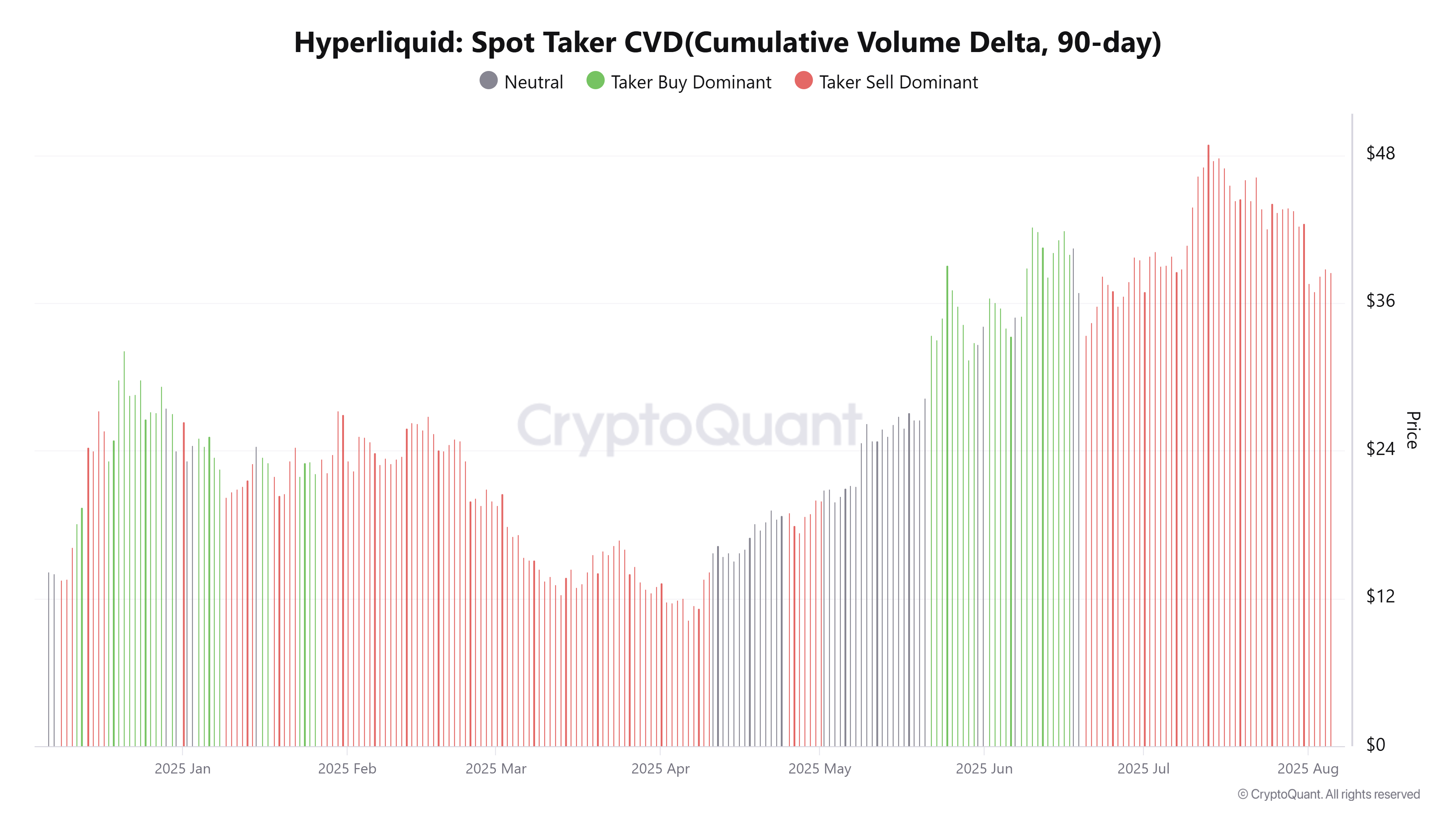
Hyperliquid Spot Taker CVD chart. Source: CryptoQuant

Hyperliquid Spot Taker CVD chart. Source: CryptoQuant

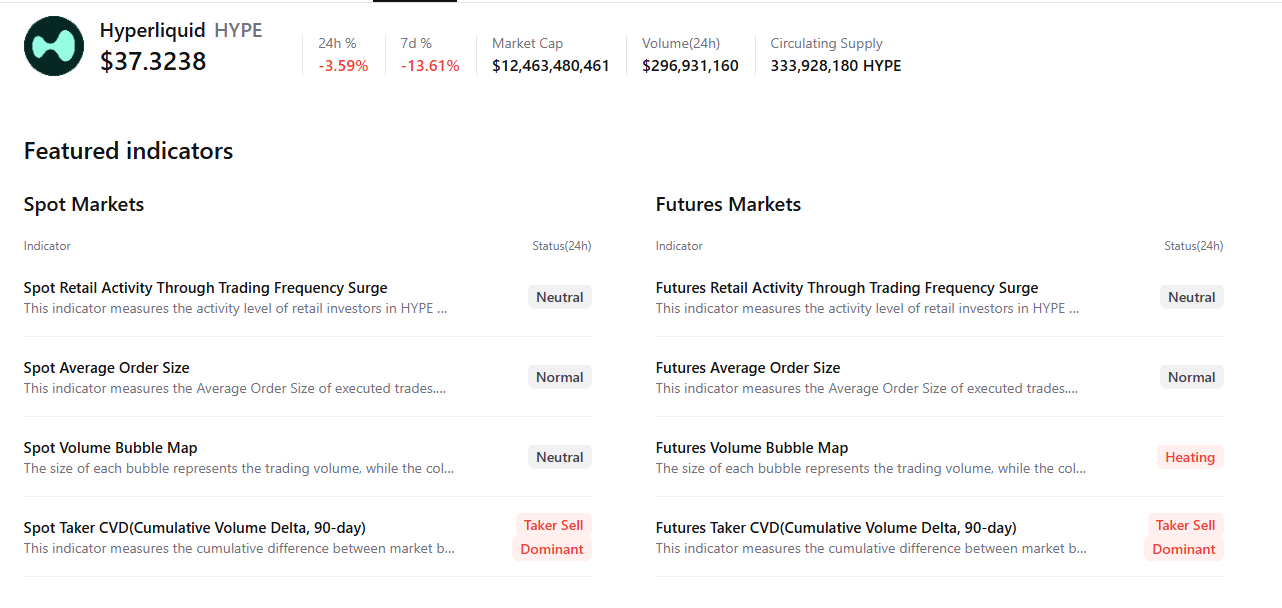
CryptoQuant’s summary data also indicates that Hyperliquid’s futures market activity is heating up as more traders are opening leveraged positions alongside negative Spot Taker CVD, signaling a potential correction ahead.
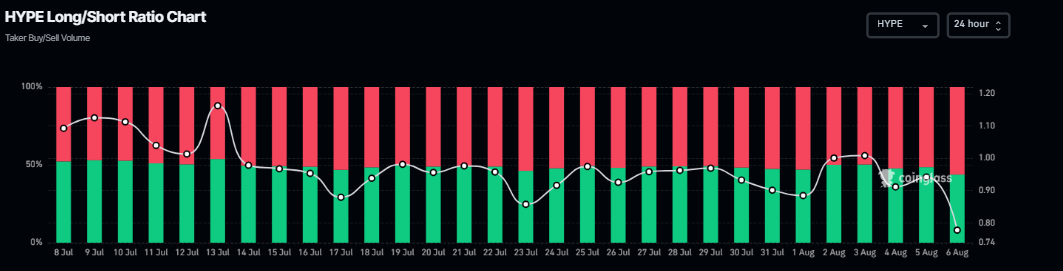
The bearish outlook is further supported by Coinglass' long-to-short ratio, which stands at 0.77 on Wednesday, marking the lowest level in over a month. A ratio below one suggests bearish sentiment in the market as traders are betting that the asset price will fall.
Hyperliquid Spot Taker CVD chart. Source: CryptoQuant

HYPE long-to-short ratio chart. Source: CoinGlass

Hyperliquid Price Forecast: Bears targeting levels below $30

Hyperliquid price broke below the ascending trendline (drawn by connecting multiple lows since early April) on Thursday and declined 10.34%, closing below the daily support at $38.87 in the next two days.

However, HYPE recovered slightly from Sunday to Monday but failed to close above its daily resistance at $38.87 and declined slightly the next day. At the time of writing on Wednesday, it continues to trade down around $37.64.

If HYPE continues its downward trend, it could retest its 61.80% Fibonacci retracement level at $34.40 (drawn from April's low of $9.32 to July's all-time high of $49.88). A successful close below this level could extend the loss to retest its weekly level at $27.49.

The Relative Strength Index (RSI) on the daily chart reads 39, below its neutral value of 50, indicating strong bearish momentum. The Moving Average Convergence Divergence (MACD) showed a bearish crossover on July 23 that still holds, also indicating bearish momentum.
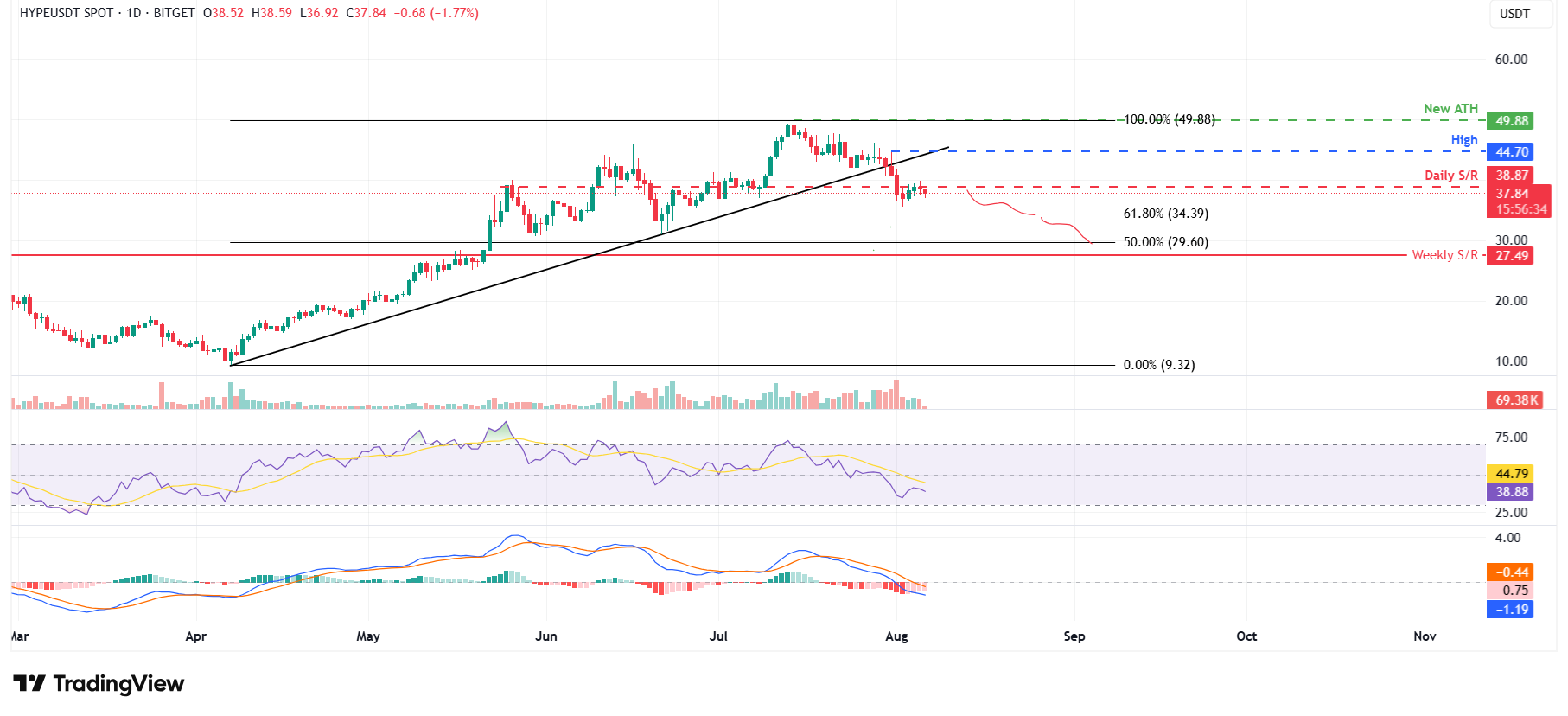
HYPE/USDT daily chart 

HYPE/USDT daily chart 

If HYPE closes above the daily resistance at $38.87, it could extend the recovery toward the July 31 high of $44.70.


Market Opportunity
Hyperliquid Logo
Hyperliquid Price(HYPE)
$25.87
$25.87$25.87
-0.61%
USD
Hyperliquid (HYPE) Live Price Chart
Disclaimer: The articles reposted on this site are sourced from public platforms and are provided for informational purposes only. They do not necessarily reflect the views of MEXC. All rights remain with the original authors. If you believe any content infringes on third-party rights, please contact service@support.mexc.com for removal. MEXC makes no guarantees regarding the accuracy, completeness, or timeliness of the content and is not responsible for any actions taken based on the information provided. The content does not constitute financial, legal, or other professional advice, nor should it be considered a recommendation or endorsement by MEXC.

You May Also Like

The Channel Factories We’ve Been Waiting For

The Channel Factories We’ve Been Waiting For

The post The Channel Factories We’ve Been Waiting For appeared on BitcoinEthereumNews.com. Visions of future technology are often prescient about the broad strokes while flubbing the details. The tablets in “2001: A Space Odyssey” do indeed look like iPads, but you never see the astronauts paying for subscriptions or wasting hours on Candy Crush.  Channel factories are one vision that arose early in the history of the Lightning Network to address some challenges that Lightning has faced from the beginning. Despite having grown to become Bitcoin’s most successful layer-2 scaling solution, with instant and low-fee payments, Lightning’s scale is limited by its reliance on payment channels. Although Lightning shifts most transactions off-chain, each payment channel still requires an on-chain transaction to open and (usually) another to close. As adoption grows, pressure on the blockchain grows with it. The need for a more scalable approach to managing channels is clear. Channel factories were supposed to meet this need, but where are they? In 2025, subnetworks are emerging that revive the impetus of channel factories with some new details that vastly increase their potential. They are natively interoperable with Lightning and achieve greater scale by allowing a group of participants to open a shared multisig UTXO and create multiple bilateral channels, which reduces the number of on-chain transactions and improves capital efficiency. Achieving greater scale by reducing complexity, Ark and Spark perform the same function as traditional channel factories with new designs and additional capabilities based on shared UTXOs.  Channel Factories 101 Channel factories have been around since the inception of Lightning. A factory is a multiparty contract where multiple users (not just two, as in a Dryja-Poon channel) cooperatively lock funds in a single multisig UTXO. They can open, close and update channels off-chain without updating the blockchain for each operation. Only when participants leave or the factory dissolves is an on-chain transaction…
Share
BitcoinEthereumNews2025/09/18 00:09
Trading time: Tonight, the US GDP and the upcoming non-farm data will become the market focus. Institutions are bullish on BTC to $120,000 in the second quarter.

Trading time: Tonight, the US GDP and the upcoming non-farm data will become the market focus. Institutions are bullish on BTC to $120,000 in the second quarter.

Daily market key data review and trend analysis, produced by PANews.
Share
PANews2025/04/30 13:50
South Korean Court Sentences Crypto Exchange Employee for Espionage

South Korean Court Sentences Crypto Exchange Employee for Espionage

The post South Korean Court Sentences Crypto Exchange Employee for Espionage appeared on BitcoinEthereumNews.com. Key Points: Employee sentenced for espionage involving
Share
BitcoinEthereumNews2025/12/30 04:09