The U.S.-listed Bitcoin-tracking exchange-traded funds have finally broken their losing streak, snapping back with a positive trading session after days of heavy outflows. According to SoSoValue data, Bitcoin ETFs pulled in approximately $91.6 million in net inflows on August 6.…The U.S.-listed Bitcoin-tracking exchange-traded funds have finally broken their losing streak, snapping back with a positive trading session after days of heavy outflows. According to SoSoValue data, Bitcoin ETFs pulled in approximately $91.6 million in net inflows on August 6.…

Bitcoin ETFs end 4-day bleeding streak with $92M inflows, can BTC follow?

The U.S.-listed Bitcoin-tracking exchange-traded funds have finally broken their losing streak, snapping back with a positive trading session after days of heavy outflows.

Summary
  • U.S.-listed Bitcoin ETFs pulled in $91.6 million in net inflows on August 6, snapping a multi-day outflow streak.
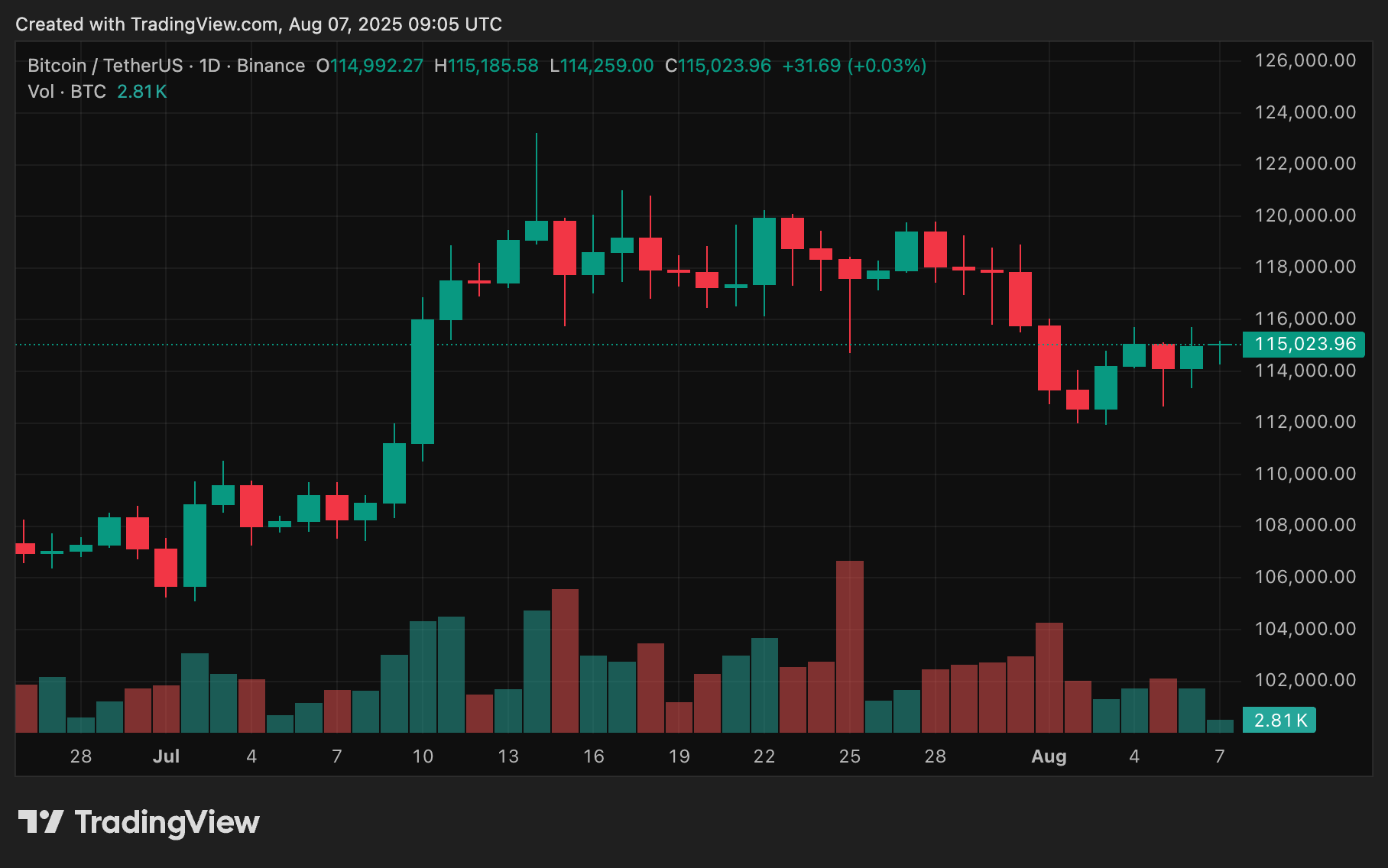
  • Bitcoin is currently hovering near $115,000, down about 6.5% below its $123,000 all-time high.
  • Analysts say the next key level to watch is $117,200.

According to SoSoValue data, Bitcoin ETFs pulled in approximately $91.6 million in net inflows on August 6. This marked a recovery after four straight sessions of outflows, during which the funds lost over $1.5 billion.

BlackRock’s IBIT led the charge, pulling in $42 million. Bitwise’s BITB followed with $26.4 million, while Grayscale’s GBTC logged $14.5 million in inflows. VanEck’s HODL joined the trend with more modest numbers, recording $4.1 million. However, not every fund joined the rebound, as Ark & 21Shares’ ARKB posted $5.4 million in outflows.

The funds’ four-day slump came as Bitcoin (BTC) itself struggled, slipping below the $120,000 mark after a strong rally. With money now flowing back into the ETFs, the question is whether Bitcoin’s price action will follow the same path.

Can Bitcoin reclaim $120,000?

At the time of writing, Bitcoin is hovering around $115,023, up 0.89% on the day. The asset has moved mostly sideways in recent weeks, stuck below the $115,000 mark since early August.
Bitcoin ETFs end 4-day bleeding streak with $92M inflows, can BTC follow? - 1

Bitcoin is down about 3% on the week, and approximately 6.5% from its $123,000 all-time high. The slump in price has been largely attributed to profit-taking efforts among both retail and institutional investors, who are seeking to cash out after the latest rally.

But market data shows that the selling trend is now easing. According to an August 6 Glassnode report, only 45% of recent Bitcoin offloads came from holders in profit. This suggests that the sell pressure is cooling off, and the relief is expected to help steady prices in the near term.

However, for BTC to recover and push higher, the combination of heavy institutional inflows from the ETFs and corporate buying, which served as the main catalyst of the latest rally, will need to return. While the recent ETF inflows are modest compared to July’s peak, corporate interest hasn’t cooled. More public companies continue to add BTC to their balance sheets, painting an optimistic picture. 

Technically, analysts have set $117,200 as the key zone to watch. According to market watcher Rekt Capital, if Bitcoin can break above this mark and hold, it would show strength and could open the door to further gains. However, if prices keep getting rejected, it could be a sign that the rally is losing steam.


Market Opportunity
Bitcoin Logo
Bitcoin Price(BTC)
$93,453.79
$93,453.79$93,453.79
+0.01%
USD
Bitcoin (BTC) Live Price Chart
Disclaimer: The articles reposted on this site are sourced from public platforms and are provided for informational purposes only. They do not necessarily reflect the views of MEXC. All rights remain with the original authors. If you believe any content infringes on third-party rights, please contact service@support.mexc.com for removal. MEXC makes no guarantees regarding the accuracy, completeness, or timeliness of the content and is not responsible for any actions taken based on the information provided. The content does not constitute financial, legal, or other professional advice, nor should it be considered a recommendation or endorsement by MEXC.

You May Also Like

The Channel Factories We’ve Been Waiting For

The Channel Factories We’ve Been Waiting For

The post The Channel Factories We’ve Been Waiting For appeared on BitcoinEthereumNews.com. Visions of future technology are often prescient about the broad strokes while flubbing the details. The tablets in “2001: A Space Odyssey” do indeed look like iPads, but you never see the astronauts paying for subscriptions or wasting hours on Candy Crush.  Channel factories are one vision that arose early in the history of the Lightning Network to address some challenges that Lightning has faced from the beginning. Despite having grown to become Bitcoin’s most successful layer-2 scaling solution, with instant and low-fee payments, Lightning’s scale is limited by its reliance on payment channels. Although Lightning shifts most transactions off-chain, each payment channel still requires an on-chain transaction to open and (usually) another to close. As adoption grows, pressure on the blockchain grows with it. The need for a more scalable approach to managing channels is clear. Channel factories were supposed to meet this need, but where are they? In 2025, subnetworks are emerging that revive the impetus of channel factories with some new details that vastly increase their potential. They are natively interoperable with Lightning and achieve greater scale by allowing a group of participants to open a shared multisig UTXO and create multiple bilateral channels, which reduces the number of on-chain transactions and improves capital efficiency. Achieving greater scale by reducing complexity, Ark and Spark perform the same function as traditional channel factories with new designs and additional capabilities based on shared UTXOs.  Channel Factories 101 Channel factories have been around since the inception of Lightning. A factory is a multiparty contract where multiple users (not just two, as in a Dryja-Poon channel) cooperatively lock funds in a single multisig UTXO. They can open, close and update channels off-chain without updating the blockchain for each operation. Only when participants leave or the factory dissolves is an on-chain transaction…
Share
BitcoinEthereumNews2025/09/18 00:09
Onyxcoin Price Breakout Coming — Is a 38% Move Next?

Onyxcoin Price Breakout Coming — Is a 38% Move Next?

The post Onyxcoin Price Breakout Coming — Is a 38% Move Next? appeared on BitcoinEthereumNews.com. Onyxcoin price action has entered a tense standoff between bulls
Share
BitcoinEthereumNews2026/01/14 00:33
Buterin pushes Layer 2 interoperability as cornerstone of Ethereum’s future

Buterin pushes Layer 2 interoperability as cornerstone of Ethereum’s future

Ethereum founder, Vitalik Buterin, has unveiled new goals for the Ethereum blockchain today at the Japan Developer Conference. The plan lays out short-term, mid-term, and long-term goals touching on L2 interoperability and faster responsiveness among others. In terms of technology, he said again that he is sure that Layer 2 options are the best way […]
Share
Cryptopolitan2025/09/18 01:15