The Ethereum Foundation has once again thrown its support behind Tornado Cash developer Roman Storm, pledging $500,000 in donations to fund the privacy-protocol developer’s legal defense. This announcement comes just days after the Tornado Cash co-founder was convicted on one of three federal charges that legal experts warn could set a dangerous precedent for criminalizing open-source development. Privacy is normal, and writing code is not a crime. https://t.co/BD55K5GDW3 — Ethereum (@ethereum) August 7, 2025 In an August 7 announcement , Hsiao-Wei Wang, co-executive director of the Ethereum Foundation, disclosed details of the donation and called upon the broader crypto community to contribute to the Tornado Cash developer’s legal defense fund. Ethereum Foundation Support Ambitious $7M donation goal as Storm Faces 5-Year Prison According to the “ freeromanstorm ” donation tracker, the Ethereum Foundation has contributed only 2% of the $500,000 target, while total legal fund support received by the Tornado Cash developer currently exceeds $4.7 million, still 31% short of the ambitious $7 million goal. Source: Free Roman Storm Supporting Roman Storm’s cause, Wang emphasized that “Privacy is normal, and writing code is not a crime.” Storm himself has been actively soliciting public contributions to his legal defense fund. A July 26 X post from the Tornado Cash developer urgently stated: “We’re running out of time — legal costs are piling up fast, and we urgently need your help.” The current legal urgency and plea for donations comes as a Manhattan jury on August 6 found Storm guilty of conspiring to operate an unlicensed money transmitter. Coin Center’s Seven Takeaways from the Storm Verdict: ▪️ 1. The sole conviction—unlicensed money transmission (18 U.S.C. § 1960)—turns mainly on legal/regulatory interpretation (“does this count as money transmission?”), not jury fact-finding. ▪️ 2. The court, at the… — Peter Van Valkenburgh (@valkenburgh) August 6, 2025 However, jurors remained deadlocked on separate conspiracy charges for money laundering and sanctions evasion after four days of deliberation. Under 18 U.S. Code Section 1960 , Storm was convicted of operating an unlicensed money transmitting business, which stipulates that anyone who “knowingly conducts, controls, manages, supervises, directs, or owns all or part of an unlicensed money transmitting business, shall be fined under this title or imprisoned not more than 5 years, or both.” The Free Pertsev & Storm legal aid organization highlighted the urgency of continued funding, confirming that Storm “risks up to 5 years of jail time if he doesn’t win the appeal, and potentially decades if the government decides to retry Counts 1 & 3.” Counts 1 and 3, which remain in legal deadlock, include charges of conspiracy to commit money laundering and conspiracy to violate U.S. sanctions, respectively. Roman has been convicted on Count 2 of conspiracy to Operate an Unlicensed Money Transmitting Business (max sentence of 5 years in prison). Here's a good thread by @valkenburgh about this charge + why it makes no sense: https://t.co/GlyEj9kPyy — Free Pertsev & Storm (@FreeAlexeyRoman) August 6, 2025 The organization noted that this case’s outcome “will set a major precedent for developers worldwide.” “Sad Day for DeFi”: Crypto Lawyers And Community Rally Support for Tornado Cash Developers The crypto community has widely criticized the unfairness of Storm’s case. On August 6, crypto lawyer Jake Chervinsky called the recent verdict “a sad day for DeFi,” arguing that “the government should never have brought this case.” He contended that Section 1960 should not apply to developers of non-custodial protocols who lack control over user funds. The government should never have brought this case. Section 1960 should not apply to the developer of a non-custodial protocol who lacks control of user funds. This case should go up on appeal. Hopefully the Second Circuit will correct this (and many other) errors in the case. — Jake Chervinsky (@jchervinsky) August 6, 2025 Chervinsky urged the case to proceed on appeal, expressing hope that “the Second Circuit will correct this (and many other) errors.” Storm’s legal difficulties stem from his role in developing Tornado Cash, a cryptocurrency mixer that enables users to obscure transaction histories by pooling funds with other users. The U.S. Treasury Department sanctioned the protocol in August 2022, alleging that $7 billion had been laundered through the platform since 2019, including frequent use by North Korea’s Lazarus Group hackers. Federal prosecutors characterized Storm as someone who profited from “hiding dirty money for criminals.” At the same time, his defense team argued that Tornado Cash was designed as a privacy tool for legitimate users, not specifically for illicit activities. Storm was indicted on these charges and sanctions violations alongside Tornado Cash co-founder Roman Semenov and Alexey Pertsev, another developer associated with the cryptocurrency-mixing platform. Tornado Cash users, developers, and crypto executives continue challenging the Treasury’s sanctions in court, arguing that the platform’s immutable smart contracts should not be subject to OFAC restrictions. 👨‍⚖️ Roman Storm, co-founder of the crypto mixing platform Tornado Cash, is urging a U.S. federal judge to dismiss all criminal charges against him. #TornadoCash #Storm https://t.co/UR6SpxMSw3 — Cryptonews.com (@cryptonews) December 20, 2024 On March 24, Coinbase’s Chief Legal Officer, Paul Grewal, demanded a final court judgment in the Tornado Case, despite the U.S. Department of the Treasury’s decision to delist the crypto mixer.The Ethereum Foundation has once again thrown its support behind Tornado Cash developer Roman Storm, pledging $500,000 in donations to fund the privacy-protocol developer’s legal defense. This announcement comes just days after the Tornado Cash co-founder was convicted on one of three federal charges that legal experts warn could set a dangerous precedent for criminalizing open-source development. Privacy is normal, and writing code is not a crime. https://t.co/BD55K5GDW3 — Ethereum (@ethereum) August 7, 2025 In an August 7 announcement , Hsiao-Wei Wang, co-executive director of the Ethereum Foundation, disclosed details of the donation and called upon the broader crypto community to contribute to the Tornado Cash developer’s legal defense fund. Ethereum Foundation Support Ambitious $7M donation goal as Storm Faces 5-Year Prison According to the “ freeromanstorm ” donation tracker, the Ethereum Foundation has contributed only 2% of the $500,000 target, while total legal fund support received by the Tornado Cash developer currently exceeds $4.7 million, still 31% short of the ambitious $7 million goal. Source: Free Roman Storm Supporting Roman Storm’s cause, Wang emphasized that “Privacy is normal, and writing code is not a crime.” Storm himself has been actively soliciting public contributions to his legal defense fund. A July 26 X post from the Tornado Cash developer urgently stated: “We’re running out of time — legal costs are piling up fast, and we urgently need your help.” The current legal urgency and plea for donations comes as a Manhattan jury on August 6 found Storm guilty of conspiring to operate an unlicensed money transmitter. Coin Center’s Seven Takeaways from the Storm Verdict: ▪️ 1. The sole conviction—unlicensed money transmission (18 U.S.C. § 1960)—turns mainly on legal/regulatory interpretation (“does this count as money transmission?”), not jury fact-finding. ▪️ 2. The court, at the… — Peter Van Valkenburgh (@valkenburgh) August 6, 2025 However, jurors remained deadlocked on separate conspiracy charges for money laundering and sanctions evasion after four days of deliberation. Under 18 U.S. Code Section 1960 , Storm was convicted of operating an unlicensed money transmitting business, which stipulates that anyone who “knowingly conducts, controls, manages, supervises, directs, or owns all or part of an unlicensed money transmitting business, shall be fined under this title or imprisoned not more than 5 years, or both.” The Free Pertsev & Storm legal aid organization highlighted the urgency of continued funding, confirming that Storm “risks up to 5 years of jail time if he doesn’t win the appeal, and potentially decades if the government decides to retry Counts 1 & 3.” Counts 1 and 3, which remain in legal deadlock, include charges of conspiracy to commit money laundering and conspiracy to violate U.S. sanctions, respectively. Roman has been convicted on Count 2 of conspiracy to Operate an Unlicensed Money Transmitting Business (max sentence of 5 years in prison). Here's a good thread by @valkenburgh about this charge + why it makes no sense: https://t.co/GlyEj9kPyy — Free Pertsev & Storm (@FreeAlexeyRoman) August 6, 2025 The organization noted that this case’s outcome “will set a major precedent for developers worldwide.” “Sad Day for DeFi”: Crypto Lawyers And Community Rally Support for Tornado Cash Developers The crypto community has widely criticized the unfairness of Storm’s case. On August 6, crypto lawyer Jake Chervinsky called the recent verdict “a sad day for DeFi,” arguing that “the government should never have brought this case.” He contended that Section 1960 should not apply to developers of non-custodial protocols who lack control over user funds. The government should never have brought this case. Section 1960 should not apply to the developer of a non-custodial protocol who lacks control of user funds. This case should go up on appeal. Hopefully the Second Circuit will correct this (and many other) errors in the case. — Jake Chervinsky (@jchervinsky) August 6, 2025 Chervinsky urged the case to proceed on appeal, expressing hope that “the Second Circuit will correct this (and many other) errors.” Storm’s legal difficulties stem from his role in developing Tornado Cash, a cryptocurrency mixer that enables users to obscure transaction histories by pooling funds with other users. The U.S. Treasury Department sanctioned the protocol in August 2022, alleging that $7 billion had been laundered through the platform since 2019, including frequent use by North Korea’s Lazarus Group hackers. Federal prosecutors characterized Storm as someone who profited from “hiding dirty money for criminals.” At the same time, his defense team argued that Tornado Cash was designed as a privacy tool for legitimate users, not specifically for illicit activities. Storm was indicted on these charges and sanctions violations alongside Tornado Cash co-founder Roman Semenov and Alexey Pertsev, another developer associated with the cryptocurrency-mixing platform. Tornado Cash users, developers, and crypto executives continue challenging the Treasury’s sanctions in court, arguing that the platform’s immutable smart contracts should not be subject to OFAC restrictions. 👨‍⚖️ Roman Storm, co-founder of the crypto mixing platform Tornado Cash, is urging a U.S. federal judge to dismiss all criminal charges against him. #TornadoCash #Storm https://t.co/UR6SpxMSw3 — Cryptonews.com (@cryptonews) December 20, 2024 On March 24, Coinbase’s Chief Legal Officer, Paul Grewal, demanded a final court judgment in the Tornado Case, despite the U.S. Department of the Treasury’s decision to delist the crypto mixer.

Ethereum Foundation Backs Tornado Cash Developer with $500K Legal Defense Fund

The Ethereum Foundation has once again thrown its support behind Tornado Cash developer Roman Storm, pledging $500,000 in donations to fund the privacy-protocol developer’s legal defense.

This announcement comes just days after the Tornado Cash co-founder was convicted on one of three federal charges that legal experts warn could set a dangerous precedent for criminalizing open-source development.

In an August 7 announcement, Hsiao-Wei Wang, co-executive director of the Ethereum Foundation, disclosed details of the donation and called upon the broader crypto community to contribute to the Tornado Cash developer’s legal defense fund.

Ethereum Foundation Support Ambitious $7M donation goal as Storm Faces 5-Year Prison

According to the “freeromanstorm” donation tracker, the Ethereum Foundation has contributed only 2% of the $500,000 target, while total legal fund support received by the Tornado Cash developer currently exceeds $4.7 million, still 31% short of the ambitious $7 million goal.
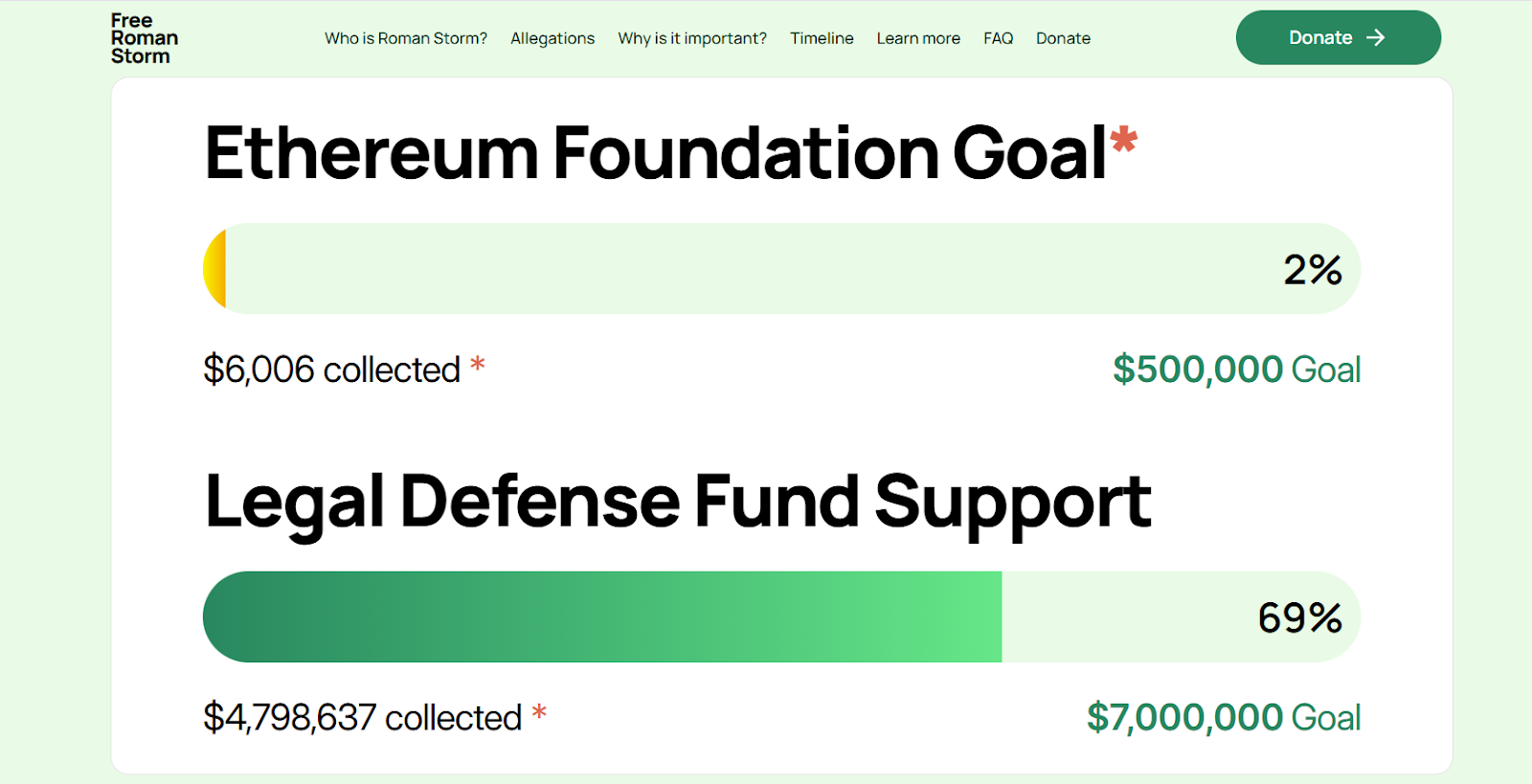
Ethereum Foundation Backs Tornado Cash Developer with $500K Legal Defense FundSource: Free Roman Storm

Supporting Roman Storm’s cause, Wang emphasized that “Privacy is normal, and writing code is not a crime.”

Storm himself has been actively soliciting public contributions to his legal defense fund.

A July 26 X post from the Tornado Cash developer urgently stated: “We’re running out of time — legal costs are piling up fast, and we urgently need your help.”

The current legal urgency and plea for donations comes as a Manhattan jury on August 6 found Storm guilty of conspiring to operate an unlicensed money transmitter.

However, jurors remained deadlocked on separate conspiracy charges for money laundering and sanctions evasion after four days of deliberation.

Under 18 U.S. Code Section 1960, Storm was convicted of operating an unlicensed money transmitting business, which stipulates that anyone who “knowingly conducts, controls, manages, supervises, directs, or owns all or part of an unlicensed money transmitting business, shall be fined under this title or imprisoned not more than 5 years, or both.”

The Free Pertsev & Storm legal aid organization highlighted the urgency of continued funding, confirming that Storm “risks up to 5 years of jail time if he doesn’t win the appeal, and potentially decades if the government decides to retry Counts 1 & 3.”

Counts 1 and 3, which remain in legal deadlock, include charges of conspiracy to commit money laundering and conspiracy to violate U.S. sanctions, respectively.

The organization noted that this case’s outcome “will set a major precedent for developers worldwide.”

“Sad Day for DeFi”: Crypto Lawyers And Community Rally Support for Tornado Cash Developers

The crypto community has widely criticized the unfairness of Storm’s case.

On August 6, crypto lawyer Jake Chervinsky called the recent verdict “a sad day for DeFi,” arguing that “the government should never have brought this case.”

He contended that Section 1960 should not apply to developers of non-custodial protocols who lack control over user funds.

Chervinsky urged the case to proceed on appeal, expressing hope that “the Second Circuit will correct this (and many other) errors.”

Storm’s legal difficulties stem from his role in developing Tornado Cash, a cryptocurrency mixer that enables users to obscure transaction histories by pooling funds with other users.

The U.S. Treasury Department sanctioned the protocol in August 2022, alleging that $7 billion had been laundered through the platform since 2019, including frequent use by North Korea’s Lazarus Group hackers.

Federal prosecutors characterized Storm as someone who profited from “hiding dirty money for criminals.” At the same time, his defense team argued that Tornado Cash was designed as a privacy tool for legitimate users, not specifically for illicit activities.

Storm was indicted on these charges and sanctions violations alongside Tornado Cash co-founder Roman Semenov and Alexey Pertsev, another developer associated with the cryptocurrency-mixing platform.

Tornado Cash users, developers, and crypto executives continue challenging the Treasury’s sanctions in court, arguing that the platform’s immutable smart contracts should not be subject to OFAC restrictions.

On March 24, Coinbase’s Chief Legal Officer, Paul Grewal, demanded a final court judgment in the Tornado Case, despite the U.S. Department of the Treasury’s decision to delist the crypto mixer.


Market Opportunity
Chainbase Logo
Chainbase Price(C)
$0.08037
$0.08037$0.08037
-0.13%
USD
Chainbase (C) Live Price Chart
Disclaimer: The articles reposted on this site are sourced from public platforms and are provided for informational purposes only. They do not necessarily reflect the views of MEXC. All rights remain with the original authors. If you believe any content infringes on third-party rights, please contact service@support.mexc.com for removal. MEXC makes no guarantees regarding the accuracy, completeness, or timeliness of the content and is not responsible for any actions taken based on the information provided. The content does not constitute financial, legal, or other professional advice, nor should it be considered a recommendation or endorsement by MEXC.

You May Also Like

How to earn from cloud mining: IeByte’s upgraded auto-cloud mining platform unlocks genuine passive earnings

How to earn from cloud mining: IeByte’s upgraded auto-cloud mining platform unlocks genuine passive earnings

The post How to earn from cloud mining: IeByte’s upgraded auto-cloud mining platform unlocks genuine passive earnings appeared on BitcoinEthereumNews.com. contributor Posted: September 17, 2025 As digital assets continue to reshape global finance, cloud mining has become one of the most effective ways for investors to generate stable passive income. Addressing the growing demand for simplicity, security, and profitability, IeByte has officially upgraded its fully automated cloud mining platform, empowering both beginners and experienced investors to earn Bitcoin, Dogecoin, and other mainstream cryptocurrencies without the need for hardware or technical expertise. Why cloud mining in 2025? Traditional crypto mining requires expensive hardware, high electricity costs, and constant maintenance. In 2025, with blockchain networks becoming more competitive, these barriers have grown even higher. Cloud mining solves this by allowing users to lease professional mining power remotely, eliminating the upfront costs and complexity. IeByte stands at the forefront of this transformation, offering investors a transparent and seamless path to daily earnings. IeByte’s upgraded auto-cloud mining platform With its latest upgrade, IeByte introduces: Full Automation: Mining contracts can be activated in just one click, with all processes handled by IeByte’s servers. Enhanced Security: Bank-grade encryption, cold wallets, and real-time monitoring protect every transaction. Scalable Options: From starter packages to high-level investment contracts, investors can choose the plan that matches their goals. Global Reach: Already trusted by users in over 100 countries. Mining contracts for 2025 IeByte offers a wide range of contracts tailored for every investor level. From entry-level plans with daily returns to premium high-yield packages, the platform ensures maximum accessibility. Contract Type Duration Price Daily Reward Total Earnings (Principal + Profit) Starter Contract 1 Day $200 $6 $200 + $6 + $10 bonus Bronze Basic Contract 2 Days $500 $13.5 $500 + $27 Bronze Basic Contract 3 Days $1,200 $36 $1,200 + $108 Silver Advanced Contract 1 Day $5,000 $175 $5,000 + $175 Silver Advanced Contract 2 Days $8,000 $320 $8,000 + $640 Silver…
Share
BitcoinEthereumNews2025/09/17 23:48
China Blocks Nvidia’s RTX Pro 6000D as Local Chips Rise

China Blocks Nvidia’s RTX Pro 6000D as Local Chips Rise

The post China Blocks Nvidia’s RTX Pro 6000D as Local Chips Rise appeared on BitcoinEthereumNews.com. China Blocks Nvidia’s RTX Pro 6000D as Local Chips Rise China’s internet regulator has ordered the country’s biggest technology firms, including Alibaba and ByteDance, to stop purchasing Nvidia’s RTX Pro 6000D GPUs. According to the Financial Times, the move shuts down the last major channel for mass supplies of American chips to the Chinese market. Why Beijing Halted Nvidia Purchases Chinese companies had planned to buy tens of thousands of RTX Pro 6000D accelerators and had already begun testing them in servers. But regulators intervened, halting the purchases and signaling stricter controls than earlier measures placed on Nvidia’s H20 chip. Image: Nvidia An audit compared Huawei and Cambricon processors, along with chips developed by Alibaba and Baidu, against Nvidia’s export-approved products. Regulators concluded that Chinese chips had reached performance levels comparable to the restricted U.S. models. This assessment pushed authorities to advise firms to rely more heavily on domestic processors, further tightening Nvidia’s already limited position in China. China’s Drive Toward Tech Independence The decision highlights Beijing’s focus on import substitution — developing self-sufficient chip production to reduce reliance on U.S. supplies. “The signal is now clear: all attention is focused on building a domestic ecosystem,” said a representative of a leading Chinese tech company. Nvidia had unveiled the RTX Pro 6000D in July 2025 during CEO Jensen Huang’s visit to Beijing, in an attempt to keep a foothold in China after Washington restricted exports of its most advanced chips. But momentum is shifting. Industry sources told the Financial Times that Chinese manufacturers plan to triple AI chip production next year to meet growing demand. They believe “domestic supply will now be sufficient without Nvidia.” What It Means for the Future With Huawei, Cambricon, Alibaba, and Baidu stepping up, China is positioning itself for long-term technological independence. Nvidia, meanwhile, faces…
Share
BitcoinEthereumNews2025/09/18 01:37
Stablecoin rewards provisions face industry test in Senate crypto bill

Stablecoin rewards provisions face industry test in Senate crypto bill

With the CLARITY Act scheduled for a markup on Thursday, some lawmakers could still be at odds over decentralized finance, stablecoins and ethical concerns.As US
Share
Coinstats2026/01/14 01:52