

Tightening the gates against smuggling
Annually, billions of pesos worth of goods and produce pass through the thousands of ports in the Philippines, making up the country’s trade industry that fuels local markets and sustains livelihoods for millions of Filipinos. Yet, alongside the legitimate flow runs a shadow economy of sorts run by smugglers. Hidden in mislabeled containers, routed through informal landing sites, slipped past inspections with forged documents, or allowed through by paid officials, illicit goods quietly enter the country every day.
The government entity tasked with preventing these mishaps and stopping these illegal activities is the Bureau of Customs (BoC). The BoC is tasked with enhancing trade facilitation, strengthening border control, and improving the collection of lawful revenues. While the agency has made strides in enhancing the country’s trade and collecting lawful revenues, the BoC has also significantly strengthened its crusade against smuggling in recent years.
First on the long list of initiatives of the BoC to combat the crime is a sweeping reform agenda being implemented in coordination with the American Chamber of Commerce as well as the US Embassy. The reform comes after the agency was listed as one of the most corrupt offices in the country as per the United States Department of State. The said reform was aimed at curbing corruption issues.
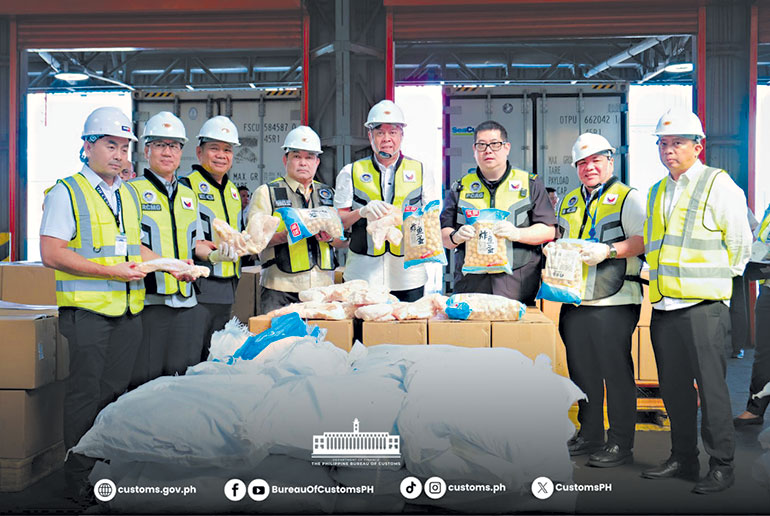 In September, the BoC intercepted two 40-foot container shipments at the Manila International Container Port found to contain misdeclared frozen chicken breasts and fish balls from China.
Another improvement is the bureau’s efforts to further accelerate digitalization in the agency to thwart smuggling. In an interview last year, BoC Commissioner Ariel F. Nepomuceno revealed a Public-Private Partnership (PPP) initiative eyed to modernize how imports and transactions are taxed. Under the proposal, importers would be charged a flat fee of P350 per transaction, regardless of whether it covers a single container van or multiple units. The program is expected to be rolled out within the next one to one-and-a-half years.
Aside from modernization and reform initiatives, the BoC has also signed various partnerships with private organizations and other government agencies to strengthen its campaign against smuggling.
In October last year, the agency signed a Memorandum of Agreement (MoA) with the Land Transportation Office (LTO) seeking to establish a more efficient system connecting vehicle importation and registration. As vehicles are some of the most valuable goods smuggled into the country, the MoA highlights the shared commitment of both agencies to ensure the timely and accurate exchange of data, streamline the tracking of imported motor vehicles, and curb illegal or fraudulent transactions.
In addition, the Philippine National Police and the BoC worked together last year for a series of successful police-initiated operations that led to the confiscation of billions of pesos worth of smuggled cigarettes and other goods.
Partnerships with private organizations have proven beneficial for the agency as well. Earlier this year, the BoC and the Philippine Iron and Steel Institute (PISI) agreed to establish a technical working group tasked with creating a centralized database to track steel imports, improve commodity classification, and support standardized customs valuation anchored on historical data. The partnership also covers initiatives on digitalization, automation, and data-driven governance, including enhanced stakeholder accreditation through the use of artificial intelligence and data analytics.
Similarly, the Federation of Filipino-Chinese Chambers of Commerce and Industry, Inc. (FCCCII) voiced its backing of the Bureau of Customs as it moves to implement broad and stringent governance reforms aimed at preventing corruption both within the agency and in its external dealings.
“In light of the recent issues affecting the Philippine government, it is good that there are leaders such as Commissioner Nepomuceno, who uphold integrity in good governance and create a very competitive and business-friendly environment for businesspeople such as the FFCCCII,” FFCCCII President Victor Lim was quoted as saying.
These improvements in modernization, reform, and partnerships are directly reflected in the agency’s performance to start 2026. Recent developments show that the bureau exceeded its January revenue target while sustaining aggressive nationwide operations against large-scale and high-value smuggling activities.
Last month alone, the BoC collected P80.744 billion, surpassing its revenue target by P513 million and posting a 100.6% collection efficiency. The figure also reflects a P1.49-billion increase, or 1.9% growth, compared to the P79.254 billion collected in January 2025.
Along with robust revenue performance, the BoC scaled its enforcement efforts across the country. In January alone, the agency carried out 66 successful operations, leading to the confiscation of smuggled and prohibited goods estimated at around P886.8 million. Among the most significant captures were illegal drugs valued at more than P309 million, including P114.566 million worth of narcotics hidden in shipments falsely declared as malachite stones. Authorities also seized illicit cigarettes and tobacco products worth roughly P209 million, highlighted by the discovery of an illegal cigarette manufacturing facility in Pampanga during a raid last Jan. 28.
These gains in policy, technology, and interagency cooperation have also translated into tangible results on the ground, most evident in a series of seizures that show the BoC’s efforts.
In the first week of January, Customs authorities seized smuggled cigarettes worth more than P105 million in Bataan and shut down an alleged illegal cigarette manufacturing facility in Mexico, Pampanga in line with President Ferdinand R. Marcos, Jr.’s directive to dismantle illicit trade networks and protect government revenues.
 Back in August, the BoC, through its Intellectual Property Rights Division, has seized counterfeit wearing apparel valued at an estimated P428 million at the Port of Manila.
At the same time, Mr. Nepomuceno ordered an investigation into alleged smuggling activities at the Port of Manila, temporarily relieving a Customs Intelligence and Investigation Service field station chief to reinforce internal accountability.
These efforts were further underscored by the seizure of P428 million worth of suspected counterfeit clothing in Tondo, Manila, involving a shipment of 1,287 boxes of counterfeit apparel that arrived in the country in August 2025, reflecting the bureau’s continued focus on both border enforcement and institutional integrity.
Overall, recent reforms, partnerships, and sustained enforcement show the BoC making measurable progress in curbing smuggling while protecting revenues, trade integrity, and public trust. — Jomarc Angelo M. Corpuz


You May Also Like

Solana Whale Dump Drama: $137M Exit Sparks SOL Price Panic vs Bull Debate
SoFi (SOFI) Stock Drops Despite Unveiling Always-On Enterprise Banking Solution




