Bitcoin Panic Selling Accelerates While Long-Term Holders Stay Inactive – Details
Bitcoin is struggling to establish a clear floor as price action hovers near the $70,000 level, a zone increasingly viewed by analysts as a decisive short-term support threshold. Persistent selling pressure, weakening sentiment, and declining momentum have kept the market on edge, with several analysts warning that further downside cannot yet be ruled out. The broader backdrop remains fragile, marked by cautious positioning and limited conviction among both retail and institutional participants.
Recent on-chain analysis from top analyst Darkfost highlights growing stress among short-term holders, a cohort historically sensitive to volatility. According to the data, Bitcoin inflows to exchanges have surged sharply, approaching 60,000 BTC within the past 24 hours. This represents the largest daily inflow recorded since the beginning of the year and suggests an increasing willingness among recent buyers to reduce exposure.

Such flows typically translate into heightened sell-side liquidity, adding pressure to spot markets already grappling with weak demand. While exchange inflows alone do not guarantee further declines, their scale often reflects defensive positioning during uncertain phases. For now, Bitcoin remains in a structurally fragile zone where sentiment, liquidity conditions, and holder behavior will likely determine whether stabilization or deeper correction follows.
Short-Term Holder Capitulation Raises Bottoming Debate
Darkfost notes that the recent surge in Bitcoin exchange inflows has been driven almost entirely by short-term holders (STH) realizing losses. According to the data, the BTC moved to exchanges over the past day was transferred below acquisition cost, confirming that recent entrants are exiting under pressure rather than taking profits.
At the same time, there is little evidence of long-term holders (LTH) distributing coins in profit, suggesting that the more structurally committed cohort remains largely inactive. This combination is often described as a capitulation phase, where weaker hands exit while stronger holders wait.
Historically, such episodes can precede several different outcomes rather than an immediate reversal. One possibility is a relief bounce if selling pressure becomes exhausted and liquidity stabilizes. Another scenario involves a prolonged consolidation period as the market digests losses and rebuilds demand. A deeper decline cannot be excluded either, particularly if macro liquidity tightens or spot demand fails to absorb continued exchange inflows.
Capitulation alone does not define a bottom. Confirmation typically requires stabilization in SOPR, declining exchange inflows, and renewed accumulation signals. Until those appear, Bitcoin remains in a vulnerable phase where sentiment, liquidity conditions, and holder behavior will likely shape the next directional move.
Bitcoin Tests Critical Support After Sharp Breakdown
Bitcoin price action in this chart reflects a decisive loss of momentum following the rejection from the $120K–$125K region seen earlier in the cycle. The recent breakdown toward the $70K area marks one of the sharpest corrective legs of the past year, with price slicing below the short-term and mid-term moving averages. The failure to hold above the 50-period and 100-period trend lines suggests a clear deterioration in market structure, shifting the bias from consolidation to corrective continuation.
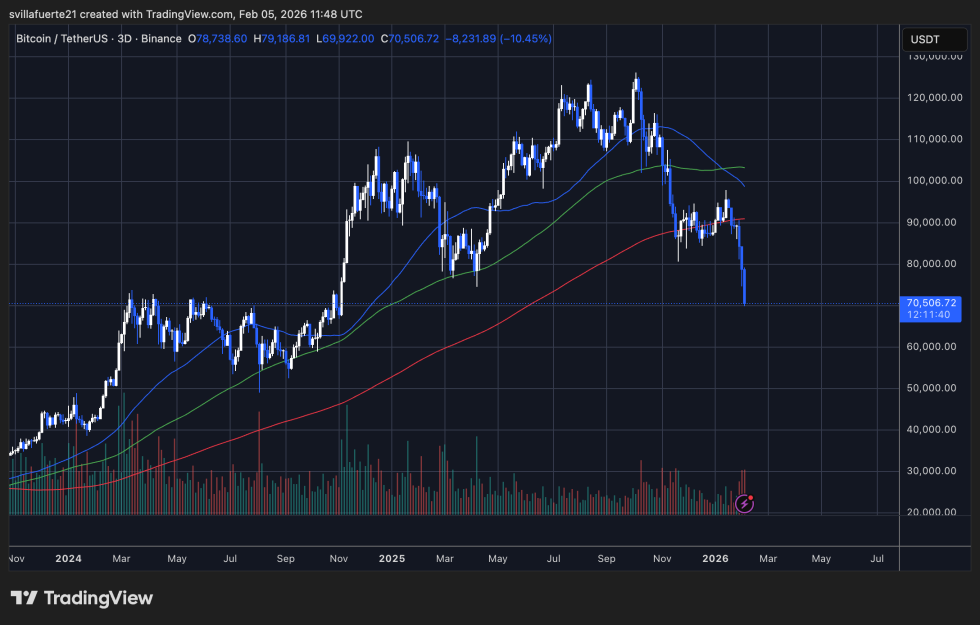
The $70K zone now emerges as a pivotal technical level. Historically, prior breakout zones often act as support on retracements, but repeated testing increases the probability of a deeper breakdown. A sustained move below this level could expose the $60K–$62K region, where previous consolidation occurred before the late-2024 rally accelerated.
Volume dynamics reinforce the cautious outlook. The recent selloff has been accompanied by rising trading activity, indicating active distribution rather than low-liquidity drift. However, if selling volume begins to fade while price stabilizes near current levels, it could suggest exhaustion among sellers.
Featured image from ChatGPT, chart from TradingView.com


You May Also Like

LIST: Bayanihan initiatives amid soaring oil prices

Crypto Hack: Drift Protocol Drained Over $200M in Private Key Breach

The Chemistry of UV Resistance: How Titanium Dioxide Protects Against the California Sun