The Hong Kong Stablecoin Ordinance (hereinafter referred to as the Ordinance) officially came into effect on August 1, 2025. The Ordinance has established strict rules for the issuance and operationThe Hong Kong Stablecoin Ordinance (hereinafter referred to as the Ordinance) officially came into effect on August 1, 2025. The Ordinance has established strict rules for the issuance and operation

A week after the stablecoin regulation came into effect, Hong Kong's over-the-counter market size dropped by 33%.

2025/08/13 09:00

The Hong Kong Stablecoin Ordinance (hereinafter referred to as the Ordinance) officially came into effect on August 1, 2025. The Ordinance has established strict rules for the issuance and operation of stablecoins, explicitly prohibiting the offer, promotion and sale of stablecoins without a license, and does not provide a transition period.

As institutions whose main business is exchanging stablecoins and fiat currencies, Hong Kong's local cryptocurrency money changers are the first to be affected. After the regulations came into effect, many over-the-counter trading service providers announced the suspension of stablecoin-related businesses while waiting to apply for licenses.

This article aims to provide regulators with an on-chain perspective on the impact of the regulations by disclosing TRC20-USDT outflow data from Hong Kong Over-the-Counter Trading Service Providers (HKVAOTC) addresses over the past 70 days.

Data Description

Bitrace has been monitoring the business address traffic of VAOTC entities located in Hong Kong or primarily serving Hong Kong customers. The latter are classified as store-type service providers that primarily serve offline customers or real-name customers, and non-store-type service providers that primarily serve online customers or anonymous customers.

The data disclosed in this survey will include the TRC20-USDT transfer data of all service providers in the two time periods of June 1 to July 31 and August 1 to August 8, 2025, Beijing time.

The following data have excluded non-operational transit activities between business addresses.

The volume of stablecoin transactions in the over-the-counter market fell by 32.94%.

Between June 1 and July 31, all business addresses transferred out a total of 3.17B USDT, with an average daily amount of 52.04M USDT; between August 1 and August 8, all business addresses transferred out a total of 279M USDT, with an average daily amount of 34.90M USDT.
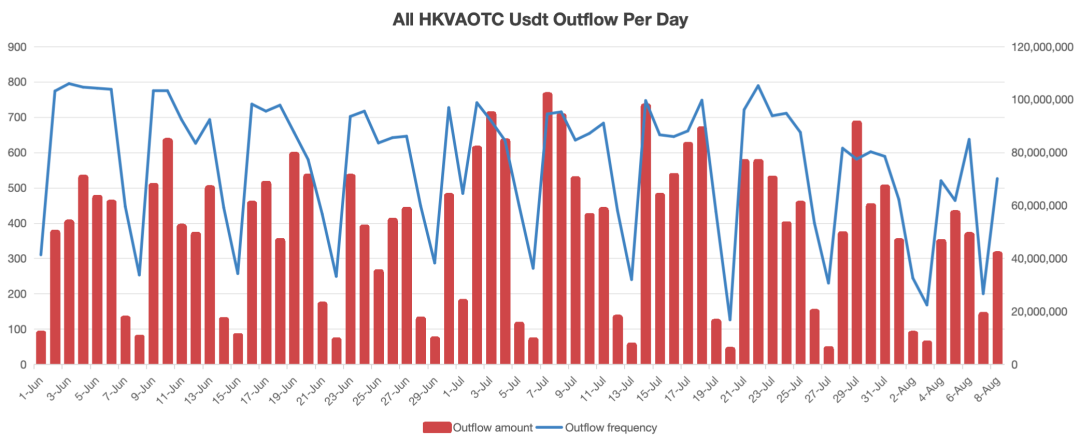
Compared with before the regulations came into effect, the overall size of the stablecoin exchange market decreased by 32.94% after August 1. This sensitivity shows the profound impact of the regulations on Hong Kong's local crypto industry.

Store type service providers reduce the scale to a larger

Traffic statistics are collected separately for store-type and non-store-type service provider business addresses.
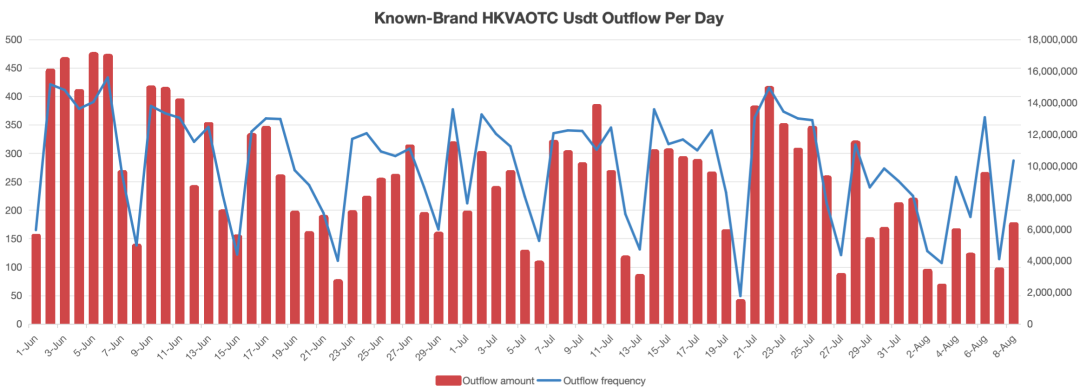
After the regulations came into effect, the average daily USDT outflow volume of store-type service providers decreased by 43.20% (9.47M -> 5.38M), while the business addresses of non-store-type service providers decreased by 30.65% (42.57M -> 29.52M).
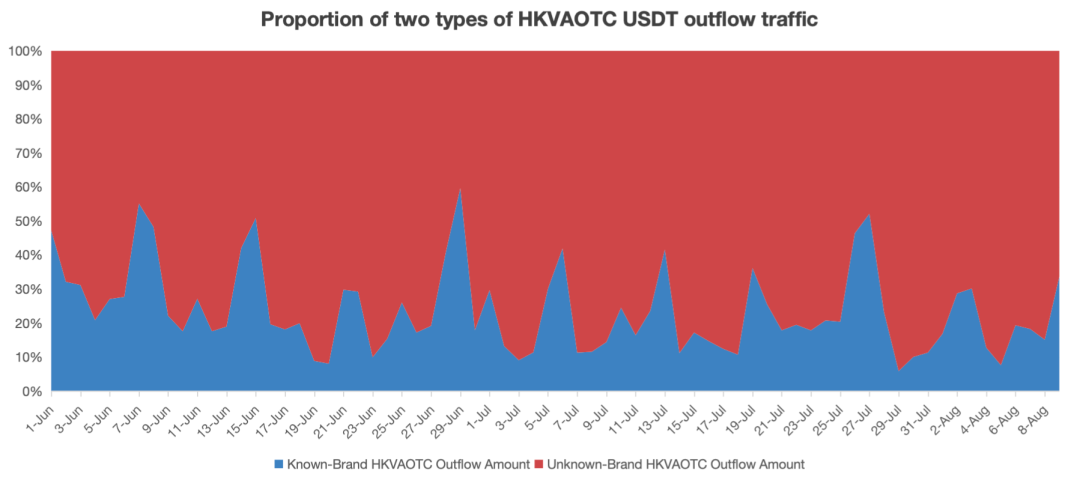
The impact on store-type service providers is significantly greater than that on non-store-type services, indicating that after the regulations came into effect, some businesses in Hong Kong's over-the-counter trading service industry tended to go underground in a short period of time.

Final Thoughts

The introduction of the Stablecoin Ordinance marks a significant step forward in regulatory compliance for Hong Kong's crypto industry, and will have a significant impact on the local over-the-counter (OTC) trading services sector in the short term. Among relevant practitioners, some are choosing to comply with regulations and apply for licenses, while others are turning to underground operations, presenting a diverse range of choices.


Market Opportunity
Effect AI Logo
Effect AI Price(EFFECT)
$0.005138
$0.005138$0.005138
+0.03%
USD
Effect AI (EFFECT) Live Price Chart
Disclaimer: The articles reposted on this site are sourced from public platforms and are provided for informational purposes only. They do not necessarily reflect the views of MEXC. All rights remain with the original authors. If you believe any content infringes on third-party rights, please contact service@support.mexc.com for removal. MEXC makes no guarantees regarding the accuracy, completeness, or timeliness of the content and is not responsible for any actions taken based on the information provided. The content does not constitute financial, legal, or other professional advice, nor should it be considered a recommendation or endorsement by MEXC.

You May Also Like

VivoPower To Load Up On XRP At 65% Discount: Here’s How

VivoPower To Load Up On XRP At 65% Discount: Here’s How

VivoPower International, a Nasdaq-listed B-Corp now pivoting to an XRP-centric treasury, said on September 16 it has structured its mining and treasury operations so that it can acquire the token “at up to a 65% discount” to prevailing market prices—by mining other proof-of-work assets and swapping those mined tokens. VivoPower Doubles Down On XRP The […]
Share
Bitcoinist2025/09/18 10:00
WIF price reclaims 200-day moving average

WIF price reclaims 200-day moving average

WIF (WIF) price is entering a critical technical phase as price action reclaims the 200-day moving average, a level that often separates bearish control from bullish
Share
Crypto.news2026/01/13 23:44
China Blocks Nvidia’s RTX Pro 6000D as Local Chips Rise

China Blocks Nvidia’s RTX Pro 6000D as Local Chips Rise

The post China Blocks Nvidia’s RTX Pro 6000D as Local Chips Rise appeared on BitcoinEthereumNews.com. China Blocks Nvidia’s RTX Pro 6000D as Local Chips Rise China’s internet regulator has ordered the country’s biggest technology firms, including Alibaba and ByteDance, to stop purchasing Nvidia’s RTX Pro 6000D GPUs. According to the Financial Times, the move shuts down the last major channel for mass supplies of American chips to the Chinese market. Why Beijing Halted Nvidia Purchases Chinese companies had planned to buy tens of thousands of RTX Pro 6000D accelerators and had already begun testing them in servers. But regulators intervened, halting the purchases and signaling stricter controls than earlier measures placed on Nvidia’s H20 chip. Image: Nvidia An audit compared Huawei and Cambricon processors, along with chips developed by Alibaba and Baidu, against Nvidia’s export-approved products. Regulators concluded that Chinese chips had reached performance levels comparable to the restricted U.S. models. This assessment pushed authorities to advise firms to rely more heavily on domestic processors, further tightening Nvidia’s already limited position in China. China’s Drive Toward Tech Independence The decision highlights Beijing’s focus on import substitution — developing self-sufficient chip production to reduce reliance on U.S. supplies. “The signal is now clear: all attention is focused on building a domestic ecosystem,” said a representative of a leading Chinese tech company. Nvidia had unveiled the RTX Pro 6000D in July 2025 during CEO Jensen Huang’s visit to Beijing, in an attempt to keep a foothold in China after Washington restricted exports of its most advanced chips. But momentum is shifting. Industry sources told the Financial Times that Chinese manufacturers plan to triple AI chip production next year to meet growing demand. They believe “domestic supply will now be sufficient without Nvidia.” What It Means for the Future With Huawei, Cambricon, Alibaba, and Baidu stepping up, China is positioning itself for long-term technological independence. Nvidia, meanwhile, faces…
Share
BitcoinEthereumNews2025/09/18 01:37