

Pantera: How to value BitMine after sweeping up 1 million ETH?
This article is from: Pantera;
Original Article by Cosmo Jiang and Erik Lowe
Compiled by Azuma, Odaily Planet Daily
Editor's Note: On the evening of August 11th, BitMine Immersion Technologies, a New York Stock Exchange-listed company, announced that as of 10:59 PM ET on August 10th, its total ETH holdings had reached 1,150,263, valued at over $4.96 billion. This not only makes BitMine the world's largest ETH treasury, but also the only entity currently holding over 1 million ETH.
On the evening of August 12, U.S. SEC public documents showed that BitMine plans to increase the total amount of common stock that can be sold under the sales agreement to a maximum of US$24.5 billion to acquire more ETH.
As BitMine's buying spree continues, the price of ETH has continued to rise, approaching new highs. BitMine's stock price has surged 1,300% since the end of June. Below, Pantera, a leading VC firm, uses BitMine as an example to analyze the valuation logic behind treasury companies. This may help us understand BitMine's strategy for increasing its holdings and the premium valuations of treasury stocks like BMNR.
The following is the original content of Pantera, translated by Odaily Planet Daily.
Our investment thesis for digital asset treasury companies (DATs) is based on a simple premise: DATs can increase net asset value per share (NAV/share) through income strategies, and long-term holding will result in greater ownership of the underlying tokens than simply holding spot assets.
Therefore, holding DAT shares may have higher return potential than holding tokens directly or investing through ETFs.
Pantera has invested over $300 million in DATs across various regions and tokens. These DATs are leveraging their unique advantages to expand their digital asset holdings through per-share value growth strategies. Below is an overview of our DAT portfolio.
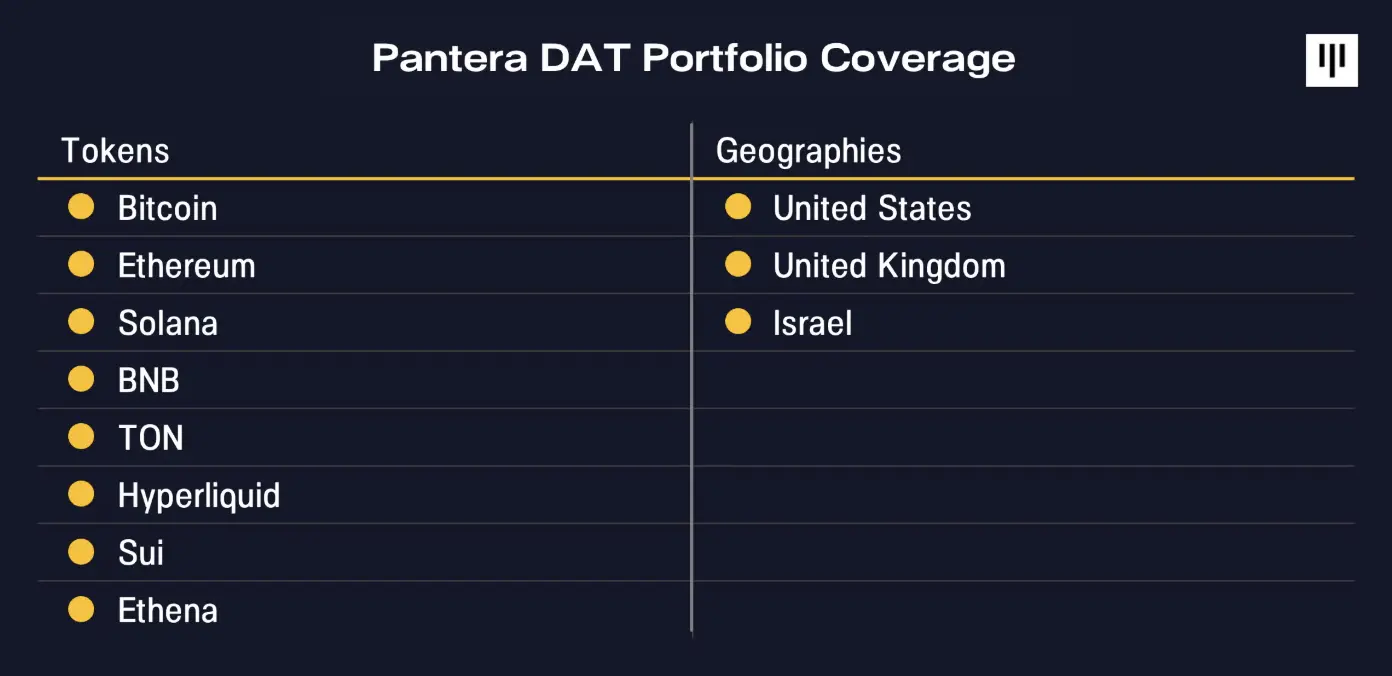
BitMine (BMNR) Case Study
BitMine Immersion (BMNR) is the first investment of the Pantera DAT Fund. BitMine has a clear strategic roadmap and strong execution capabilities. Fundstrat founder Tom Lee, as BitMine's chairman, has outlined the company's long-term vision of acquiring 5% of the total ETH supply—what they call "5% Alchemy." We believe it's useful to explore the value creation of BMNR through a case study of a highly executed DAT.
Since BitMine launched its treasury strategy, it has become the largest ETH treasury and the third largest DAT globally, currently holding a total of 1,150,263 ETH worth $4.9 billion (as of August 10, 2025).
BMNR is also the 25th most liquid stock in the U.S. today, with an average daily trading volume of approximately $2.2 billion (five-day moving average as of August 8, 2025).
Underlying assets: Ethereum’s value support
The success of a DAT depends first and foremost on the long-term investment value of its underlying token. BitMine's core belief is that Ethereum will become one of the most significant macro trends of the next decade as Wall Street moves on-chain. As we discussed last month, the rise of tokenized real-world assets (RWAs) and stablecoins is driving the "on-chain migration"—currently, major public blockchains host $25 billion in RWAs and $260 billion in stablecoins, with the latter becoming the 17th largest holder of US Treasury bonds.
On July 2, 2025, at the Pantera DAT conference call, Tom Lee said: “Stablecoins have become the ChatGPT narrative of cryptocurrency.”
As the primary platform for this migration, Ethereum will continue to benefit from the growing demand for block space. Financial institutions' reliance on Ethereum's security will further incentivize them to participate in the Proof-of-Stake network, driving up demand for ETH.
Increase EPS
After establishing the investment value of the underlying token, the DAT's business model is to maximize the number of tokens held per share. The primary methods for increasing "tokens held per share" are:
- Premium issuance: additional shares are issued at a price higher than the net asset value (NAV) of each token;
- Issuing convertible bonds: Profit from the dual volatility of stocks and tokens;
- Earn on-chain income: Get more tokens through staking rewards, DeFi income, etc. (This is a unique advantage of ETH DAT over early Bitcoin DAT);
- Mergers and acquisitions of other DATs: Acquiring similar companies with transaction prices close to or below NAV;
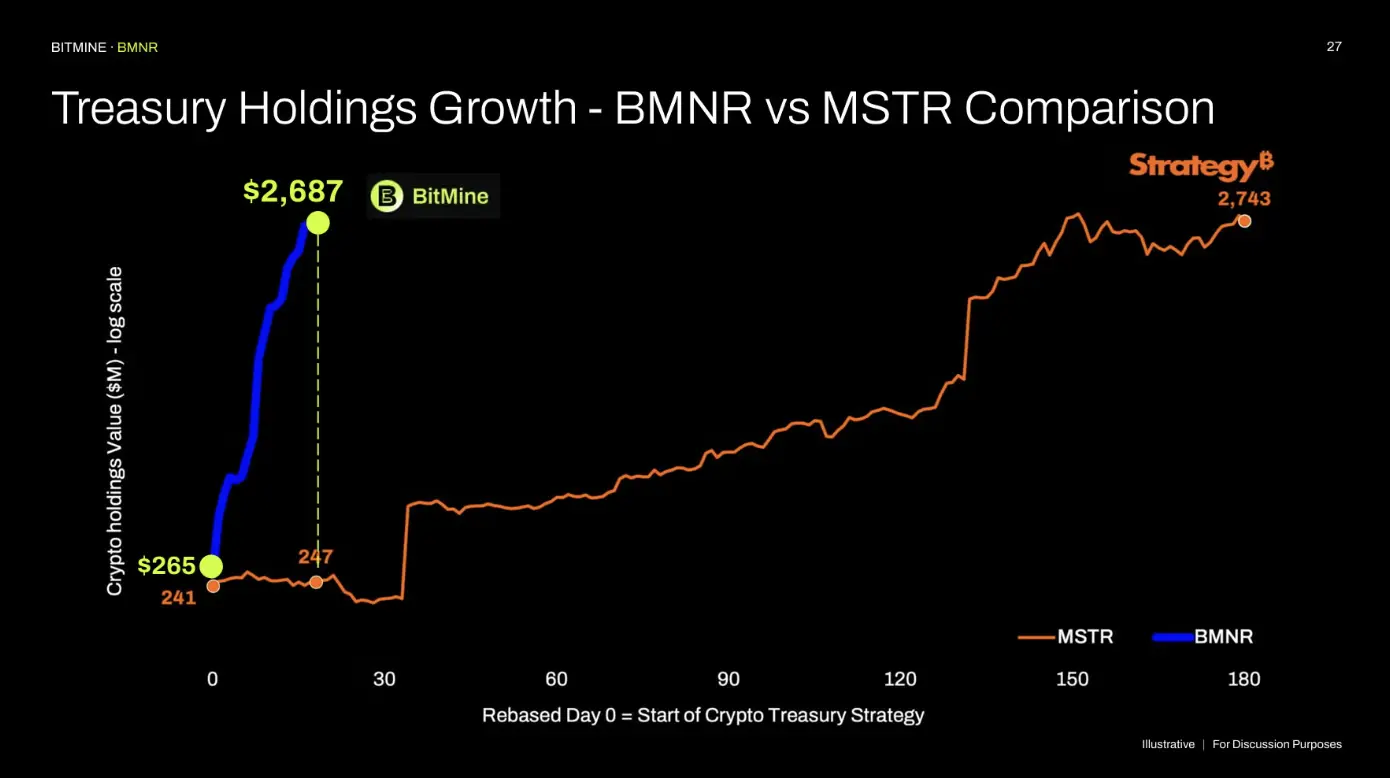
In the first month of launching its ETH treasury strategy, BitMine's ETH per-share holdings grew faster than Strategy (formerly MicroStrategy)'s cumulative performance in the first six months. Currently, growth is primarily achieved through stock issuance and staking rewards, and it may expand into tools such as convertible bonds in the future.
Triple Drivers of Value Creation
DAT's stock price can be broken down into the product of three main factors:
- Number of tokens per share;
- The price of the underlying token;
- NAV premium multiple (mNAV);
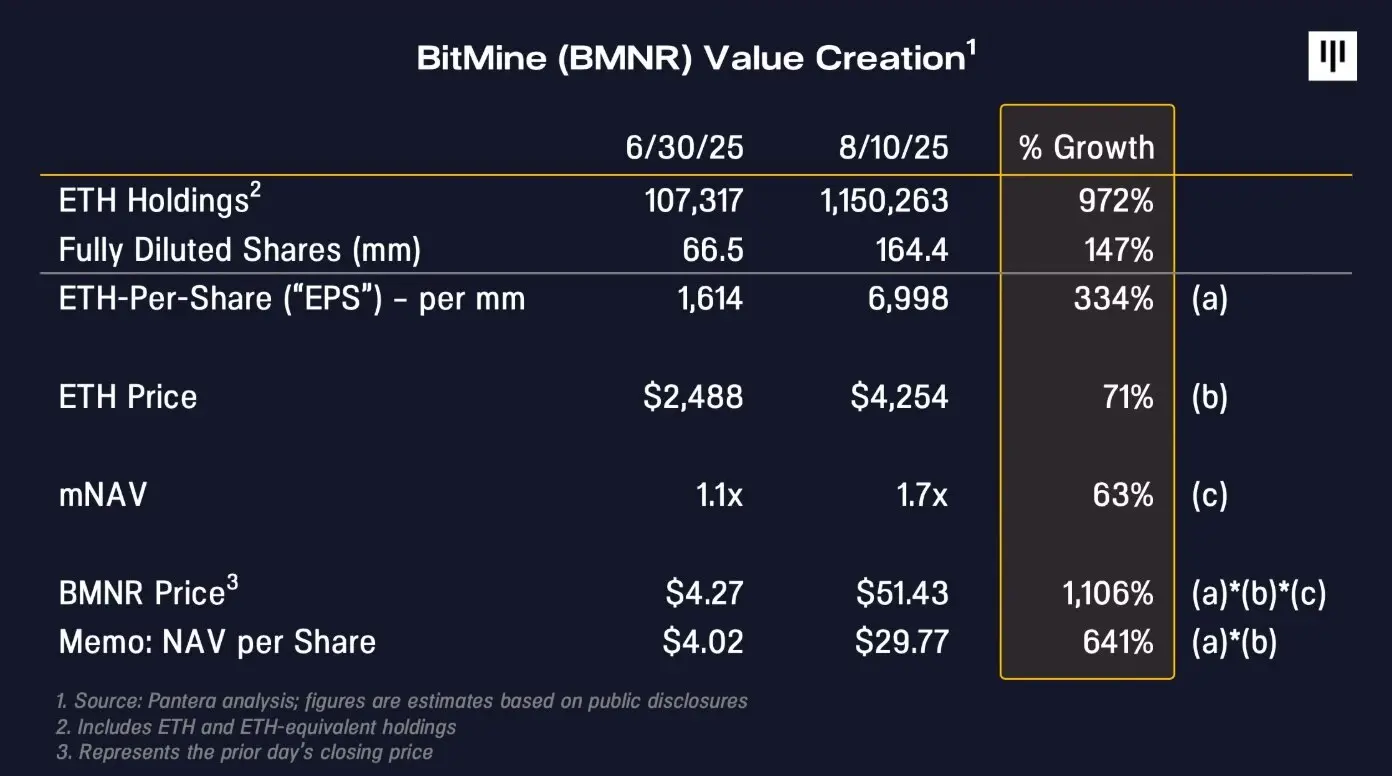
Take BMNR as an example: At the end of June, BMNR was trading at $4.27 per share, about 1.1 times its NAV of $4 per share after its initial DAT capital raise; more than a month later, the stock closed at $51 (Odaily note: the current share price has risen to $62.44, corresponding to the price on June 26, an increase of more than 1,300%), about 1.7 times its estimated NAV of $30 per share.
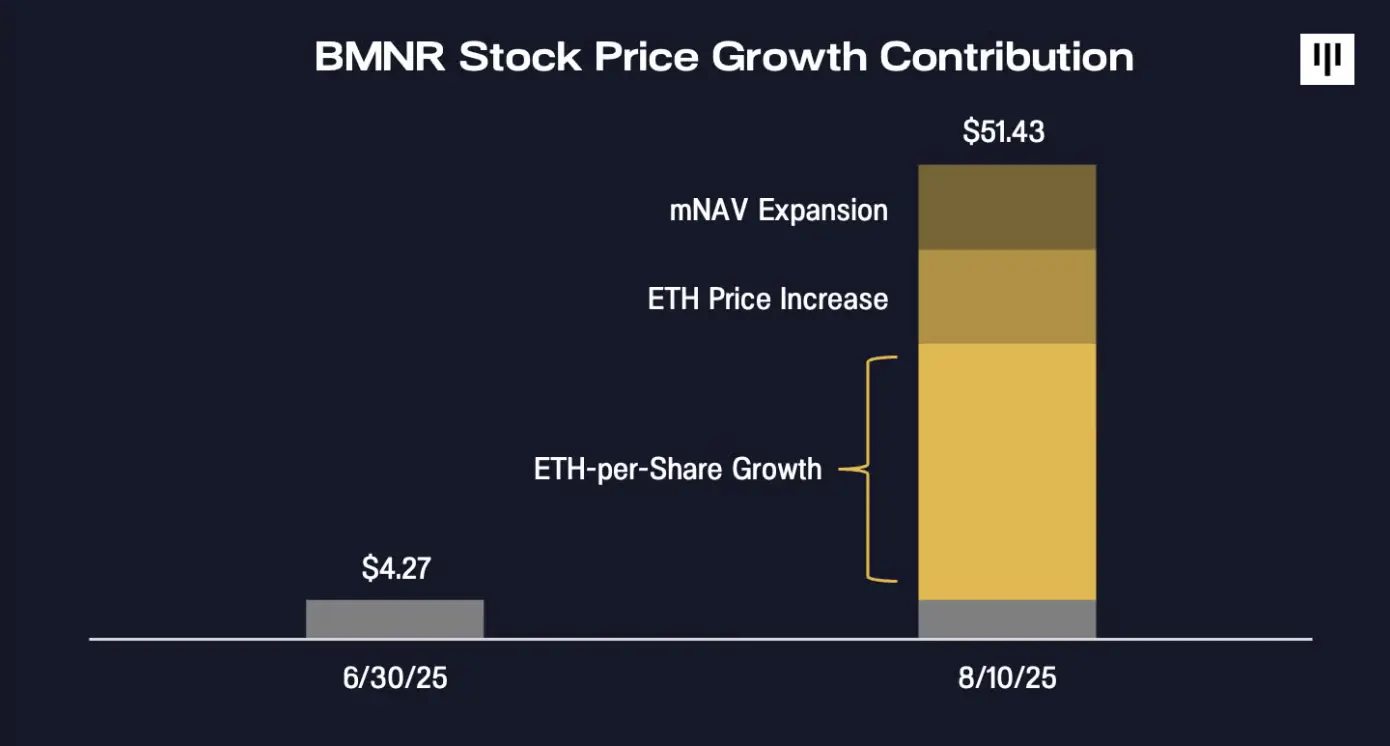
In the 1100% price increase in just over a month:
- A 330% increase in the number of tokens per share contributed approximately 60% of the growth;
- The price increase of the underlying asset ETH (2500 → 4300 USD) contributed about 20% of the growth;
- The increase in mNAV to 1.7x contributed approximately 20% of the growth;
This shows that the rise in BMNR's stock price mainly comes from the appreciation of ETH per share that can be controlled by management, which is the core advantage of DAT compared to spot holdings.
There is another factor regarding mNAV that we have not yet explored.
A natural question is: Why would anyone buy a DAT at a premium to its NAV? I think a useful analogy here is with balance sheet-based financial businesses, including banks. Banks seek to generate income on their assets, and investors assign a valuation premium to banks they believe can consistently generate income above their cost of capital. The highest-quality banks trade at a premium to their NAV (or book value); for example, JPMorgan Chase & Co. trades at over 2x NAV. Similarly, if investors believe a DAT can consistently increase its NAV per share, they might choose to value it at a premium to its NAV.
We believe BMNR's approximately 640% monthly increase in NAV per share justifies its mNAV premium. BitMine's ability to consistently execute its strategy will be evident over time, inevitably with challenges along the way. BitMine's management team and track record to date have attracted support from traditional financial institutions, including Stan Druckenmiller, Bill Miller, and ARK Invest. We expect the growth stories of the highest-quality DATs, like Strategy, to gradually be appreciated by a wider range of institutional investors.


You May Also Like

XRP Overtakes BNB to Reclaim #3 Spot With $87.1B Market Cap

The Crypto News Cycle Just Shifted and the Wallets That Found Pepeto First Are Already Inside




