The throughput for the Solana network briefly reached a theoretical TPS (transactions per second) rate of 100K over the weekend after a stress load hit the layer-1 blockchain. A blockThe throughput for the Solana network briefly reached a theoretical TPS (transactions per second) rate of 100K over the weekend after a stress load hit the layer-1 blockchain. A block

Solana Network Hits Theoretical 100K TPS In Latest Stress Test

The throughput for the Solana network briefly reached a theoretical TPS (transactions per second) rate of 100K over the weekend after a stress load hit the layer-1 blockchain.

A block facilitated and written to the blockchain by a validator called “Cavey Cool” saw the network process 43,016 successful transactions and 50 failed ones. The peak TPS for this block reached 107,540 TPS.

Solana developer and Helius co-founder Mert Mumtaz commented on the milestone on X, and said that Solana has become the “first major blockchain with a recorded 100K TPS” on its mainnet. 

However, critics have debated the validity of the reported TPS, especially since the transactions in question were mainly ones that don’t alter the network’s state.

One X user commented under the developer’s post, arguing that the “current state of Solana can’t handle organic traffic” at that level. “Things start to break down at a few thousand TPS,” the user added. 

Another X user celebrated the milestone, but suggested that the next meme coin “mania” could cause the network to suffer another outage, similar to what happened with the launch of the Official Trump (TRUMP) token. 

Up until the President’s meme coin launched, “Solana was flexing throughput,” but then “flatlined” under the overwhelming pressure, the user said.

Transactions Designed To Stress-Test Solana Point To High Theoretical Throughout

Critics pointed out that most of the transactions in this weekend’s block were not token exchanges or trades, but were rather no-operation or “noop” program calls, or instructions that don’t perform any meaningful computation on the network.

“Noop” program calls are lightweight instructions that are used to stress-test a network’s capacity, but do not directly reflect everyday payment or complex application use. 

Mumtaz proactively addressed critics’ claims, and said that developers could still “deduce that you can also theoretically do about 80-100K tps in transfers, oracle updates, and similar” operations.  

That’s largely due to the fact that the real cost of those transactions includes signature checks, data loading, and other overhead beyond execution itself, according to the Solana developer. 

Solana’s True TPS Is Much Lower Than Mumtaz Argues

Solana’s throughput is currently much lower than the Helius co-founder said is theoretically possible. 

Data from Solscan, the Solana blockchain explorer, shows that the network’s “True TPS” stands at 952, while its TPS including vote transactions stands at around 3,568.9. 

Chainspect and Solscan also peg the effective throughput for payments and applications on the Solana network at roughly 1,000 TPS. 
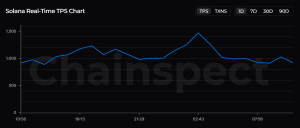
Solana true TPS

Solana true TPS (Source: Chainspect

Chainspect shows that Solana has a “Max” theoretical TPS of 65,000 transactions as well. 

That’s still lower than the TPS of ICP, the layer-1 competitor that has a max theoretical TPS of 209,708 transactions, according to Chainspect. The blockchain also has a slightly higher “true TPS” of 1,082 transactions. 

While ICP and Solana are neck and neck in terms of actual speed,  they still lag far behind the throughput of centralized payments giant Visa, which achieves a true TPS equal to that of Solana’s theoretical throughput of 65,000 transactions.

Solana TVL Nears January All-Time High

Regardless of the type of transactions processed in this weekend’s block, the milestone could attract users to the Solana network, especially when combined with the blockchain’s low fees and high speeds. 

Looking at the blockchain’s Total Value Locked (TVL), Solana is already nearing the all-time high (ATH) that was reached at the start of the year.

Back then, Solana’s TVL soared to above $11.989 billion, data from DefiLlama shows. After a pullback in the months that followed, the metric started to rise again at the beginning of April. Now, the network’s TVL stands at about $10.343 billion as of 8:35 a.m. EST. 

Ethereum maintains a comfortable lead in terms of TVL, with more than $89.62 billion stored on its blockchain. 

Solana Price Drops Amid Broader Market Downturn

Despite the recent TPS milestone, the Solana price was unable to withstand the bearish wave that hit the crypto market in the last 24 hours.

According to CoinMarketCap, the SOL price slid more than 4% to stand at $183.20 as of 9:10 a.m. EST. 
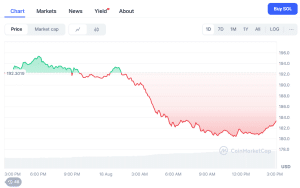
Solana price chart

SOL price chart (Source: CoinMarketCap)

Market Opportunity
Solayer Logo
Solayer Price(LAYER)
$0,1714
$0,1714$0,1714
+1,60%
USD
Solayer (LAYER) Live Price Chart
Disclaimer: The articles reposted on this site are sourced from public platforms and are provided for informational purposes only. They do not necessarily reflect the views of MEXC. All rights remain with the original authors. If you believe any content infringes on third-party rights, please contact service@support.mexc.com for removal. MEXC makes no guarantees regarding the accuracy, completeness, or timeliness of the content and is not responsible for any actions taken based on the information provided. The content does not constitute financial, legal, or other professional advice, nor should it be considered a recommendation or endorsement by MEXC.

You May Also Like

Huawei goes public with chip ambitions, boosting China’s tech autonomy post-Nvidia

Huawei goes public with chip ambitions, boosting China’s tech autonomy post-Nvidia

The post Huawei goes public with chip ambitions, boosting China’s tech autonomy post-Nvidia appeared on BitcoinEthereumNews.com. Huawei publicly revealed its full chip roadmap on Thursday during its annual Connect conference in Shanghai, confirming it would begin releasing some of the world’s most powerful computing systems in a push to reduce China’s reliance on Nvidia and other foreign chipmakers, according to Reuters. Eric Xu, Huawei’s rotating chairman, disclosed that the company had developed its own high-bandwidth memory, a technology previously led by Samsung and SK Hynix. Xu said, “We will follow a 1-year release cycle and double compute with each release,” making it clear Huawei now intends to release next-gen chips and hardware annually with increased processing capabilities. The announcement came just days before U.S. President Donald Trump and Chinese President Xi Jinping are expected to meet on Friday, following trade talks between both countries earlier in the week. The move is widely seen as an attempt by Beijing to project confidence in its tech ecosystem as U.S.-China tensions continue to grow. Huawei releases full schedule for Ascend, Kunpeng chips, and computing clusters Huawei detailed the timeline for its AI chip series Ascend, starting with the 910C, which was released earlier this year. The Ascend 950 will launch in 2026 with two variants. The 960 will follow in 2027, and the 970 is scheduled for 2028. Huawei also confirmed its Kunpeng server chips will receive updates in 2026 and 2028. China’s chip war with the U.S. escalated this week as Nvidia was accused of violating China’s anti-monopoly law, and several large Chinese tech firms were ordered to cancel Nvidia AI chip orders. Financial Times reported that government regulators had also instructed distributors to stop placing new Nvidia orders. One executive in China’s chip distribution industry said his company was told verbally to stop buying Nvidia chips and was only allowed to sell current inventory. That executive declined…
Share
BitcoinEthereumNews2025/09/18 21:20
Whales keep selling XRP despite ETF success — Data signals deeper weakness

Whales keep selling XRP despite ETF success — Data signals deeper weakness

The post Whales keep selling XRP despite ETF success — Data signals deeper weakness appeared on BitcoinEthereumNews.com. XRP ETFs have crossed $1 billion in assets
Share
BitcoinEthereumNews2025/12/20 02:55
Foreigner’s Lou Gramm Revisits The Band’s Classic ‘4’ Album, Now Reissued

Foreigner’s Lou Gramm Revisits The Band’s Classic ‘4’ Album, Now Reissued

The post Foreigner’s Lou Gramm Revisits The Band’s Classic ‘4’ Album, Now Reissued appeared on BitcoinEthereumNews.com. American-based rock band Foreigner performs onstage at the Rosemont Horizon, Rosemont, Illinois, November 8, 1981. Pictured are, from left, Mick Jones, on guitar, and vocalist Lou Gramm. (Photo by Paul Natkin/Getty Images) Getty Images Singer Lou Gramm has a vivid memory of recording the ballad “Waiting for a Girl Like You” at New York City’s Electric Lady Studio for his band Foreigner more than 40 years ago. Gramm was adding his vocals for the track in the control room on the other side of the glass when he noticed a beautiful woman walking through the door. “She sits on the sofa in front of the board,” he says. “She looked at me while I was singing. And every now and then, she had a little smile on her face. I’m not sure what that was, but it was driving me crazy. “And at the end of the song, when I’m singing the ad-libs and stuff like that, she gets up,” he continues. “She gives me a little smile and walks out of the room. And when the song ended, I would look up every now and then to see where Mick [Jones] and Mutt [Lange] were, and they were pushing buttons and turning knobs. They were not aware that she was even in the room. So when the song ended, I said, ‘Guys, who was that woman who walked in? She was beautiful.’ And they looked at each other, and they went, ‘What are you talking about? We didn’t see anything.’ But you know what? I think they put her up to it. Doesn’t that sound more like them?” “Waiting for a Girl Like You” became a massive hit in 1981 for Foreigner off their album 4, which peaked at number one on the Billboard chart for 10 weeks and…
Share
BitcoinEthereumNews2025/09/18 01:26