Bitcoin’s recent price surge has sparked debate over whether the market has finally found a bottom or is simply reacting to short-term exhaustion. The critical Bitcoin’s recent price surge has sparked debate over whether the market has finally found a bottom or is simply reacting to short-term exhaustion. The critical

Is Bitcoin’s Latest Bounce Real or Just a Temporary Rebound?

2026/02/07 22:57
2 min read
For feedback or concerns regarding this content, please contact us at crypto.news@mexc.com

Bitcoin’s recent price surge has sparked debate over whether the market has finally found a bottom or is simply reacting to short-term exhaustion.

The critical issue is not how strong the bounce looks on price alone, but whether it reflects a real shift in underlying demand.

In Bitcoin markets, rebounds often occur during broader downtrends. These moves are typically driven by short-covering, position adjustments, and a brief easing of fear, rather than fresh spot buying. As a result, they can appear convincing while lacking the foundations needed for a sustained reversal.

What On-Chain Behavior Is Showing Right Now

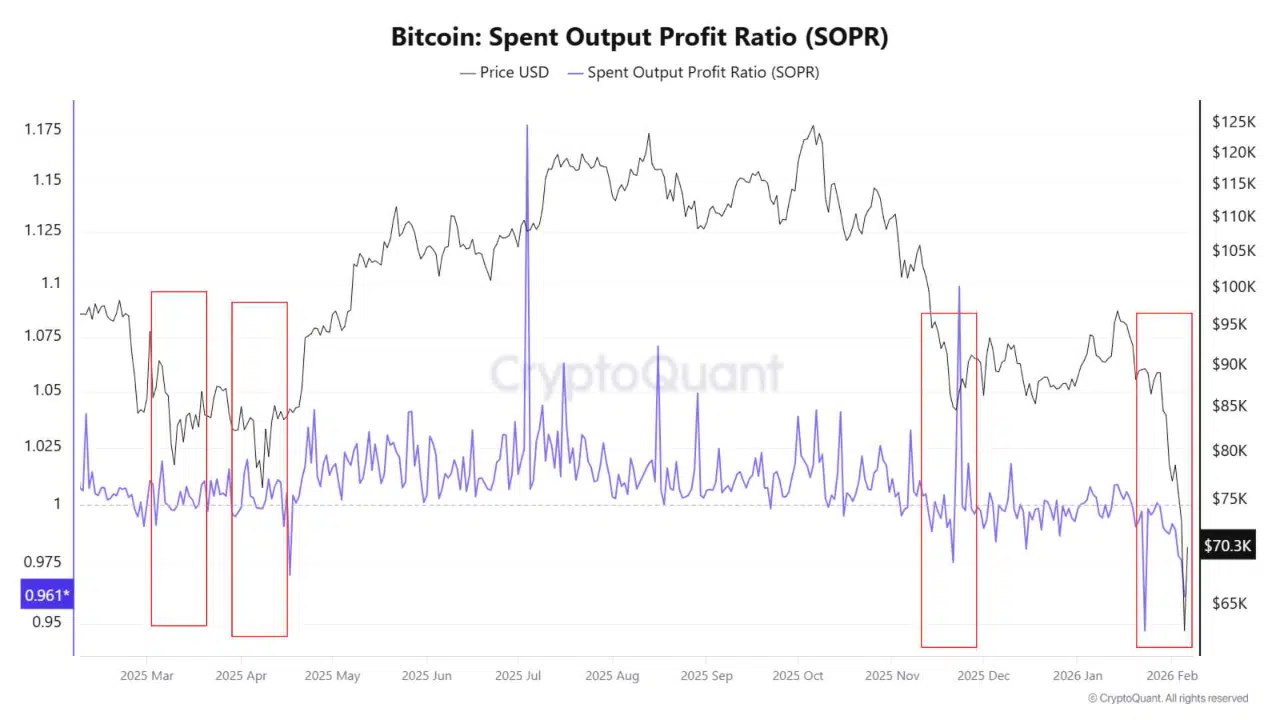
New report, shared by CryptoQuant focuses on the Spent Output Profit Ratio (SOPR), a metric that shows whether Bitcoin being moved on-chain is sold at a profit or at a loss.
Source: https://cryptoquant.com/insights/quicktake/69864ac

According to the report when SOPR is below 1, it means market participants are selling at a loss. This behavior signals risk reduction and defensive positioning, not confidence. Historically, this condition has not marked final market bottoms. Instead, it has appeared repeatedly during early and mid bear-market phases.

Bitcoin Inflows to Binance Rise as Selling Pressure and Panic Build

Why This Matters for the Current Move

Current data fits that historical pattern. While Bitcoin’s price has rebounded, SOPR has not recovered and held above 1. This suggests that sellers are still accepting losses, and that the rally is not yet supported by strong, sustained spot demand.

In past cycles, true bottoms formed only after extended periods of SOPR weakness, multiple failed recoveries above 1, and widespread loss realization. Until those conditions were met, rebounds tended to fade rather than develop into new uptrends.

Structural Takeaway

Based strictly on the on-chain data shown in the chart, today’s Bitcoin rally looks more like a reflexive bounce than confirmation of a durable trend reversal. Price has reacted, but underlying behavior has not yet shifted. Without evidence that sellers have stopped exiting at a loss, caution remains warranted despite the strength of the short-term move.

The post Is Bitcoin’s Latest Bounce Real or Just a Temporary Rebound? appeared first on ETHNews.

Market Opportunity
Notcoin Logo
Notcoin Price(NOT)
$0.0003596
$0.0003596$0.0003596
+4.87%
USD
Notcoin (NOT) Live Price Chart
Disclaimer: The articles reposted on this site are sourced from public platforms and are provided for informational purposes only. They do not necessarily reflect the views of MEXC. All rights remain with the original authors. If you believe any content infringes on third-party rights, please contact crypto.news@mexc.com for removal. MEXC makes no guarantees regarding the accuracy, completeness, or timeliness of the content and is not responsible for any actions taken based on the information provided. The content does not constitute financial, legal, or other professional advice, nor should it be considered a recommendation or endorsement by MEXC.

You May Also Like

Chorus One and MEV Zone Team Up to Boost Avalanche Staking Rewards

Chorus One and MEV Zone Team Up to Boost Avalanche Staking Rewards

The post Chorus One and MEV Zone Team Up to Boost Avalanche Staking Rewards appeared on BitcoinEthereumNews.com. Through the partnership with MEV Zone, Chorus One users will earn extra yield automatically. The Chorus One Avalanche node has a total stake of over 1.7 million, valued at around $55 million. This collaboration will introduce MEV Zone to both public nodes and Validator-as-a-Service. The Avalanche network stands to benefit from fairer and more efficient markets due to enhanced transparency. Chorus One, a highly decorated institutional-grade staking provider, has inked a strategic partnership with MEV Zone to enhance yield generation on the Avalanche (AVAX) network. The Chorus One partnered with MEV Zone to increase the AVAX staking yields, while simultaneously contributing to the general growth of the Avalanche network. “At Chorus One, we see this as an important step in our ongoing journey to provide robust infrastructure and innovative yield strategies for our partners and clients,” the announcement noted.  Why Did Chorus One Partner With MEV Zone? The Chorus One platform has grown to a top-tier institutional-grade staking ecosystem, with more than 40 blockchains, since 2018. In a bid to evolve with the needs of crypto investors and the supported blockchains, Chorus One has inked several strategic partnerships in the recent past, including MEV Zone. In the recent past, MEV Zone has specialized in addressing the Maximal Extractable Value (MEV) challenges on the Avalanche network. The MEV Zone will help Chorus One’s AVAX node validator to use Proposer-Builder Separation (PBS). As such, Chorus One’s AVAX node will seamlessly select certain transactions that are more profitable when making blocks. For instance, MEV Zone will help Chorus One’s AVAX node validator to capture arbitrage and liquidation transactions more often since they are more profitable.  How will Chorus One’s AVAX Stakers Benefit Via This Partnership? The Chorus One AVAX node has grown over the years to more than 1.77 million coins staked, valued…
Share
BitcoinEthereumNews2025/09/18 03:19
NYDFS Mandates Blockchain Analysis for Banks’ Digital Asset Offerings

NYDFS Mandates Blockchain Analysis for Banks’ Digital Asset Offerings

Detail: https://coincu.com/news/nydfs-blockchain-guidance-digital-assets/
Share
Coinstats2025/09/17 23:40
Arbitrageurs profited over $40 million from pricing mismatches on Polymarket in a single year.

Arbitrageurs profited over $40 million from pricing mismatches on Polymarket in a single year.

PANews reported on September 18th that, according to Decrypt, a new academic paper revealed systematic pricing biases on the prediction market platform Polymarket, allowing arbitrageurs to profit from it by over $40 million in a single year. The paper, titled "Unraveling the Probability Forest: Arbitrage Opportunities in Prediction Markets," analyzed data from April 2024 to April 2025 and found pricing errors in over 7,000 markets. The research identified two primary arbitrage patterns: one where the sum of "yes/no" share prices in the same market deviates from the theoretical value of $1; and the other where probability divergences occur in logically related markets (such as "Trump wins" and "Republicans win"). By simultaneously buying and selling related contracts, traders can achieve risk-free returns. While arbitrage activity ultimately leads to market price inequality, research indicates that pricing misalignments can persist for hours. This phenomenon is not limited to Polymarket but also occurs on regulated platforms such as Kalshi.
Share
PANews2025/09/18 11:46