

Intel Corporation (INTC) Stock; Rises as Trump Administration Considers 10% Stake
TLDRs:
- Intel shares rose this week amid talks of a potential 10% government stake.
- The US may convert Chips Act grants into Intel equity, boosting influence.
- Strategic government ownership in tech is part of a growing global trend.
- Historical precedent shows federal stakes can deliver significant economic returns.
Intel Corporation (NASDAQ: INTC) has see its stock rise almost 15% this week following reports that the Trump administration is exploring the possibility of taking a 10% stake in the semiconductor giant.
This stake would be acquired by converting some or all of the chipmaker’s US Chips and Science Act grants into equity, a move that could make the US government Intel’s largest shareholder. At Intel’s current market value, the stake is estimated to be worth approximately $10.5 billion.
Discussions between Intel and government officials are ongoing, and no final decision has been reached. Intel is slated to receive up to $10.9 billion in Chips Act grants, most of which were awarded under the Biden administration. These grants are structured to be disbursed gradually as Intel meets various commercial and military production milestones. As of January 2025, Intel had received $2.2 billion of these funds.
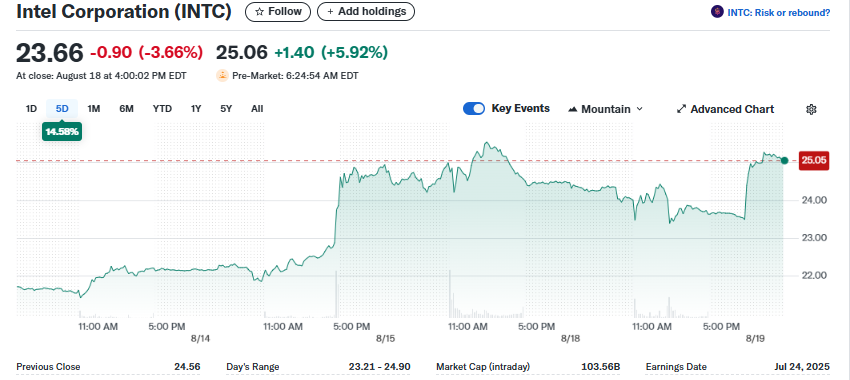 Intel Corporation (INTC)
Historical Returns from Federal Tech Investments
Government involvement in technology has long shown the potential for significant economic returns. The proposed stake in Intel follows a pattern of federal investments that catalyze innovation and economic growth.
Defense spending has historically fueled breakthroughs in computing and electronics, laying the foundation for Silicon Valley and driving decades of private-sector innovation.
Studies indicate that every dollar of military R&D spending can stimulate $2.40 to $5.90 in private-sector research, highlighting the broader economic influence of targeted federal investments.
Strategic Government Ownership Emerges Globally
The Intel discussions reflect a growing trend toward direct government equity stakes in strategically important industries. This approach goes beyond traditional grant funding, allowing governments to maintain long-term influence over critical companies while potentially benefiting from their financial upside.
Recent US examples include the Department of Defense’s $400 million preferred equity stake in rare-earth producer MP Materials Corp., which made the Pentagon the company’s largest shareholder with roughly 15% ownership. Additionally, the US administration has negotiated a 15% cut of certain semiconductor sales to China, signaling heightened federal involvement in strategic sectors.
Internationally, countries like China have actively pursued state-backed semiconductor investments, reinforcing the notion that governments increasingly treat technology as a national asset requiring oversight, not just subsidies. Intel’s potential equity conversion illustrates this shift, signaling that the US is embracing a more proactive role in securing its technological future.
Implications for Intel and Investors
If the government proceeds with the 10% stake, Intel could see increased scrutiny and guidance on strategic decisions, especially related to national security and critical technologies. Investors appear optimistic, as reflected by the stock’s rise over the past week. While the final terms of any deal remain uncertain, the market’s response underscores confidence in the long-term benefits of government-backed initiatives in foundational industries.
This development also highlights a broader lesson: well-structured government stakes in technology can accelerate innovation, create economic value, and strengthen national competitiveness, benefits that extend far beyond the immediate financial investment.next?
The post Intel Corporation (INTC) Stock; Rises as Trump Administration Considers 10% Stake appeared first on CoinCentral.


You May Also Like

Spark (SPK) Surges 76% as DeFi Lending Protocol Captures Market Share

Shiba Inu (SHIB) Sees 86 Billion Removed in 24 Hours: Will Centralized Exchanges Fall?




