

Best VMware Alternatives for VDI, Cloud, and HCI Workloads
A lot of teams in the IT industry we talk to share the same concern regarding VMware’s licensing shifts: how do we maintain performance and stability while avoiding surprises, lock‑in, and complex pricing?
The good news is that 2026 has a strong bench of VMware alternatives, and you don’t have to force one platform to fit every job. Check out the list of alternatives we’ve prepared, with your needs prioritized.
Best VMware Alternatives for HCI, Cloud, & VDI Workloads
When it comes to avoiding the licensing nightmare of VMware, enterprises and SMBs want simplicity and cost effectiveness first. But they also want better desktop performance, a predictable UX, and straightforward management.
Check out the five VMware alternatives that are disrupting the VMware HCI monopoly in 2026:
1) Sangfor Full-Stack HCI
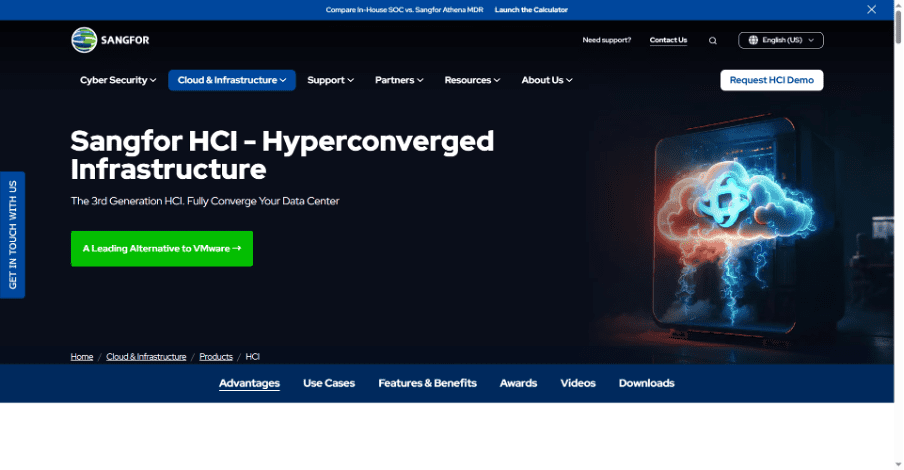 Sangfor Full-Stack HCI
https://www.sangfor.com/cloud-and-infrastructure/products/hci-hyper-converged-infrastructure
Sangfor HCI is an ideal choice for organizations prioritizing simplicity and cost effectiveness without the licensing drama of VMware.
It integrates compute, storage, and networking into a single platform with Sangfor aSV (its hypervisor), making it the ideal choice for enterprises that require high efficiency. Plus, small and medium-sized SMBs can also choose Sangfor for easy scalability.
To add to that, Sangfor makes it easy to migrate workloads through its cloud platform and supports disaster recovery. Simultaneously, Sangfor aSAN efficiently manages storage, keeping operations streamlined. As a strong hyperconverged infrastructure solution, Sangfor is an ideal VMware competitor for cloud and VDI deployments for users, regardless of their size or operational requirements.
2) Nutanix
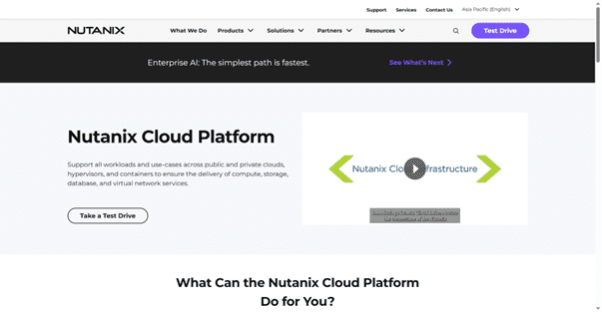 Nutanix
https://www.nutanix.com/en_sg/products
Nutanix is also a pioneer thanks to its web-scale, software-defined architecture. It does exactly what VMware used to do for many users: consolidates compute, storage, and networking, just like VMware’s software-defined data center stack.
Additionally, Nutanix HCI builds the foundation for smooth VDI workload handling. As a virtualization provider, Nutanix makes operations easy for its clients by significantly reducing complexity and lowering CapEx by a notable margin.
3) Microsoft Azure Stack HCI & AVD
 Microsoft Azure Stack HCI & AVD
https://azure.microsoft.com/en-us
Azure Stack HCI works efficiently in Microsoft-centric environments and offers tight integration for identity, policies, and endpoint management. Undoubtedly, it’s ideal for standardized Windows fleets.
If you’re seeking a robust hybrid desktop solution centered on Microsoft, use Azure Virtual Desktop on Azure Stack HCI. It delivers seamless on‑premises compute with Azure’s cloud management, monitoring, and security.
4) Scale Computing
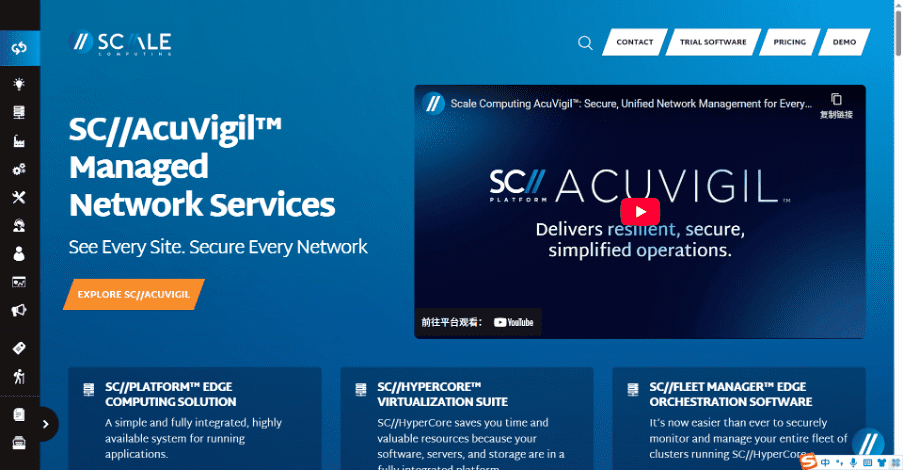 Scale Computing
https://www.scalecomputing.com/
While names like Sangfor and Nutanix serve a wider corpus of virtualization needs, the Scale Computing Platform significantly appeals to smaller branches. When it comes to fulfilling VMware alternatives for small branches, businesses, or SMBs, Scale Computing is a worth-mentioning name.
They are known for their “no-virtualization-tax,” which reduces resource overhead and maximizes performance. On top of that, organizations looking for VDI alternatives to VMware, small branches can also rely on the simplified approach of Scale Computing.
5) Proxmox VE
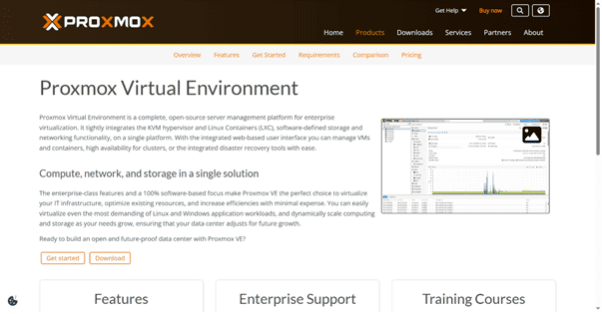 Proxmox VE
https://www.proxmox.com/en/
A sizable number of enterprises and SMBs prioritize cost-effective and open source options. That’s where VMware alternatives like Promox VE step in. At its core, Proxmox combines KVM for virtual machines and LXC for containers, giving you a flexible hyperconverged setup without the heavy licensing costs.
Users can also extend Promox VE into hybrid cloud environments with integrations. However, it’s more hands-on compared to other polished commercial platforms.
They can also handle VDI workloads with community support and integrations. So, for teams that like control and customization, Promox VE is a good VMware alternative.
Sangfor HCI: a Balanced VMware Alternative for HCI, Cloud, & VDI Workloads
Sangfor is the balanced right choice for VDI, Cloud, and HCI workloads. We found multiple reasons why this is true.
First, Sangfor unifies all three (compute, storage, and networking) into a single unified stack. It’s the perfect server virtualization software for organizations struggling with their virtualization TCO.
Also, when it comes to VDI, Sangfor aDesk requires just HCI and VDC, therefore, making deployment easy and resource-efficient.
Second, when it comes to cloud, Sangfor is hybrid-ready out of the box, supporting seamless integration with public clouds and offering its own Sangfor Cloud for flexibility.
Third, for HCI, Sangfor’s aSV hypervisor delivers VMware Enterprise Plus-level features with simplified licensing and lower total cost of ownership.
You Need a Path!
VMware transitions are front‑and‑center right now. We’ve seen teams freeze for months, worried about the migration cliff. However, you don’t need a cliff, but a path. That’s what leading providers like Sangfor, Nutanix, and Microsoft HCI offer.
They are making licensing transparent and migration easy with guided steps. Plus, names like Sangfor don’t make security an afterthought; they make it a pre-integrated solution. Whether you’re leading an IT team or an organization, it is high time to consider a suitable alternative that doesn’t make TCO a budget burden.


You May Also Like

Moscow Exchange prepares to start trading cryptocurrencies this year

Breaking Down Settlement Factors in Formula Injury Lawsuits

India Busts ₹226 Crore Crypto Network Linked to Drugs and Terror Financing



