

SushiSwap Enters Solana Ecosystem With 4M+ Users in Tow
- SushiSwap has launched on Solana to enable over four million users to swap tokens native to Solana while using the Sushi interface.
- Bridging and cross-chain swaps become operational upon launching, where Sushi routing is used and Solana speed and low fees are exploited to run them.
SushiSwap has landed on the Solana network, adding Solana token swaps and cross-chain trading to the Sushi interface as part of its multi-chain expansion plan. The project announced the rollout on February 9, saying Solana users can now access Sushi’s trading and liquidity products while using Solana’s low fees and fast transaction processing.
The deployment enables token swaps on Solana and supports cross-chain swap-and-bridge flows within Sushi’s existing routing stack. Sushi said the integration is live immediately, so users can trade Solana-native assets without leaving the Sushi interface, while also moving assets between chains through supported cross-chain routes.
Sushi CEO Alex McCurry said the expansion opens Solana trading to Sushi’s user base of more than 4 million. He described the move as part of Sushi’s aim to provide a multi-chain trading experience that supports both simple swaps and more advanced features as the platform broadens its product set.
SushiSwap to Use Jupiter Ultra API for Routing and Execution
To support trade execution on Solana, Sushi integrated Jupiter’s Ultra API, tapping into the DEX’s routing and execution tools to help optimize pricing and swap completion. Sushi said this approach allows it to offer a Solana-native swap experience while remaining connected to its broader aggregation and cross-chain trading infrastructure.
Solana’s official X account also confirmed that SushiSwap has launched on the network, noting that token swaps and cross-chain trading are live. Sushi posted that the Solana rollout is “long-awaited,” adding that swap and bridge functionality is available at launch. Jupiter confirmed it is powering Solana trading on Sushi, offering access to SOL-native assets and liquidity through the Ultra API.
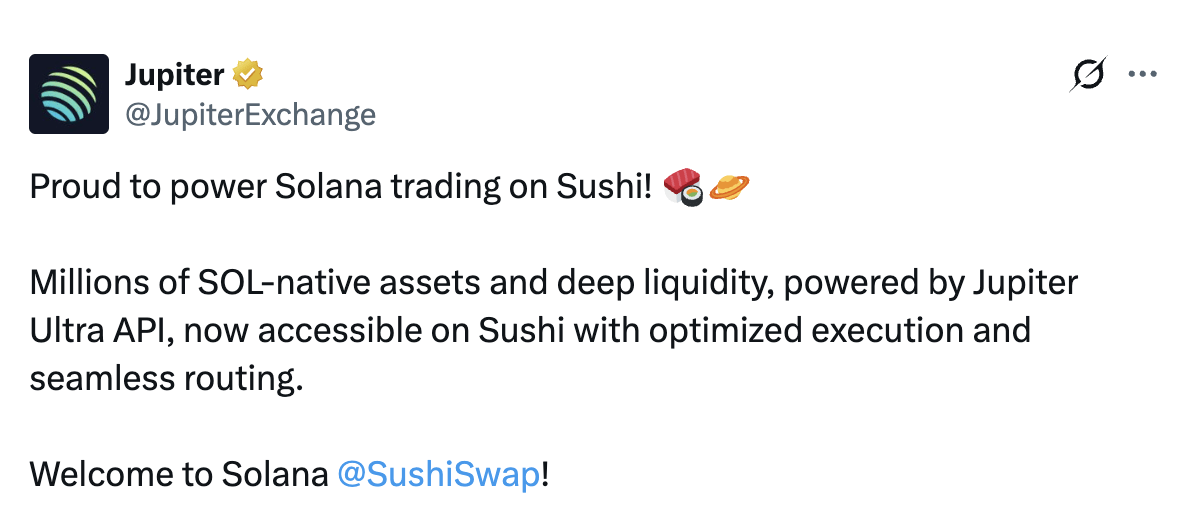 Image courtesy of Jupiter Exchange on X.
McCurry also commented on X that Sushi has historically been an EVM-focused DEX and that not reaching Solana sooner was “an oversight.” He added that Solana trading was set as a top priority early in his tenure, and he referenced perpetuals as a future focus, without providing a release date. In a separate post, he said Sushi intends to support trading for a wide range of onchain assets and markets, reflecting a focus on where user activity is concentrated.
The Solana integration is described as an initial phase, with Sushi stating that additional functionality and ecosystem initiatives will roll out over time as it expands its presence on the network. However, the company did not provide a detailed product timeline for upcoming Solana features, but said the launch was a starting point for further development.
As the platform continues its aggregator work across networks, Sushi previously added SwapXfi as a liquidity source on SonicLabs to broaden access to faster trade routes. With the Solana deployment now live, Sushi is extending its aggregation model into a high-activity trading environment while keeping swaps and cross-chain execution available through its existing interface.
Meanwhile, the Solana and SushiSwap tokens have attempted recovery amid the collaboration. At press time, Solana (SOL) was trading at $84.32 after a 1% overnight rise, while the SushiSwap (SUSHI) price was down slightly to trade at $0.1990.
]]>

You May Also Like

Y Combinator rolls out new deal package for crypto startups

China solar panel exports to Africa jump by 83% as demand for clean energy surges

Amazon (AMZN) Stock; Rises on $33B Southeast Asia AI and cloud push



