Banco BBVA Argentina S.A. (BBAR) Stock: Earnings Drop 62% YoY Despite Loan & Deposit Growth
TLDR:
-
BBVA Argentina’s earnings plunge 62% YoY despite stable margins.
-
After-hours drop follows weak Q2 results for BBVA Argentina.
-
Loan growth shines, but BBVA profits tumble under inflation stress.
-
BBAR hit by falling returns even as deposits and loans surge.
-
BBVA Argentina holds strong liquidity amid profit slide.
Banco BBVA Argentina S.A. (BBAR) closed marginally lower at $14.93 on August 20, slipping 0.07% during the trading session. However, the stock faced a steeper decline of 2.34% in after-hours trading, closing at $14.58.
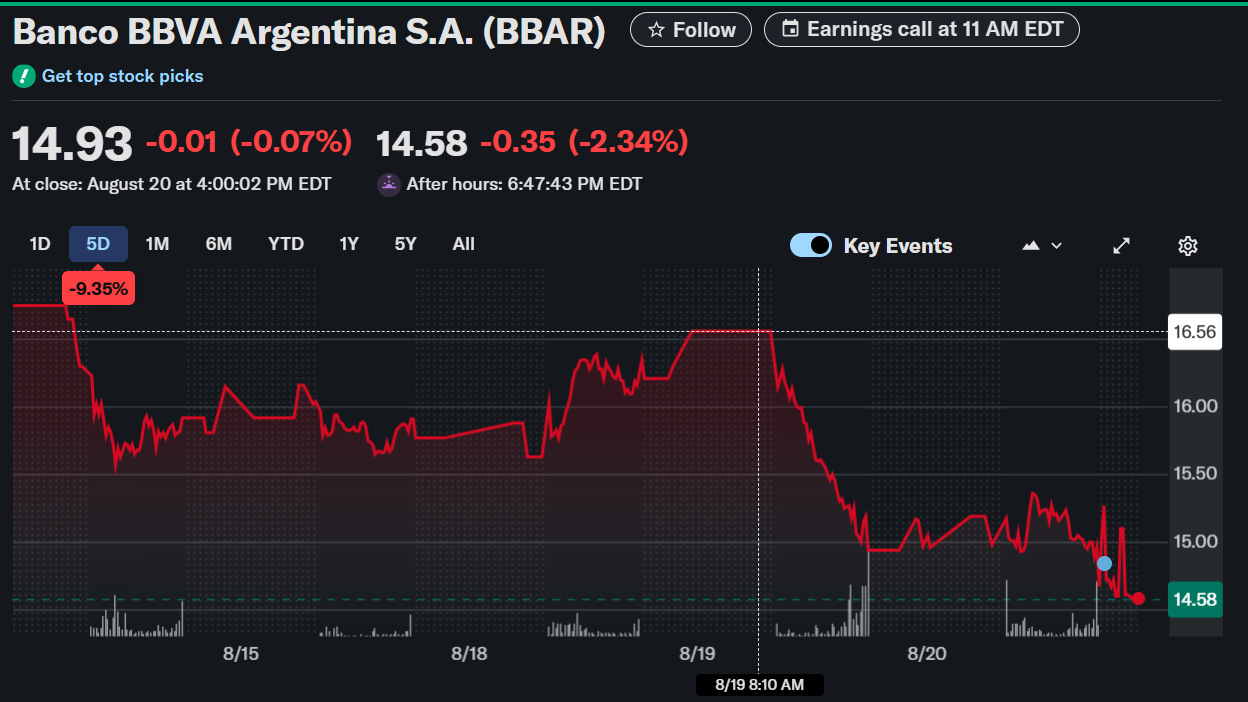
Banco BBVA Argentina S.A. (BBAR)
Earnings Slump Despite Inflation Adjustments
BBVA Argentina reported a sharp 62.1% drop in inflation-adjusted net income year-over-year for Q2 2025. The bank posted ARS 59.6 billion in net income, down from ARS 157.4 billion in Q2 2024. This also reflected a 31.1% drop compared to the ARS 86.5 billion earned in Q1 2025.
The six-month accumulated net income in 2025 totaled ARS 146.1 billion, declining 31.7% from ARS 213.8 billion a year ago. Average return on assets fell to 1.2% in Q2 2025, compared to 2.0% in Q1 2025. Similarly, return on equity slipped to 7.6%, down from 11.4% in the previous quarter.
Margins and Profitability Show Mixed Trends
Net interest margin (NIM) in Q2 2025 stood at 19.1%, remaining stable versus 19.2% in Q1 2025. The local currency NIM held steady at 21.7%, while NIM in U.S. dollars improved to 5.4% from 3.9%. This improvement in USD margins partially offset the decline in overall earnings.
The bank’s efficiency ratio was 56.5%, barely changed from 56.3% in the previous quarter. Despite weaker profits, the bank kept its cost-to-income ratio in check. BBVA maintained profitability through operational controls, though falling returns continued to pressure its performance.
Regulatory capital remained strong, with a total capital ratio of 18.4%, and Tier 1 capital also at 18.4%. This represented a 123.9% surplus over the minimum requirement. Additionally, total liquid assets accounted for 48.7% of total deposits, indicating solid liquidity.
Loan and Deposit Growth Strengthens Market Share
In Q2 2025, total financing to the private sector rose 15.7% quarter-over-quarter in real terms to ARS 11.3 trillion. This reflected a significant 109.6% increase year-over-year, with all credit lines showing growth. Export financing, overdrafts, and other loans saw notable expansions of 23.5%, 34.6%, and 25.2%, respectively.
The bank’s private sector loan market share reached 11.61%, up 35 basis points from the previous quarter. Year-over-year, this increased by 107 basis points, reflecting consistent credit activity. BBVA demonstrated effective loan growth even as earnings declined.
Total consolidated deposits reached ARS 13.0 trillion, up 12.0% in real terms from Q1 2025. Time deposits grew by 36.3%, while savings accounts rose 11.6%, particularly in foreign currency. BBVA’s deposit market share rose to 9.64%, adding 49 basis points QoQ and 214 basis points YoY.
Non-performing loans (NPL) held steady with a ratio of 2.28%, supported by a coverage ratio of 115.5%. The quality of the loan book remained sound, with risk indicators within controlled levels. BBVA continued to manage credit risk effectively while navigating a tougher earnings landscape.
The post Banco BBVA Argentina S.A. (BBAR) Stock: Earnings Drop 62% YoY Despite Loan & Deposit Growth appeared first on CoinCentral.


You May Also Like

Wall Street expert reveals top Tesla stock bull case

OpenAI Proposes Robot Taxation and Universal AI Dividend for American Workers