SWIFT has begun testing Ripple’s XRP Ledger and Hedera’s Hashgraph for cross-border payments
SWIFT, a global payments giant, has started experimenting with Ripple’s XRP Ledger and Hedera’s Hashgraph (HBAR), two blockchain networks, to make it easier to send money between countries. This project could change the way banks send money around the world.
The goal of the tests is to make blockchain technology work with banking systems that are already in place. The ISO 20022 guidelines will be used to make this happen.
SWIFT’s blockchain tests show a careful but important step toward connecting old-fashioned banking with cutting-edge digital infrastructure. The market will be closely monitoring the trials to see if there are any signs of a long-term plan.
The possible use of ISO 20022 standards in digital assets could set new standards for global connectivity. XRP and HBAR are two examples of how blockchain could change the way money is sent and received.
Swift could expose XRP and HBAR to $trillions
XRP and HBAR have the ability to facilitate fast, scalable, and energy-efficient cross-border payments. XRP is known for having almost instant settlement times and strong backing from the banking sector. It handles about 1,500 transactions per second with very little energy use.
On the other hand, HBAR uses a hashgraph consensus method to allow more than 10,000 transactions per second while using the same small amount of energy and having strong corporate governance. Both assets are being evaluated to see how well they can make it easier to transfer assets and use tokenization in a global financial setting.
Swift will not be the only beneficiary. XRP and HBAR will likely benefit from more efforts to standardize and validate them by institutions. Also, SWIFT processes over $150 trillion in cross-border payments every year. That’s basically the lifeblood of global finance. Even if just a tiny fraction of that flow shifts onto blockchains like XRP or HBAR, it could create massive transactional demand for these tokens.
Meanwhile, even after the news, the price of XRP is steady at a price of $2.88, which is a 0.67% decline. On the other hand, HBAR is trading at $0.2338, which is also a 1.14% decline.
Rising institutional and regulatory blockchain interest
The trials are a good sign for the crypto industry. They show that more institutions are starting to understand how blockchain can be used in financial processes. Also, according to analysts, the trials show how blockchain-based solutions could work with current banking systems to improve speed, governance, and standardization.
SWIFT’s approach focuses on making sure that different systems can work with each other and on integrating them gradually.
Although SWIFT hasn’t said for sure that it will use any one blockchain technology in the long run, it is testing a lot of different platforms. This shows that it understands how the industry is changing and how important it is to be flexible.
These tests are happening at the same time that regulators are becoming more interested in digital currencies. For instance, Hong Kong has a stablecoin lab, and China is looking into yuan-backed stablecoins.
In addition, as earlier reported by Cryptopolitan, the financial regulator in Shanghai, the State-owned Assets Supervision and Administration Commission (SASAC) convened a high-level meeting to explore strategic policy responses to stablecoins and digital currencies despite the crypto ban.
Key regulatory bodies are accelerating their engagement with blockchain in the United States. The Securities and Exchange Commission (SEC) announced “Project Crypto,” a landmark initiative aimed at modernising digital-asset regulation. This is to clarify crypto classifications and facilitate blockchain integration into traditional finance.
However, these regional projects are still in their early stages compared to SWIFT’s more advanced tests at the institutional level.
If you're reading this, you’re already ahead. Stay there with our newsletter.


You May Also Like
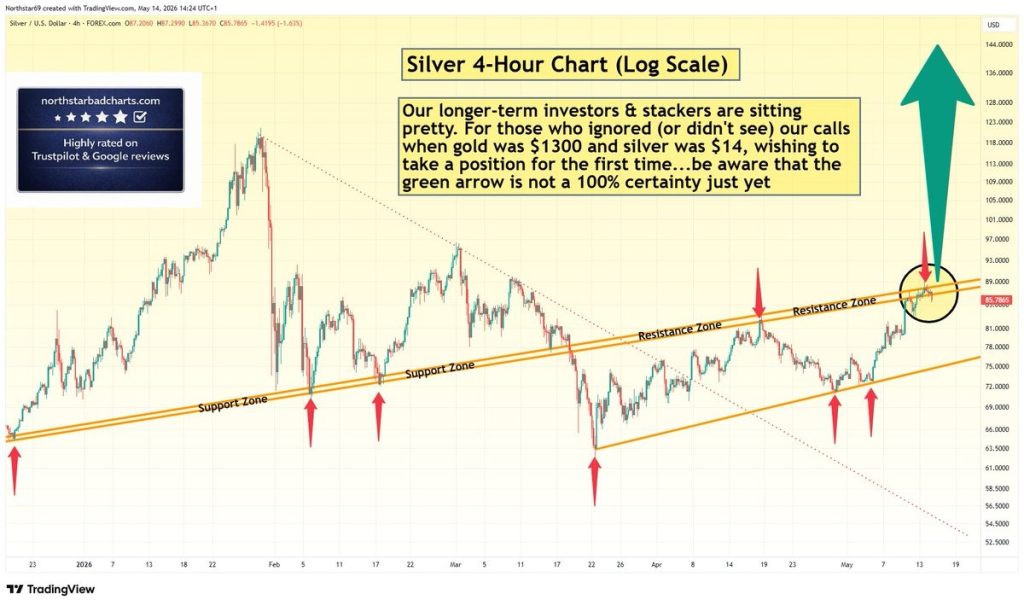
Silver Price Warning: Green Arrow Setup Is Not Confirmed – Wait for Clear Signal

Facebook spotlights African cinema in 6th ‘Made by Africa, loved by the world’ campaign