Asset-Based Lending Industry Statistics 2026: Trends, Growth, and Insights
The asset-based lending (ABL) industry has been quietly reshaping the financial landscape, providing businesses with a reliable and flexible financing option. In the face of fluctuating markets and growing operational costs, companies have increasingly turned to asset-based lending to unlock capital tied up in physical and financial assets.
This alternative lending model allows businesses to leverage their inventory, accounts receivable, and equipment to secure loans, facilitating growth even during periods of economic uncertainty. The ABL sector is poised for significant growth, driven by evolving market trends and technological innovations.
Editor’s Choice
- ABL-backed M&A deals account for 30.2% of leveraged buyout value, key in corporate restructuring.
- 8 major ABL institutions acquired niche players, boosting syndication and tech integrations.
- Cross-border ABL transactions grew by 14.2%, supporting global working capital amid supply chain shifts.
- Healthcare and manufacturing account for 38% of the total ABL market share, driven by equipment financing and M&A.
- Borrower migration to ABL rose by 12.1% year-over-year in a high-interest environment for flexible funding.
Recent Developments
- Many large lenders are piloting or deploying automated underwriting technologies to accelerate credit decisions and reduce manual review time.
- Sustainability-linked ABL loans grew by 20.1%, aligning with ESG goals for rate reductions on carbon and social benchmarks.
- 25.3% of lenders offer multicurrency cross-border ABL services, managing FX risk globally.
- 35% of new ABL entrants are fintech lenders with digital onboarding and AI risk evaluation for SMEs.
- Digital ABL platforms account for 27% of new originations, enabling real-time asset monitoring.
Asset-Based Lending Market Growth Overview
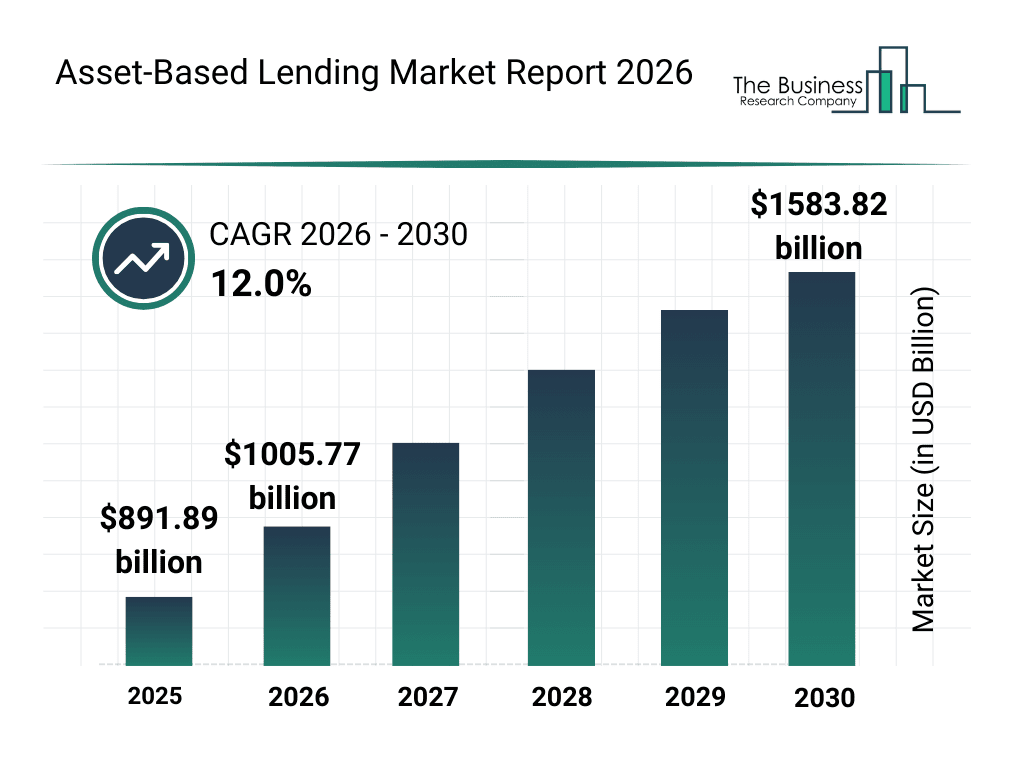
- The global Asset-Based Lending market was valued at $891.89 billion in 2025, reflecting strong demand for collateral-backed financing solutions.
- In 2026, the market expanded to $1,005.77 billion, officially crossing the $1 trillion milestone.
- The industry is projected to reach $1,583.82 billion by 2030, signaling substantial long-term expansion.
- The market is expected to grow at a robust 12.0% CAGR between 2026 and 2030, highlighting sustained momentum.
- From 2025 to 2030, the market is forecast to add nearly $691.93 billion in total value, underscoring accelerating institutional and corporate adoption.
- The steady upward trajectory from 2025 through 2030 indicates consistent annual expansion, driven by increased reliance on inventory, receivables, and asset-backed financing structures.
 (Reference: The Business Research Company)
Asset-Based Lending Market Trends
- Automation tools are increasingly incorporated into collateral valuation processes, though adoption levels vary widely depending on lender size and technological infrastructure
- Sustainability-linked ABL loans represent 21% of transactions as an ESG priority for borrowers and investors.
- Non-bank institutions account for 37% of ABL transactions with faster execution and flexible terms.
- Retail sector ABL financing increased by 25% due to inventory volatility and liquidity needs.
- ABL-backed M&A activity rose by 17.2% for middle-market expansion and asset purchases.
- Supply chain ABL financing grew 12.3% in manufacturing and wholesale for working capital.
- Blockchain is used by 15% of lenders for collateral tracking in syndicated deals.
Key Sectors Utilizing Asset-Based Lending
- The manufacturing sector leads with 30.2% of the total U.S. ABL market for inventory and supply chain financing.
- Healthcare utilizes 24.5% of ABL volume, supporting expansions and operational costs.
- Retail and wholesale accounts for 21.8% of ABL loans amid e-commerce and demand shifts.
- Technology firms represent 18.1% of ABL users, funding R&D and scaling.
- Construction sector ABL financing rose 15.2%, driven by infrastructure projects.
- Automotive, including EV, accounts for 9.4% of ABL loans for manufacturing investments.
- Agriculture and food processing make up 8.2%, managing crop cycles and logistics.
Challenges and Risks Involved in Asset-Based Lending
- ABL loan rates rose by an average 1.1% due to higher interest rates, raising costs for leveraged businesses.
- Collateral valuation volatility is high in retail and tech due to demand shifts and obsolescence.
- 7.2% of ABL lenders reported fraudulent collateral claims, boosting verification tech.
- Cross-border ABL complexity is up due to geopolitical risks, regulations, and currency fluctuations.
- 23.4% of businesses underutilize collateral due to poor asset visibility and systems.
- 11.9% ABL-backed borrowers defaulted in retail and logistics due to cash flow issues.
- 15.2% of lenders faced cyber incidents on digital platforms, increasing security investments.
Asset-Based Lending Market Share by End-User
- Small and medium-sized enterprises (SMEs) hold 61.2% market share.
- Large enterprises account for 38.8% of the market.
Technological and Digital Innovations in ABL
- AI is used by 72% of ABL lenders for risk assessment and faster loan approvals.
- Blockchain adoption in ABL grew by 18%, improving asset tracking transparency.
- Automation tools reduced operational costs by 28% for loan management.
- 45% of lenders use predictive analytics to forecast borrower defaults.
- Smart contracts manage 23% of ABL agreements for automatic enforcement.
- Digital onboarding cut processing times by 35%, speeding capital access.
- Real-time asset monitoring is adopted by 62% of lenders, mitigating depreciation risks.
Top Impacting Factors
- Inflation drove 24.1% of businesses to ABL from costlier traditional loans.
- E-commerce accounts for 12.7% of retail ABL transactions for inventory optimization.
- Supply chain disruptions increased ABL use 11.4% in manufacturing.
- Interest rates boosted ABL volume 8.5% over earnings-based lending.
- Private equity is involved in 29.3% of ABL deals for LBOs and acquisitions.
- European regulations caused 6.8% lenders compliance challenges in ABL.
- Green ABL loans are offered by 17% of lenders for ESG rate reductions.
Geographical Market Insights
- North America accounts for 47.1% of global ABL activity, led by manufacturing and healthcare.
- Europe ABL market grew 7.4%, with the UK and Germany at over 62% regional volume.
- Asia-Pacific expanded 11.5% fastest, driven by China, India, automotive sectors.
- Latin America grew 6.1%, led by Brazil, for receivables lending.
- Africa ABL up 4.9% with South Africa leading in mining and agriculture.
- Cross-border Europe-North America ABL transactions rose 14.2% for diversified capital.
- Middle East growth hit 9.1%, led by the UAE in oil, gas, and construction.
Frequently Asked Questions (FAQs)
The average U.S. asset-based loan facility ranges between $25 million and $100 million, with larger syndicated facilities exceeding $500 million.
Accounts receivable represent approximately 70%–80% of collateral in traditional ABL facilities.
Approximately 65%–70% of asset-based lending volume is provided by commercial banks, while 30%–35% comes from non-bank lenders and private credit funds.
Asset-based loans typically achieve recovery rates above 70%–80%, compared to 40%–60% for unsecured or cash-flow-based loans during default scenarios.
Approximately 35% of U.S. middle-market companies utilize asset-based lending or secured credit facilities as part of their capital structure.
Conclusion
The asset-based lending industry continues to thrive, evolving through digital innovations and responding to global economic shifts. From sustainability-linked loans to cross-border transactions, ABL has proven to be a versatile and resilient financing option for businesses of all sizes. The adoption of advanced technologies like AI, blockchain, and real-time asset monitoring is set to drive the industry further, making ABL more efficient, secure, and accessible. With the potential for substantial growth in both developed and emerging markets, ABL is poised to become an even more integral part of the global financial system in the years ahead.
The post Asset-Based Lending Industry Statistics 2026: Trends, Growth, and Insights appeared first on CoinLaw.
You May Also Like

JPMorgan Chase Warns Fed Rate Cuts Could Be ‘Ultimately Negative’ for Stocks, Bonds and US Dollar: Report

Pi Network Maps 50M Coins Daily as Mainnet Tops 9B